


Omeprazole vs Lansoprazole vs Esomeprazole: Which PPI Is Best?
The three most prescribed PPIs, compared head-to-head — effectiveness, side effects, interactions and the honest answer to “which should I take?”
Part of the Complete Acid Reflux Guide.
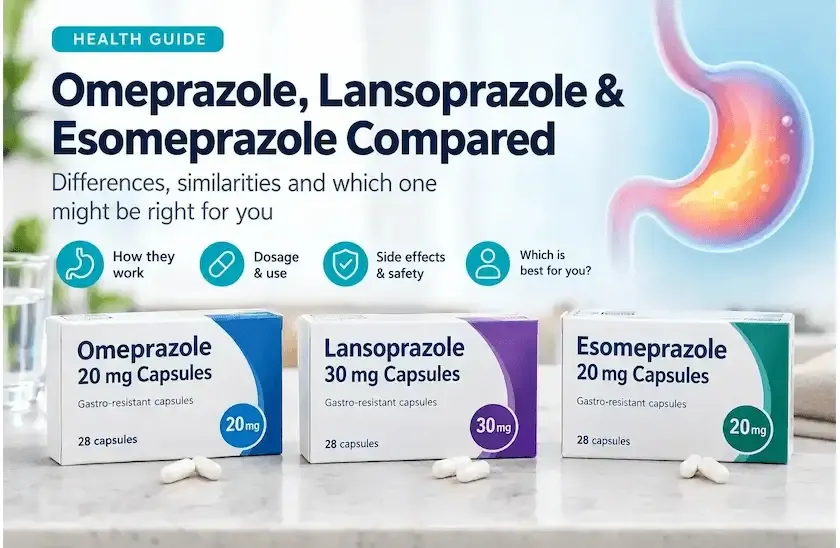
The short answer: for most people all three work comparably, so omeprazole is tried first (cheap, well-evidenced, best in pregnancy). Lansoprazole wins where clopidogrel or swallowing matters; esomeprazole where severe oesophagitis or a poor first response calls for a bit more.
Find the Right PPI Online
Access Doctor’s GPhC-registered pharmacist independent prescribers can assess your symptoms and recommend the most appropriate PPI — quickly and confidentially.
Start Your Consultation →How PPIs work — and why they’re so similar
All proton pump inhibitors block the same enzyme — the H+/K+ ATPase “proton pump” in the stomach lining — shutting down acid production until new pumps form. That shared mechanism is why the differences between them are modest and mostly practical: chemistry, metabolism, interactions and formulation, rather than dramatic gaps in how well they relieve reflux. Understand the mechanism once in What is a proton pump inhibitor? and the comparison below makes sense.
Head-to-head comparison table
| Feature | Omeprazole | Lansoprazole | Esomeprazole |
|---|---|---|---|
| Brand | Losec | Zoton FasTab | Nexium |
| Standard GORD dose | 20–40mg once daily | 15–30mg once daily | 20–40mg once daily |
| OTC | Yes (20mg, up to 14 days) | Yes (15mg, up to 14 days) | Yes (20mg, up to 14 days) |
| Formulations | Capsules, dispersible tablets | Capsules, orodispersible (FasTab) | Tablets, sachets |
| Clopidogrel | Avoid — reduces its effect | Preferred | Avoid — reduces its effect |
| Pregnancy evidence | Most — generally preferred | Limited | Limited |
| Typical use case | First-line for most | Alternative; clopidogrel; swallowing difficulty | Severe oesophagitis; poor first response |
Omeprazole in brief
The UK’s most prescribed PPI and usual first choice — in clinical use since the late 1980s, extensively studied, inexpensive, and the PPI with the most pregnancy evidence. Standard GORD dose is 20mg once daily (40mg for severe symptoms); OTC omeprazole is 20mg for short-term use. For full doses, side effects, alcohol and interactions, see the complete omeprazole guide, and order it at omeprazole (branded as Losec).
Lansoprazole in brief
A well-established alternative, comparable to omeprazole in effect and the usual choice where the omeprazole–clopidogrel interaction matters or where swallowing is difficult — it is the PPI most commonly available as an orodispersible tablet (Zoton FasTab). Standard GORD dose 30mg once daily; prescription-only in the UK. Full detail in the lansoprazole guide; order at lansoprazole.
Esomeprazole in brief
The refined S-isomer of omeprazole, giving slightly more consistent acid suppression — with a modest, real advantage in healing severe erosive oesophagitis. Generally reserved for severe disease or a poor response to standard omeprazole. Standard GORD dose 20mg, 40mg for oesophagitis. Full detail in the esomeprazole guide; order at esomeprazole.
Which PPI should you take?
Here is the decision logic in plain terms:
- Most people → omeprazole. Longest track record, most evidence, lowest cost, best pregnancy data. The sensible default.
- On clopidogrel, or struggle to swallow → lansoprazole. Avoids the clopidogrel interaction; comes as a melt-in-the-mouth tablet.
- Severe oesophagitis, or omeprazole didn’t control it → esomeprazole. The slight extra potency earns its place here.
- Interactions are the main concern → pantoprazole or rabeprazole (below).
NICE’s position: all PPIs produce a class effect at equivalent doses, so NICE recommends choosing on clinical circumstances, interactions and cost rather than assumed efficacy — and using the cheapest appropriate option first. Switching is fine if the first doesn’t suit you.
What about pantoprazole and rabeprazole?
The two PPIs this guide doesn’t focus on are worth a section, because they answer a specific question — “omeprazole vs pantoprazole” and similar — that many people search. Pantoprazole (Pantoloc) and rabeprazole (Pariet) work just as well for reflux as the big three, and their distinguishing feature is fewer drug interactions: both have less effect on the CYP2C19 liver enzyme, so they are the go-to when interaction risk is the priority — for example alongside clopidogrel, or where rabeprazole’s different metabolism helps in people for whom omeprazole works inconsistently. They are prescription-only in the UK. In short: comparable relief, chosen for the interaction profile rather than extra strength.
Drug interactions — the real difference
Interactions are the most clinically important difference between these medicines. Omeprazole and esomeprazole are the strongest inhibitors of CYP2C19; lansoprazole less so; pantoprazole and rabeprazole least.
Clopidogrel: omeprazole and esomeprazole reduce clopidogrel’s antiplatelet effect by competing for CYP2C19 — MHRA advises avoiding these two in people on clopidogrel, favouring lansoprazole, pantoprazole or rabeprazole.
Also relevant across the class: methotrexate (levels can rise), warfarin (may need extra INR monitoring), certain HIV medicines (absorption impaired), antifungals such as itraconazole, and levothyroxine (separate the doses). Tell your prescriber everything you take before starting a PPI.
Seek urgent help for difficulty swallowing, unexplained weight loss, vomiting blood or black stools, or severe worsening upper-abdominal pain — and if you are over 55 with new dyspepsia, see a doctor promptly. Chest pain with breathlessness or pain spreading to arm or jaw: call 999.
Get the Right PPI Prescribed Online
Complete a short online consultation and our pharmacist independent prescribers will match the PPI to your symptoms, medicines and history — with next-day UK delivery.
Start Your Consultation →Frequently Asked Questions
Which is better: omeprazole or lansoprazole?
Both are effective PPIs and, at standard doses, work comparably for most people — head-to-head trials show no consistent winner. Omeprazole has the longer track record and most pregnancy evidence; lansoprazole is preferred where the omeprazole-clopidogrel interaction matters or where an orodispersible tablet helps. Most people do equally well on either, so the choice comes down to individual factors.
Is esomeprazole stronger than omeprazole?
Slightly, milligram for milligram — esomeprazole is the refined S-isomer of omeprazole and gives somewhat more consistent acid suppression, with modestly better healing in severe erosive oesophagitis. For routine heartburn and GORD, the real-world difference is small and most people do equally well on omeprazole, which is why it is usually tried first.
What about pantoprazole and rabeprazole?
They are the other two UK-licensed PPIs, and their main advantage is fewer drug interactions — both have less effect on the CYP2C19 enzyme than omeprazole or esomeprazole, so they are useful where interaction risk matters (for example with clopidogrel). Their effectiveness for reflux is comparable; they tend to be chosen for interaction reasons rather than greater potency.
Can I switch from omeprazole to lansoprazole?
Yes — switching between PPIs is straightforward and needs no gap in treatment, because they all work the same way. Omeprazole 20mg roughly matches lansoprazole 30mg. Do it through a prescriber, who will confirm the equivalent dose and check any interactions.
What is the standard dose of omeprazole for acid reflux?
The standard prescription dose for GORD in adults is omeprazole 20mg once daily, taken before breakfast, increased to 40mg for severe or persistent symptoms. Over-the-counter omeprazole 20mg is available for short-term heartburn, for a maximum of 14 days without medical advice.
Which PPI has the fewest drug interactions?
Pantoprazole and rabeprazole have the fewest, as they have less effect on the CYP2C19 liver enzyme. Among the three main drugs, lansoprazole interacts less than omeprazole or esomeprazole — notably it is preferred over omeprazole for people taking clopidogrel, whose antiplatelet effect omeprazole and esomeprazole can reduce.
Treatment from Access Doctor
Access Doctor’s pharmacist independent prescribers can assess your symptoms and prescribe the most appropriate PPI following a short online consultation, with discreet UK delivery.
Acid Reflux · Rx
Omeprazole
The first-line choice — well-evidenced, low cost, best in pregnancy.
View product →Acid Reflux · Rx
Lansoprazole
Preferred with clopidogrel; orodispersible FasTab available.
View product →Acid Reflux · Rx
Esomeprazole
The refined option for severe oesophagitis or poor first response.
View product →Acid Reflux · Rx
Losec (branded omeprazole)
The original omeprazole brand, for those who prefer it.
View product →References
- National Institute for Health and Care Excellence. Gastro-oesophageal reflux disease and dyspepsia in adults (CG184). Updated 2023. nice.org.uk
- National Institute for Health and Care Excellence. Dyspepsia — proven GORD: prescribing a proton pump inhibitor. NICE CKS. 2024. cks.nice.org.uk
- Graham DY, Tansel A. Interchangeable use of proton pump inhibitors based on relative potency. Clinical Gastroenterology and Hepatology. 2018. pubmed.ncbi.nlm.nih.gov
- Richter JE et al. Efficacy and safety of esomeprazole compared with omeprazole in GERD patients with erosive esophagitis. American Journal of Gastroenterology. 2001. pubmed.ncbi.nlm.nih.gov
- Medicines and Healthcare products Regulatory Agency. Omeprazole and esomeprazole: interaction with clopidogrel. Drug Safety Update. 2010. gov.uk
Medical disclaimer: This article is for informational purposes only and does not constitute medical advice. Always consult a qualified healthcare professional for diagnosis and treatment. In a medical emergency, call 999.