
Have used Access doctor a couple of times now, the process was very smooth and the products arrived very quickly. Would not hesitate to recommend x
ALISON P · 1 year ago

Our friendly team is available to help Monday to Friday 9:00am – 5:00pm.
If you need urgent assistance, do not use this service. Call 111, or in an emergency call 999.

Fast, discreet delivery
Free delivery over £40
100% UK-based pharmacy
All doctors & pharmacists UK-based
Free advice & support
Clinical support free · Mon–Fri 9am–5pm
Why Patients Choose Access Doctor
10+
Years serving UK patients
—
Verified patient reviews
1,000+
Licensed treatments
24/7
Consultation available
Access Doctor · Both
Order before 3pm — same-day dispatch (MON - FRI)
~5 min consultation
Secure & confidential · Reviewed by a UK prescriber
Elocon Ointment is one of a group of medicines called topical corticosteroids. It is classified as a “potent corticosteroid”. These medicines are put on the surface of the skin to reduce the redness and itchiness caused by certain skin problems. In adults and children, Elocon Ointment is used to reduce redness and itchiness caused by certain skin problems called psoriasis or dermatitis. Psoriasis is a skin disease in which itchy, scaly, pink patches develop on the elbows, knees, scalp and other parts of the body. Dermatitis is a condition brought on by the skin reacting to outside agents e.g. detergents, causing the skin to become red and itchy.
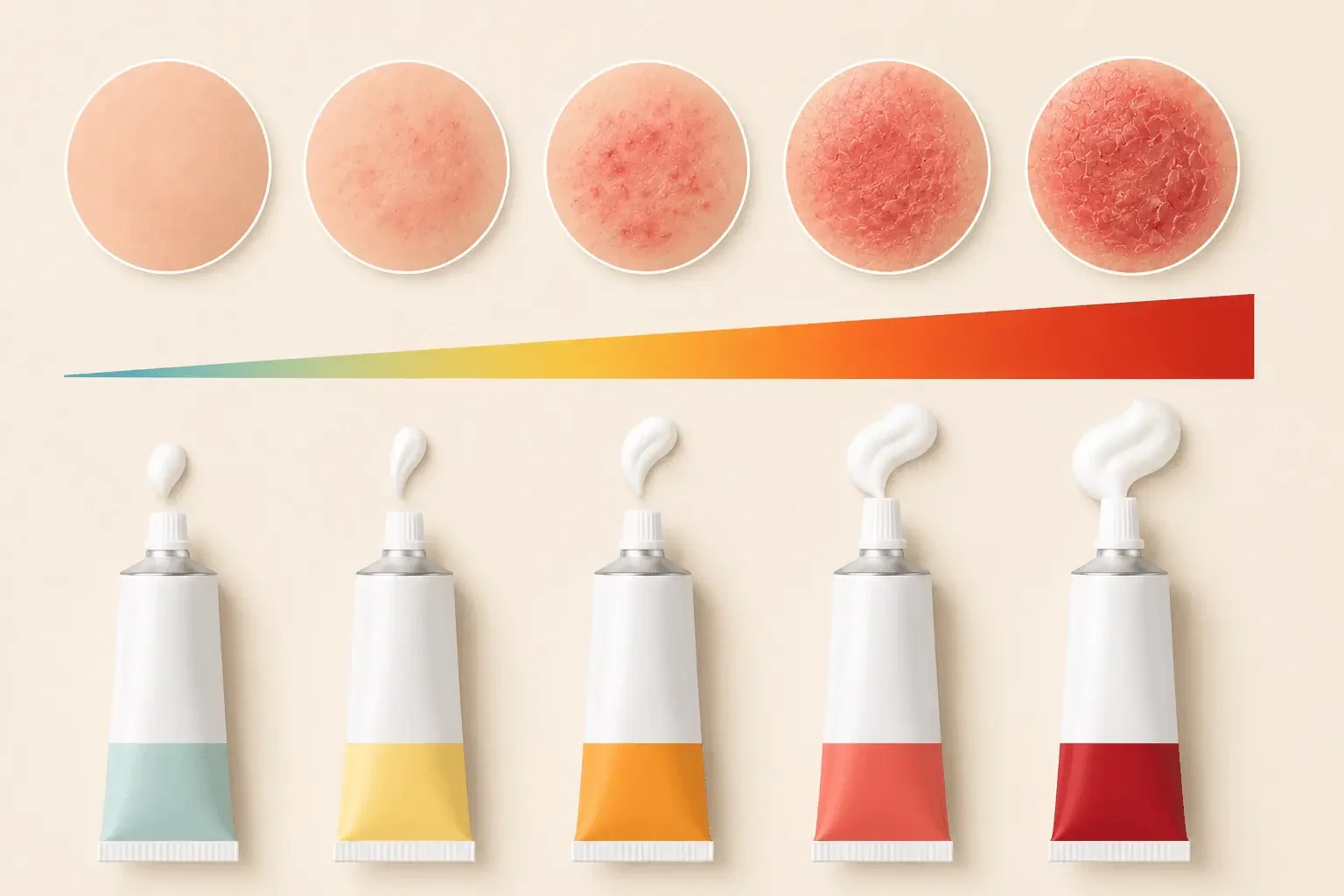
Elocon ointment is a prescription-only topical corticosteroid containing mometasone furoate 0.1% in a petrolatum-based ointment formulation. Like Elocon cream, it sits in the potent class of the UK topical steroid ladder and is used for moderate to severe inflammatory skin conditions including chronic eczema and atopic dermatitis, psoriasis on limited body areas, discoid eczema, lichen planus, and severe contact dermatitis. The ointment formulation is specifically suited to conditions where the skin has become dry, thickened, scaly, or lichenified (tough and leathery from repeated scratching or chronic inflammation), which is why it's often the preferred form for long-standing established patches rather than for acute or weeping flares.
The active ingredient is identical; the difference is entirely in the base. The cream has a water-based emulsion that absorbs quickly and leaves minimal residue. The ointment has a greasy petrolatum-based vehicle that creates an occlusive film on the skin surface, reducing water loss, softening the outer skin layers, and increasing how much mometasone furoate penetrates into the deeper layers. For moist, weeping, or acutely inflamed skin, the cream is usually better because the ointment would feel uncomfortable and impede natural evaporation. For dry, thick, scaly, or lichenified patches, the ointment typically gives better penetration and more effective treatment. For the face, neck, or skin fold areas, the cream is generally preferred because the ointment base feels too heavy. Many patients use both: cream for face or acute flares, ointment for body patches or overnight.
This seems counterintuitive when both list 0.1% mometasone furoate on the label. The explanation lies in how the skin absorbs the medicine. The outermost layer of skin acts as a barrier, and the ointment's occlusive base helps the medicine cross it more efficiently through two mechanisms. It hydrates the stratum corneum (outer skin layer), which temporarily increases its permeability, and it creates a film that prevents the medicine from evaporating or being wiped away before it has absorbed. Together these effects deliver more mometasone furoate into the skin from the same amount of product. This holds for all paired cream and ointment topical steroids: the ointment is always somewhat more potent in practice, even at the same labelled concentration.
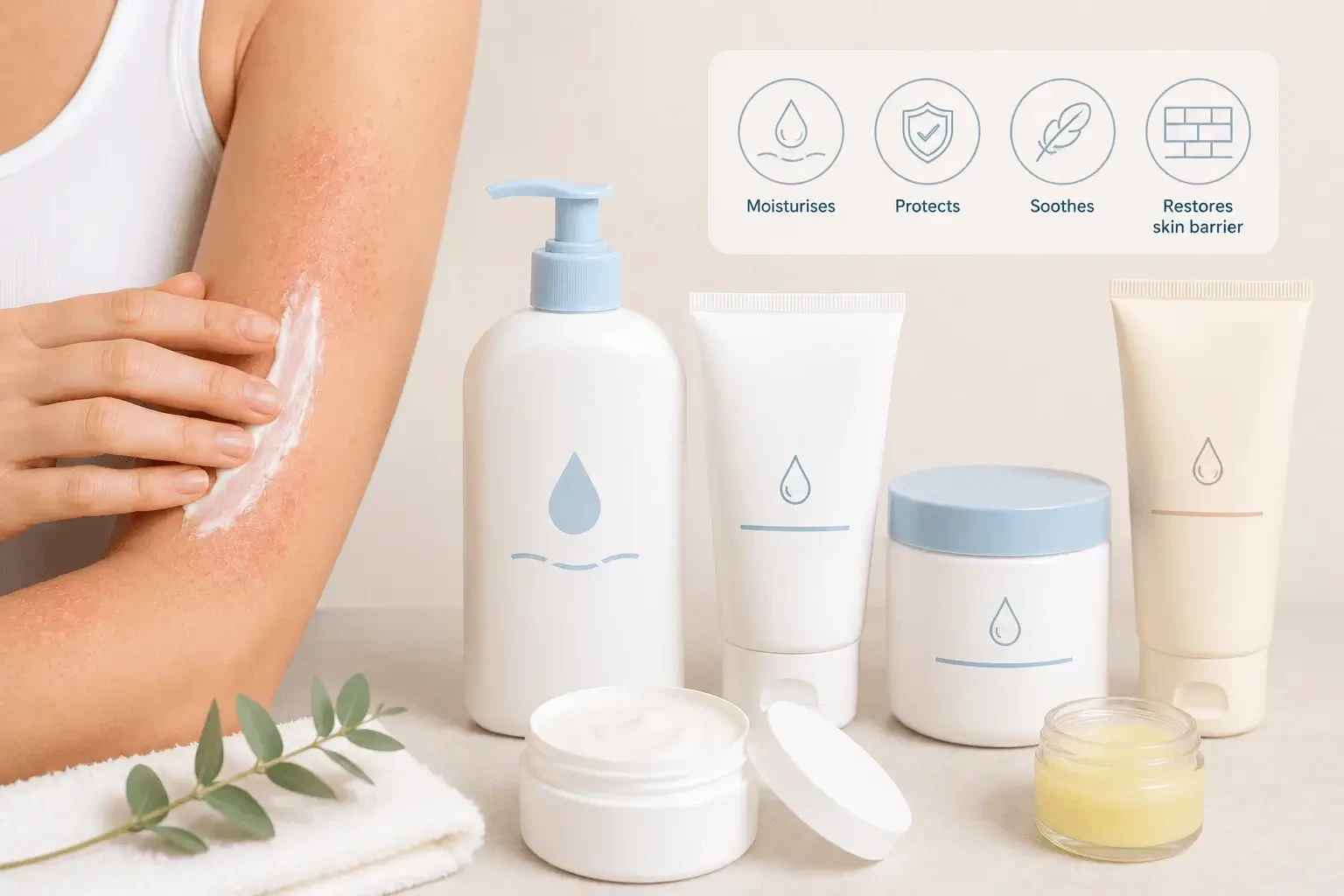
Apply a thin layer to the affected area once daily. Thin is important: the ointment is greasy and there's a natural tendency to apply generously to feel adequately covered, but excess amounts waste medicine and increase unnecessary absorption without improving efficacy. The fingertip unit (FTU) is the standard guide: one FTU (the amount on an adult's index finger from tip to first crease) equals about half a gram and covers an area equivalent to two adult palm prints. Rub the ointment in gently. Wash your hands after applying unless your hands are the area being treated. Allow at least 30 minutes before applying an emollient over the same area. Clothing worn over freshly applied ointment can smear it off before it has fully absorbed, so allowing it a few minutes to settle before dressing is sensible.
Lichenification is the term for skin that has become thickened, tough, and leathery from chronic scratching or rubbing. The normal grid-like surface pattern of the skin becomes much more prominent, the skin feels hard and resistant to touch, and it often takes on a brownish pigmentation. In eczema, it commonly develops on the backs of the knees, inner elbows, nape of the neck, and wrists. Lichenified skin is challenging to treat because the thickened barrier makes it harder for topical medicines to penetrate. The ointment formulation helps specifically here: the occlusive base hydrates and softens the thickened outer layer, improving penetration and allowing mometasone furoate to reach the inflamed cells beneath. Most dermatologists choose the ointment specifically for lichenified patches rather than the cream.
Applying any topical steroid under an occlusive dressing (cling film, plastic wrap, wet wrap bandage, or tightly bound ordinary dressings) significantly increases absorption, sometimes dramatically. For a potent steroid like Elocon ointment, that increased absorption means greater systemic exposure and higher risk of side effects including HPA axis suppression with repeated use. Wet wrapping and occlusive bandaging techniques are sometimes used by specialist dermatology nurses in treatment-resistant eczema, but they require specific clinical supervision and aren't something to improvise at home. Using Elocon ointment under normal breathable clothing or under a non-occlusive wound dressing is different and generally fine.
The standard course for adults is up to 3 to 4 weeks, applied once daily, with a review at that point. If the condition has responded, step down to a moderately potent steroid (Eumovate) or to emollients alone rather than continuing the potent steroid. Stopping after a long course may be done gradually, reducing to every other day then less frequently, to avoid a rebound flare. For chronic lichenified eczema, proactive maintenance (applying the ointment two or three times weekly to lichenified patches even when they've cleared) is sometimes used under specialist guidance, with the aim of preventing re-lichenification before it re-establishes.
This is not recommended for the ointment specifically, which differs from the cream in this respect not because the steroid is more dangerous on the face in ointment form but because the greasy, petrolatum-based vehicle is impractical and uncomfortable on facial skin. For facial eczema that needs a potent steroid, Elocon cream is the preferred formulation when clinically indicated. The general cautions about potent steroids on the face (skin thinning, perioral dermatitis, risks near the eyes) apply to all Elocon formulations equally.
The side effect profile mirrors Elocon cream but with the higher absorption characteristic of ointments taken into account. Local effects include skin thinning (atrophy), telangiectasia, bruising more easily, stretch marks (particularly on flexures), pigmentation changes, increased hair growth in treated areas, perioral dermatitis if used around the mouth, and worsening of any underlying fungal or bacterial infection. Folliculitis (small infected hair follicle spots) is a specific ointment-related risk, particularly in areas where hair follicles are occluded by the greasy base with prolonged use. Systemic effects (HPA axis suppression, Cushingoid features with extensive prolonged use) are more likely with the ointment than the cream applied to the same area, because of higher absorption.
Elocon ointment carries the same paediatric licence as the cream, covering children from age 2, and can be used under medical supervision. Children's thinner skin and higher surface-area-to-body-weight ratio mean courses are kept short and areas treated are limited. In pregnancy, short-term use on small areas is generally acceptable when the clinical need is clear and milder options haven't worked; preference remains for the mildest effective steroid, and the ointment's higher absorption means it's an even stronger reason to avoid extensive use. In breastfeeding, the ointment is compatible for short-term use on limited areas; avoid applying to the breast or nipple.
Spreading redness, golden crusts, weeping, increasing pain or fever alongside a treated patch suggest bacterial superinfection, which needs antibiotics rather than continuing the steroid alone. A patch that worsens under the ointment rather than improving should prompt reassessment: occasional patches turn out to be fungal infections (particularly tinea) that steroids actively worsen. A rash failing to respond after a full 3 to 4 week course at correct dosing warrants review. Any systemic symptoms (fever, joint pain, fatigue, weight loss) alongside a skin condition need medical assessment. For extensive or persistently treatment-resistant lichenified eczema, dermatology referral opens up additional options: phototherapy, ciclosporin, dupilumab and other biologics, and specialist bandaging techniques.
Have used Access doctor a couple of times now, the process was very smooth and the products arrived very quickly. Would not hesitate to recommend x
This ointment helps with my skin condition on my feet it relieves the itching and treats the infected area.
Helpful articles and clinical guides related to this treatment category.
Free consultation
Online review by a UK prescriber
Next-day delivery
Order before 3pm where offered
Discreet packaging
Plain outer packaging