


Trimethoprim Side Effects UK: Common, Serious and Long-term Risks Explained
▶ Featured Answer — Trimethoprim side effects UK
Common trimethoprim side effects include nausea, vomiting, diarrhoea, skin rash, and headache — usually mild and resolving after the course. Serious but rare effects include severe allergic reactions, blood disorders (unusual bruising/bleeding), and liver or kidney problems — seek immediate medical attention if these occur. Stop trimethoprim and call 999 in a medical emergency.
Concerned About Trimethoprim Side Effects?
Our GPhC-registered pharmacist independent prescribers can advise on the most appropriate UTI antibiotic for your individual circumstances.
Start Online Consultation →Overview
Trimethoprim is a commonly prescribed antibiotic in the UK, most often used for UTIs and cystitis. It is generally considered safe for short-term use, but like all medications, it can cause side effects in some people.
This guide provides comprehensive information about trimethoprim side effects — what is common, what is rare but serious, and what you should do if you experience any concerning symptoms. For information on dosage and course lengths, see: Trimethoprim for UTI: dosage and course length. For what trimethoprim is and how it works, see: What is trimethoprim? Uses and how it works.
If you have been prescribed trimethoprim and are experiencing side effects, or if you're considering treatment and want to understand the risks, you can buy trimethoprim through Access Doctor following a confidential consultation with a UK-registered prescriber.
Common Side Effects of Trimethoprim
Common side effects are generally mild and resolve once treatment ends:
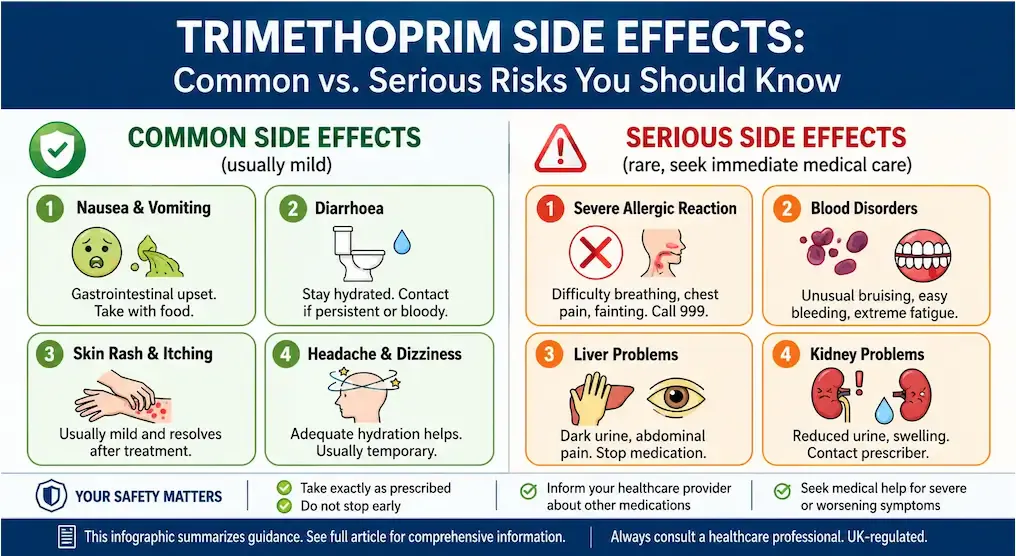
Nausea & Vomiting
Gastrointestinal upset is the most commonly reported side effect. Taking trimethoprim with food helps reduce nausea significantly.
Diarrhoea
Usually mild and temporary. Stay well hydrated. If it persists or becomes bloody, contact your prescriber.
Skin Rash & Itching
A mild rash can occur in some people. Usually resolves after completing the course. If severe or spreading, seek medical advice.
Headache & Dizziness
Mild headache or dizziness may occur. Ensure adequate hydration during treatment. Usually temporary.
How Long Do Trimethoprim Side Effects Last?
Most mild trimethoprim side effects — nausea, headache, mild rash and stomach upset — settle within 2–3 days as your body adjusts to the medicine, and clear completely within a few days of finishing the course. A mild rash can occasionally take a little longer to fade after the final dose.
Side effects that persist beyond the end of the course, or that worsen rather than settle while you are taking it, are not typical — contact your prescriber. If itching or rash is worsening or spreading at any point, seek medical advice the same day, as this can occasionally be the start of a more significant reaction.
In short: mild side effects usually last 2–3 days; anything still present a few days after finishing your tablets warrants a call to your prescriber.
Serious Side Effects
The following are rare but serious — seek immediate medical attention if any occur:
| Side Effect | Symptoms to Watch For | Action |
|---|---|---|
| Severe allergic reaction | Difficulty breathing, swelling of face/lips/tongue/throat, chest pain, fainting, shock | Call 999 immediately |
| Blood disorders | Unusual bruising, easy bleeding, extreme fatigue, increased infections, mouth ulcers | Seek urgent medical assessment |
| Liver problems | Yellowing of skin or eyes (jaundice), dark urine, abdominal pain | Stop medication, seek urgent care |
| Kidney problems | Reduced urine output, swelling, fatigue — particularly in pre-existing kidney disease | Contact your prescriber promptly |
Trimethoprim 200mg Side Effects — Are They Dose-Related?
200mg twice daily is the standard adult dose for urinary tract infections, and at this dose over a short 3–7 day course, side effects are usually mild and short-lived — the profile described above. You are not taking a “high” dose: 200mg is the normal treatment strength. If you have been prescribed trimethoprim 200mg, you are on the standard licensed dose for UTI treatment.
The risk of more significant side effects — effects on blood cells, folate depletion and raised potassium — rises mainly with long-term or repeated use, such as low-dose prophylaxis for recurrent UTIs, rather than with the standard short course. Patients on long-term trimethoprim may be offered periodic blood monitoring for this reason. If you have been prescribed trimethoprim long-term and haven’t had a review recently, raise it with your prescriber.
How to Take Trimethoprim Safely to Minimise Side Effects
- Take doses at the same time each day — ideally morning and evening
- Take with food if nausea is a concern
- Swallow tablets whole with a full glass of water — do not chew
- Complete the full prescribed course — stopping early increases resistance risk
- Avoid missing doses — if you miss one, take it as soon as remembered (unless near next dose time)
What to Do If You Experience Side Effects from Trimethoprim
For mild side effects (nausea, rash, diarrhoea) that are not severe, contact your prescriber — they can advise whether to continue at the current dose, reduce the dose, or switch to an alternative antibiotic. Do not stop taking trimethoprim without prescriber advice unless you experience a serious reaction, as this risks the infection returning.
For serious reactions (difficulty breathing, unusual bruising, jaundice, high fever with sore throat), stop trimethoprim immediately and seek emergency medical care. If you are having an anaphylactic reaction, call 999.
Report any trimethoprim side effects via the MHRA Yellow Card scheme at mhra.gov.uk/yellowcard. This helps the MHRA monitor medication safety across the UK.
Trimethoprim Side Effects in the Elderly
Older adults are more likely to experience significant side effects from trimethoprim, for three main reasons: kidney function naturally declines with age (and trimethoprim is cleared by the kidneys), raised potassium (hyperkalaemia) is more likely — especially alongside common medicines such as ACE inhibitors, ARBs or spironolactone — and effects on blood cell production are more likely on longer courses.
For this reason, prescribers often check recent kidney function before prescribing trimethoprim to older patients, use the shortest effective course, and may recommend blood monitoring for anyone on long-term prophylaxis.
Symptoms to report promptly in older patients: new muscle weakness, unusual tiredness, confusion, or an irregular or fluttering heartbeat during a course of trimethoprim. These can be signs of raised potassium and warrant a same-day call to the prescriber or GP.
Precautions and Drug Interactions
- Warfarin — trimethoprim enhances anticoagulant effect; INR monitoring required
- Methotrexate — combined folate inhibition can increase methotrexate toxicity significantly
- ACE inhibitors, ARBs and spironolactone — combined use raises the risk of high potassium (hyperkalaemia), particularly in older patients and those with reduced kidney function
- Cyclosporine — potential for reduced cyclosporine efficacy
- Pyrimethamine — combined use further depletes folate; avoid unless directed
- Before starting trimethoprim, inform your prescriber if you are pregnant or breastfeeding, have kidney or liver problems, have a folate deficiency, are at risk of high potassium levels (elderly, or on potassium-raising medications), or have porphyria
Long-Term Side Effects of Trimethoprim
Trimethoprim is typically prescribed for short 7-day courses for UTIs. If prescribed for longer periods (recurrent UTI prophylaxis or acne), additional monitoring may be needed for:
- Bone marrow suppression — reduced blood cell production
- Folate deficiency — trimethoprim’s mechanism can deplete folate over time; folic acid supplementation may be recommended
- Peripheral neuropathy — numbness, tingling, or pain in hands and feet (rare)
Trimethoprim Allergy and Resistance
If you have a known allergy to trimethoprim, do not take this medication. An alternative antibiotic will be prescribed. Antibiotic resistance is a growing public health concern — trimethoprim resistance has been increasing in the UK, which is why NICE now recommends nitrofurantoin as first-line ahead of trimethoprim.
Alternative Treatments for UTIs
If trimethoprim is not suitable due to allergy, resistance, or side effects:
- Nitrofurantoin — NICE first-line for uncomplicated UTIs; lower current resistance rates
- Cephalexin — a cephalosporin antibiotic; useful where both nitrofurantoin and trimethoprim are unsuitable
- Fosfomycin — single-dose option for uncomplicated UTIs; used in specific resistance situations
For more information on cystitis medicines, see: Cystitis Medicines UK: Nitrofurantoin and Trimethoprim Explained. For the complete trimethoprim guide, see: What is trimethoprim? Uses and how it works.
💊 NICE First-Line Antibiotic
Nitrofurantoin (Macrobid)
MHRA-approved first-line antibiotic for cystitis & UTIs. Prescription via GPhC-regulated online consultation.
Order Nitrofurantoin →💊 Prescription Antibiotic
Trimethoprim
MHRA-approved alternative antibiotic for cystitis. Suitable where nitrofurantoin is not appropriate.
Order Trimethoprim →Get Expert UTI Prescribing Advice
Concerned about trimethoprim side effects or need an alternative? Our GPhC-registered pharmacist independent prescribers will assess your circumstances and recommend the most appropriate treatment.
Treat Cystitis Online →For a comprehensive overview of cystitis and UTI — causes, symptoms, diagnosis and all treatment options — see our complete cystitis and UTI guide.
Frequently Asked Questions
Can trimethoprim cause nausea?
Yes — nausea is the most common side effect of trimethoprim. Taking each dose with or just after food reduces it significantly, and it usually settles within a couple of days as your body adjusts. If nausea is severe, or you are vomiting and cannot keep doses down, contact your prescriber — an alternative antibiotic may be more suitable.
Can trimethoprim cause a severe allergic reaction?
Yes — severe allergic reactions (anaphylaxis) to trimethoprim are rare but possible. Symptoms of a severe reaction include difficulty breathing, swelling of the face, lips, tongue or throat, a rapid heartbeat, dizziness, and collapse. If you experience any of these, stop trimethoprim immediately and call 999. Mild skin rash or itching is more common and usually resolves when the course finishes.
Does trimethoprim interact with warfarin?
Yes — trimethoprim enhances the anticoagulant effect of warfarin, increasing bleeding risk. If you take warfarin, your INR should be monitored more closely during and after a course of trimethoprim. Inform your prescriber and your anticoagulation team before starting trimethoprim. Access Doctor’s consultation will screen for warfarin use.
Can trimethoprim cause a yeast infection?
Antibiotics can disturb the natural vaginal flora, which may allow Candida yeast to overgrow, resulting in a vaginal thrush infection. This can occur with trimethoprim, though it is not one of the most commonly reported side effects. If you develop symptoms of thrush (vaginal itching, soreness, or white discharge) during or after a trimethoprim course, over-the-counter antifungal treatments such as clotrimazole pessary or fluconazole capsule are appropriate.
What are the common side effects of trimethoprim?
Common side effects include nausea and vomiting (take with food), diarrhoea, skin rash or itching, and headache. These are usually mild and resolve after completing the course. Serious side effects are rare but include severe allergic reactions, blood disorders, liver problems, and kidney effects.
Can trimethoprim cause antibiotic resistance?
Yes — overuse or incomplete courses contribute to resistance. Trimethoprim resistance has been increasing in UK UTI pathogens, which is why NICE now recommends nitrofurantoin as first-line. Always take trimethoprim only when prescribed, complete the full course, and never share medication or use leftover antibiotics. Report side effects via the MHRA Yellow Card scheme.
What are the alternatives to trimethoprim for UTIs?
The main alternative is nitrofurantoin (NICE first-line for uncomplicated UTIs, lower current resistance rates). If both are unsuitable, cephalexin or fosfomycin may be prescribed. Your Access Doctor prescriber will recommend the most appropriate option based on your medical history, kidney function, and allergies.
References
- NICE. Urinary tract infection (lower) — women. Clinical Knowledge Summaries. cks.nice.org.uk
- NHS. Cystitis. nhs.uk/conditions/cystitis
- UKHSA. ESPAUR report 2023. gov.uk
- Electronic Medicines Compendium. Nitrofurantoin 100mg m/r capsules — SmPC. medicines.org.uk/emc
- Electronic Medicines Compendium. Trimethoprim 200mg tablets — SmPC. medicines.org.uk/emc
Medical disclaimer: This article is for informational purposes only and does not constitute medical advice. Always consult a qualified healthcare professional for diagnosis and treatment. Nitrofurantoin and trimethoprim are prescription-only medicines — a medical consultation is required before they can be dispensed. If you have a fever, loin/back pain, or are pregnant, seek urgent in-person medical care. In a medical emergency, call 999.