


Skinoren for Acne UK: The Patient Journey from Week 1 to 16+
A UK-focused, clinically reviewed guide to using Skinoren (azelaic acid) for acne — purging, the week-by-week timeline, AM/PM routine, ingredients to avoid, and how it compares to other prescription topicals available in the UK.
This guide is written for patients in the United Kingdom. It reflects UK prescribing practice, NICE guidance, and medicines licensed by the MHRA. Skinoren is a prescription-only medicine in the UK and must be dispensed by a UK-registered pharmacy following a clinical consultation. If you are outside the UK, the information here may not match your country’s licensing, availability, or clinical guidance.
Part of the Access Doctor complete guide to acne in the UK.
Skinoren cream doesn’t get talked about as much as tretinoin or Duac gel, but it has some real practical advantages for acne patients in the UK. It doesn’t bleach your pillowcase or towels like benzoyl peroxide can. It doesn’t carry the pregnancy warning that retinoids do. And it works on the dark marks that linger after spots clear — something most other prescription topicals completely ignore. This guide covers the actual day-to-day experience of using Skinoren for acne in the UK: what happens in the first weeks, how to build your routine around it, and why so many people give up just before it starts working.
Not based in the UK? Skinoren (azelaic acid) is licensed under different names, at different concentrations, and with different prescribing rules outside the UK. If you are in the US, Canada, Australia, India, or elsewhere, speak to a prescriber in your own country rather than relying on UK-specific dosing or pharmacy information here.
When to get urgent help in the UK — call 999 or go to A&E if you develop:
- Facial swelling of the lips, tongue, or throat, or difficulty breathing after applying a new topical
- A rapidly spreading rash with fever, blistering, or peeling skin — possible serious drug reaction
- Severe eye pain, redness, or vision change alongside a new facial rash
For non-emergency advice in the UK, call NHS 111 or contact your GP. See your GP if acne is causing significant scarring, affecting your mental health, or not improving after 8 to 12 weeks of prescription treatment.
Get a Skinoren Prescription Online (UK)
GPhC-registered pharmacist independent prescribers. Skinoren cream and gel for acne. Fast online consultation. Discreet next-day UK delivery. UK-licensed medicines only. GPhC pharmacy #9011198.
Start Your Consultation →UK patients only. Prescription-only medicine — a clinical consultation is required before dispensing.
How Skinoren Works for Acne Specifically
Azelaic acid addresses acne through three pathways that work simultaneously — targeting bacteria, blocked pores, and the dark marks that acne leaves behind:
- Kills C. acnes bacteria without generating antibiotic resistance — unlike clindamycin or erythromycin, long-term use does not select for resistant bacterial strains
- Normalises keratinocyte shedding inside the follicle — preventing the blockages that lead to comedones (blackheads and whiteheads), the foundation of all acne lesions
- Inhibits tyrosinase — the enzyme responsible for post-inflammatory hyperpigmentation (PIH). Skinoren treats the dark marks left by acne while simultaneously treating active breakouts, making it unique among prescription topicals available in the UK
For a detailed look at azelaic acid as an active ingredient — including comparison to retinoids, benzoyl peroxide, and antibiotics — see: Azelaic acid UK: how it works and what the evidence shows.
The Purging Phase: What to Expect (and What Is Not Purging)
True purging occurs when a treatment dramatically accelerates cell turnover (most commonly with retinoids like tretinoin or adapalene). Microcomedones that were forming below the skin’s surface are brought to the surface faster than usual, causing a temporary increase in visible breakouts. This typically peaks at 3–6 weeks and then resolves as the backlog clears.
Skinoren purging is uncommon and mild. Because azelaic acid does not cause the same degree of cell turnover acceleration as retinoids, a pronounced purging phase is not expected. Mild initial tingling, dryness, or slight redness is normal and is the skin adjusting to a new active — not a purge.
When to be concerned: If breakouts increase significantly after 4 weeks of Skinoren use and continue worsening rather than improving, contact your prescriber. This is more likely to indicate a skin reaction or inappropriate formulation than a purge.
Week-by-Week Acne Treatment Timeline
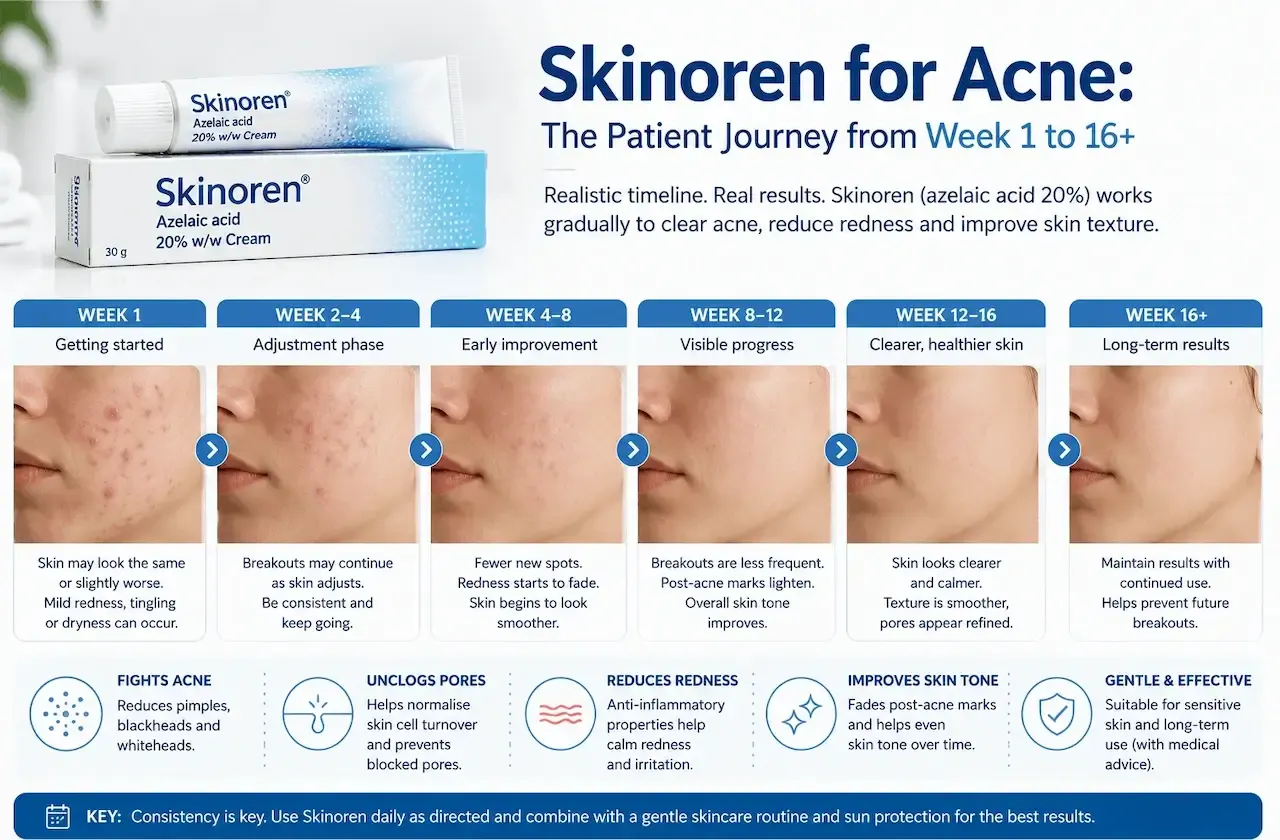
| Timeframe | What typically happens | What to do |
|---|---|---|
| Weeks 1–2 | Mild tingling or warmth on application; possible mild dryness. No visible change in breakouts yet — this is expected. | Start once daily PM. Apply unfragranced moisturiser after. Do not increase frequency yet. |
| Weeks 3–4 | Skin starting to adjust. Tingling usually decreasing. Some early reduction in new inflammatory lesions possible. | If tolerating well, increase to twice daily (AM + PM). Continue SPF every morning. |
| Weeks 5–8 | Noticeable reduction in papules and pustules. Fewer new breakouts forming. Skin texture beginning to improve. | Maintain twice-daily use. Introduce additional actives (e.g. niacinamide, retinoid) if desired — alternate nights for retinoids. |
| Weeks 9–12 | Significant improvement in active lesions. PIH beginning to lighten. Skin tone becoming more even. | Continue twice daily. Review with prescriber if improvement has plateaued — may need combination with oral treatment for moderate acne. |
| Months 4–6 | Ongoing PIH fading. Skin tone more even. Active breakouts well controlled. | Continue maintenance use. Skinoren is safe for long-term ongoing use — it does not lose efficacy or generate resistance. |
| 6+ months | PIH significantly faded. Skin at maximum benefit. Maintenance use sustains results. | Continue as maintenance therapy. Do not stop if clear — PIH and acne often return within weeks of stopping. |
AM/PM Skincare Routine for Acne With Skinoren
Morning routine
1
Gentle cleanser
Non-foaming, fragrance-free cleanser. Avoid sodium lauryl sulfate or physical scrubs — they damage the skin barrier and worsen inflammation.
2
Skinoren (pea-sized amount)
Apply to the entire affected area. Wait 5–10 minutes to absorb.
3
Lightweight non-comedogenic moisturiser
Essential — especially in the first weeks. Niacinamide-containing moisturisers complement Skinoren’s depigmenting effect.
4
SPF 30+ (non-negotiable)
UV exposure directly worsens PIH — undoing Skinoren’s depigmenting work. Use a non-comedogenic gel or fluid formula. In the UK, sun protection matters even on overcast days.
Evening routine
1
Cleanse (double cleanse if wearing SPF)
Start with micellar water or a balm cleanser to remove SPF, then follow with your gentle cleanser.
2
Skinoren (pea-sized amount)
Apply on dry skin. If using a retinoid on alternate nights, apply the retinoid instead — do not apply both on the same evening until tolerating both well.
3
Barrier-repair moisturiser
More emollient than your morning moisturiser. Ceramide-containing formulas are ideal during the first 4 weeks.
Ingredients to avoid alongside Skinoren
- Physical scrubs — damage the skin barrier and spread bacteria
- High-alcohol toners — dehydrate skin and cause reactive excess oil production
- Fragrance — leading cause of contact dermatitis; worsens inflammatory acne
- Heavy occlusive oils (coconut oil, cocoa butter) — highly comedogenic
Skinoren vs Other Prescription Acne Topicals
| Treatment | Antibiotic resistance risk | Bleaches fabric | Safe in pregnancy | Treats PIH |
|---|---|---|---|---|
| Skinoren (azelaic acid) | ✓ No risk | ✓ No | ✓ Yes (supervised) | ✓ Yes |
| Topical clindamycin | ✗ Yes | ✓ No | ⚠ Caution | ✗ No |
| Benzoyl peroxide | ✓ No risk | ✗ Yes | ⚠ Caution | ✗ No |
| Topical retinoids | ✓ No risk | ✓ No | ✗ Contraindicated | ⚠ Partial |
| Duac gel (BPO + clindamycin) | ✗ Yes | ✗ Yes | ✗ Not recommended | ✗ No |
For a full comparison of all prescription acne treatments available online in the UK, see: Prescription acne treatment online UK: all options compared.
Prescription topical · UK
Skinoren Cream / Gel
Azelaic acid 20% cream or 15% gel. Available following GPhC-registered online consultation. UK-licensed medicine.
View Skinoren →All acne treatments · UK
Acne Treatment Clinic
Full range of NICE-aligned prescription acne treatments — Duac, Treclin, lymecycline, co-cyprindiol and more.
Browse Treatments →Getting Skinoren in the UK
Skinoren is a prescription-only medicine (POM) in the UK. That means you cannot legally buy it over the counter, and any website offering it without a clinical consultation is operating outside UK law. Legitimate routes are your GP, a dermatology referral for moderate to severe acne, or a regulated UK online pharmacy prescribing after clinical assessment.
NHS prescriptions are free if you are under 16, over 60, pregnant, or hold a valid medical exemption certificate. Otherwise the standard NHS prescription charge applies per item. Private prescriptions through services like Access Doctor are not covered by NHS exemptions and are priced separately.
Ready to Start Skinoren? (UK Patients)
Access Doctor provides Skinoren cream and gel via regulated online consultation for UK patients. GPhC pharmacy #9011198. Same-day prescription, discreet next-day UK delivery.
Order Skinoren Online →Prescription-only medicine. A clinical consultation is required. UK delivery only.
Frequently Asked Questions
Does Skinoren cause skin purging?
Purging is uncommon with Skinoren compared to retinoids. Unlike tretinoin or adapalene, azelaic acid does not dramatically accelerate cell turnover. Mild initial dryness or tingling is normal and not a true purge. A sudden significant increase in breakouts after 4 weeks that is getting worse rather than better should be assessed by your prescriber.
How long does Skinoren take to work for acne?
Most people notice fewer new breakouts within 4–6 weeks. Significant improvement in skin texture and reduction in inflammatory lesions is typically seen by week 8–10. Maximum results for PIH (dark marks) require 3–6 months. Do not stop treatment early if results feel slow.
Can I use Skinoren with adapalene or tretinoin for acne?
Yes, but introduce them on alternate nights initially. After 4–6 weeks, many people tolerate both in the same routine. Always use SPF 30+ every morning when using either product.
Can I use Skinoren twice a day from the start?
No — start with once daily in the evening for the first 2–4 weeks. Increase to twice daily (morning and evening) when well tolerated. Most people can increase by week 3–4.
Should I apply Skinoren to whole face or just spots?
Apply Skinoren to the entire affected area — not as a spot treatment. Azelaic acid prevents new comedones forming and is most effective when applied across the full face (or affected area).
What should I do if Skinoren makes my skin very dry?
Reduce to once-daily application temporarily. Apply an unfragranced, non-comedogenic moisturiser after Skinoren has absorbed. Once dryness improves (usually within 1–2 weeks), gradually increase back to twice daily. If severe dryness persists, speak to your prescriber.
Is Skinoren available on the NHS in the UK?
Yes. Skinoren (azelaic acid 20% cream and 15% gel) can be prescribed by a GP or dermatologist on the NHS. NHS prescription charges apply unless you are exempt (under 16, over 60, pregnant, or holding a medical exemption certificate). Private prescriptions through regulated online services are also available.
References
- NICE. Acne vulgaris: management (NG198). 2021, updated 2025. nice.org.uk/guidance/ng198
- Graupe K et al. Efficacy and safety of topical azelaic acid (20% cream). Int J Dermatol. 1996;35(7):533–534.
- Siddiqui K et al. Azelaic acid for acne vulgaris: a review. Br J Dermatol. 2023. doi:10.1111/bjd.21743
- NHS. Acne. nhs.uk/conditions/acne
- MHRA. Yellow Card Scheme — reporting suspected side effects. yellowcard.mhra.gov.uk
Medical disclaimer: This article is for informational purposes only and does not constitute medical advice. Always consult a qualified healthcare professional for diagnosis and treatment. Skinoren is a prescription-only medicine in the UK — a clinical consultation is required before it can be dispensed. Completing a consultation does not guarantee treatment will be prescribed. In a medical emergency, call 999.
Yellow Card: If you suspect you have had a side effect from any medicine mentioned in this article, you can report it to the MHRA Yellow Card scheme at yellowcard.mhra.gov.uk. Reporting is voluntary and helps make UK medicines safer.