

We’re here to help.
Our friendly team is available to help Monday to Friday 9:00am – 5:00pm.
If you need urgent assistance, do not use this service. Call 111, or in an emergency call 999.
Our friendly team is available to help Monday to Friday 9:00am – 5:00pm.
If you need urgent assistance, do not use this service. Call 111, or in an emergency call 999.
Fast, discreet delivery
Free delivery over £40
100% UK-based pharmacy
All doctors & pharmacists UK-based
Free advice & support
Clinical support free · Mon–Fri 9am–5pm
Why Patients Choose Access Doctor
10+
Years serving UK patients
—
Verified patient reviews
1,000+
Licensed treatments
24/7
Consultation available
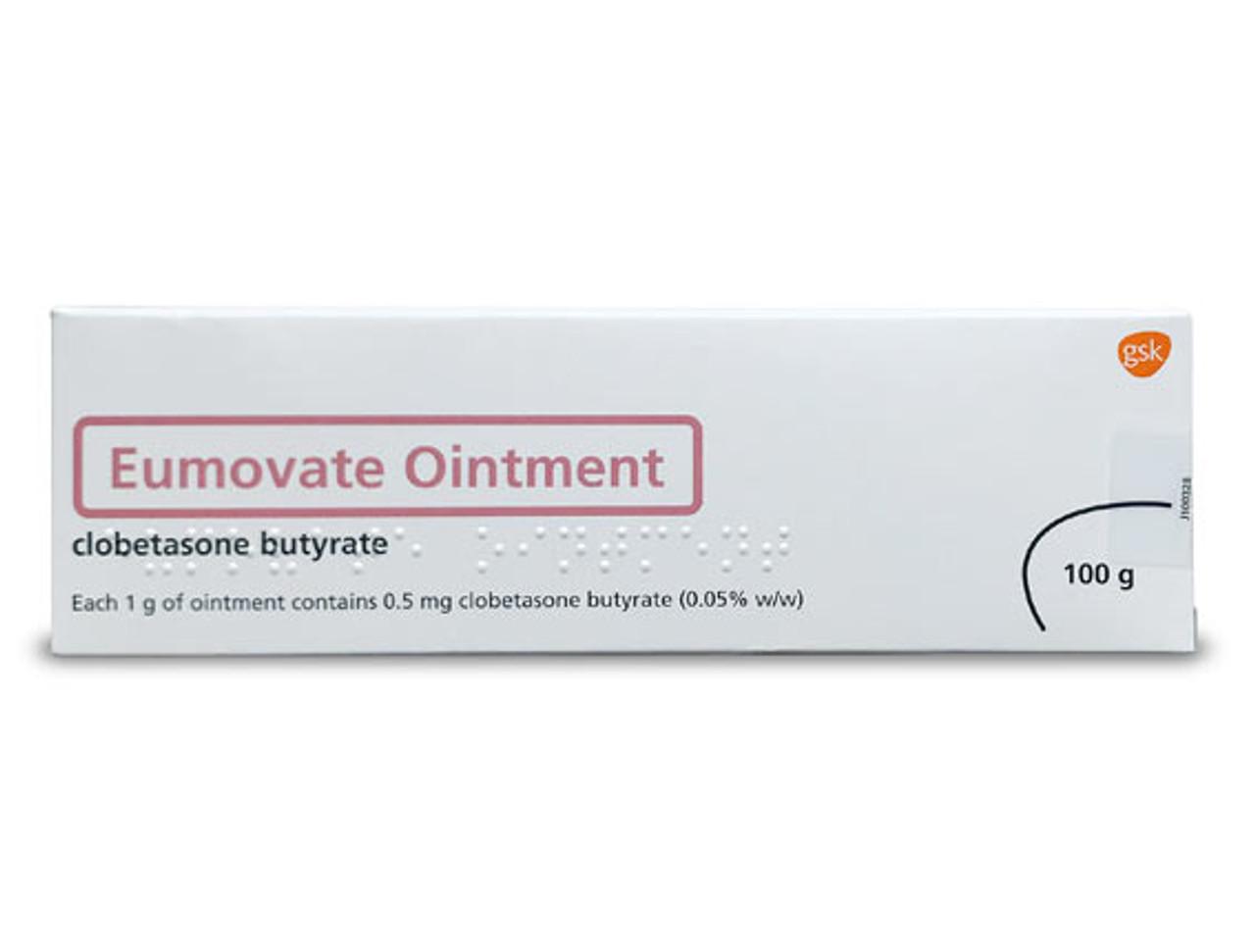
Eumovate Ointment is a prescription medicine that contains clobetasone butyrate. Clobetasone is a corticosteroid that is applied topically to relieve skin inflammation and itching and is used to treat a number of conditions including: Atopic eczema Allergic contact dermatitis Irritant contact dermatitis Psoriasis Seborrheic dermatitis Thick skin rash due to excessive scratching to relieve itching An eruption of hard nodules on the skin with intense itching Discoid lupus erythematosus Erythroderma is characterized by intense and widespread reddening of the skin Severe reactions to insect stings and bites
Order before 3pm — same-day dispatch (MON - FRI)
~5 min consultation
Secure & confidential · Reviewed by a UK prescriber
Eumovate Ointment is a prescription medicine that contains clobetasone butyrate. Clobetasone is a corticosteroid that is applied topically to relieve skin inflammation and itching and is used to treat a number of conditions including: Atopic eczema Allergic contact dermatitis Irritant contact dermatitis Psoriasis Seborrheic dermatitis Thick skin rash due to excessive scratching to relieve itching An eruption of hard nodules on the skin with intense itching Discoid lupus erythematosus Erythroderma is characterized by intense and widespread reddening of the skin Severe reactions to insect stings and bites
Eumovate is a topical corticosteroid cream and ointment containing clobetasone butyrate 0.05%, classified as a moderately potent steroid in the UK grading system. It's used to treat mild to moderate inflammatory skin conditions including eczema, seborrhoeic dermatitis, contact dermatitis (both irritant and allergic), discoid eczema, insect bites with significant inflammatory reactions, and prickly heat. Unlike hydrocortisone, which sits at the mild end of the spectrum, Eumovate provides stronger anti-inflammatory effect and is generally chosen when mild steroids have not adequately controlled a flare, or when the condition starts out at a level of severity that mild steroids would struggle to address.
Not always. Eumovate 0.05% is available over the counter as a pharmacy medicine (P-medicine) in the UK, which means a pharmacist supervises the sale. This makes it one of the few moderately potent steroids accessible without a prescription, distinguishing it from betamethasone and mometasone, which are prescription-only. The OTC packs carry specific use restrictions: they're licensed for adults and children over 12, for use on the body but not the face, genitals, or perianal area, not for broken or infected skin, and for short-term use of up to 7 days. Under prescription, Eumovate can be used for longer courses, in younger children, and in a wider range of locations including the face. If your condition needs treatment for longer than 7 days, on the face, or in a child under 12, the right step is a GP or prescriber consultation rather than continuing with OTC packs.
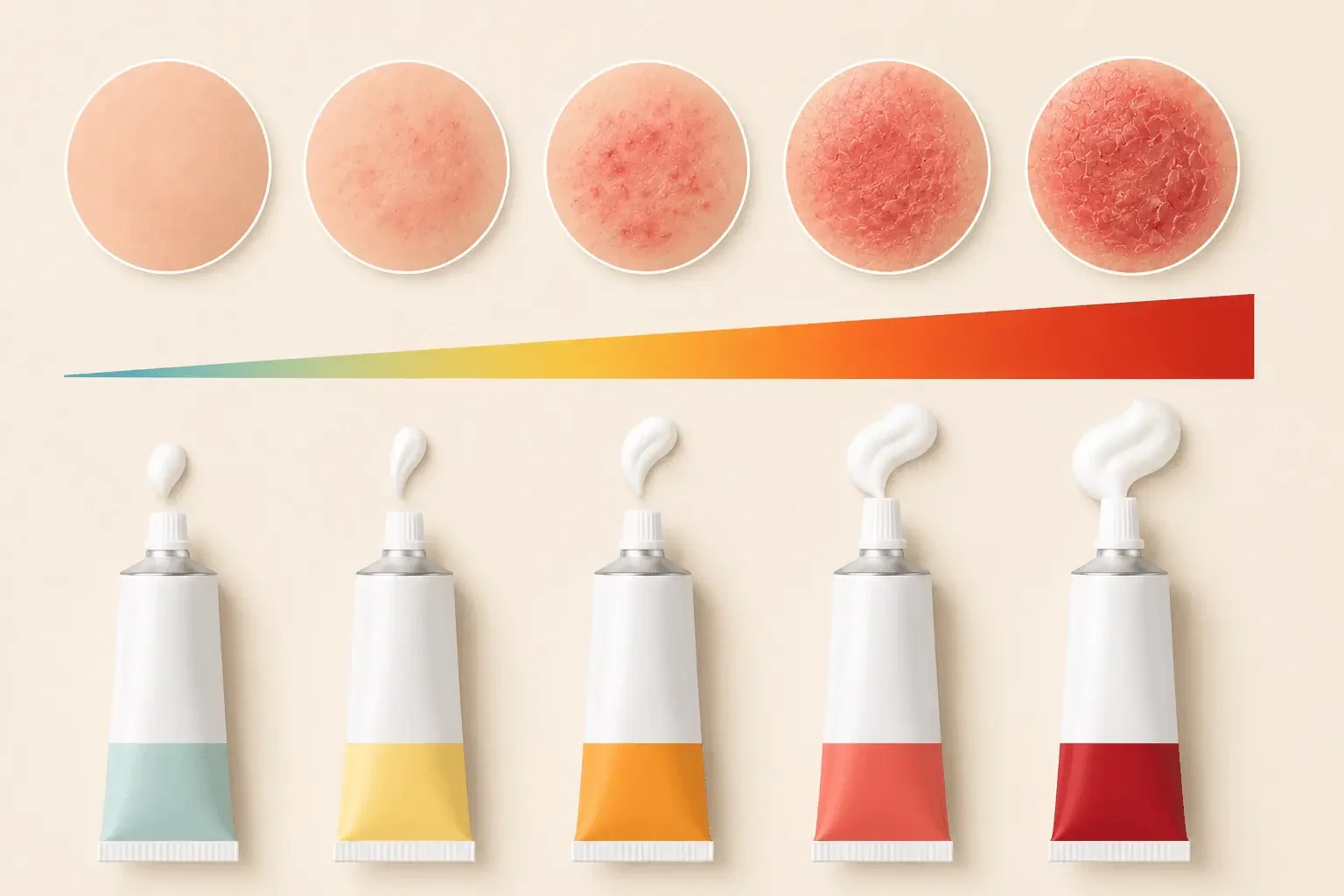
The UK topical steroid potency ladder has four rungs, and Eumovate sits on the second: mild (hydrocortisone 1%), moderately potent (clobetasone butyrate 0.05%, i.e., Eumovate), potent (betamethasone valerate 0.1%, i.e., Betnovate), and very potent (clobetasol propionate 0.05%, i.e., Dermovate). Eumovate is roughly two to three times more potent than hydrocortisone 1% and roughly three to four times less potent than betamethasone 0.1%. In practical terms, this means it steps up where hydrocortisone has failed but stops short of the side-effect profile that comes with potent steroids. Eumovate is particularly useful for facial eczema and flexural areas where potent steroids carry too much risk of skin thinning and other side effects, but where hydrocortisone hasn't been effective. Many patients use all three at different points: hydrocortisone for mild flares, Eumovate for moderate flares, and betamethasone (with a prescription) for severe flares.
The active ingredient is identical; the difference is in the base. The cream has a water-based emulsion that absorbs quickly, leaves less residue, and feels lighter. The ointment has a greasy, oily base that sits on the skin, locks in moisture, and creates a partial seal. The cream is better for moist or weeping skin, for face application where the ointment would feel heavy and uncomfortable, for daytime use under clothing, and for people who find greasy products hard to tolerate. The ointment is better for dry, thick, scaly patches, for overnight use, and for chronic lichenified skin where extra moisture-locking helps the skin heal. The ointment is also slightly more clinically potent than the cream of the same concentration, because the occlusive base increases steroid penetration into the skin. Many patients use both: cream for the face or daytime, ointment for body patches or overnight.
Clobetasone butyrate is a synthetic corticosteroid that works in the same fundamental way as hydrocortisone and betamethasone, just at intermediate potency. When applied to the skin, it penetrates into the cells of the upper layers and binds to glucocorticoid receptors inside those cells. The receptor-steroid complex moves into the cell nucleus and changes which genes are switched on and off. The result is a broad anti-inflammatory effect: production of inflammatory chemicals (prostaglandins, leukotrienes, cytokines) is suppressed, fewer inflammatory cells are recruited into the skin, small blood vessels in the inflamed area constrict (which is why redness fades), and itch and discomfort settle. Clobetasone butyrate is designed to achieve this through a relatively selective profile that produces strong local anti-inflammatory effects with less systemic absorption than many potent steroids at the same clinical efficacy level, which is one of the reasons it's considered safer for face and flexure use than betamethasone.
Apply Eumovate thinly to the affected area once or twice daily, depending on the product instructions. The fingertip unit (FTU) approach applies here as it does to other topical steroids: one FTU is the amount squeezed onto an adult's index finger from the tip to the first crease, equals about half a gram, and covers an area roughly equivalent to two adult palm prints. Apply only to the inflamed patches, not to large areas of surrounding healthy skin. Rub it in gently until it just disappears; a thin layer is the right amount, not a thick coating. Wash your hands after application unless your hands are the area being treated. If you're using an emollient alongside, allow at least 30 minutes between applying the two products.
The OTC limit is 7 days. If your skin hasn't clearly improved within that time or symptoms are getting worse, speak to a pharmacist or GP rather than continuing. Under medical supervision, courses of up to 4 weeks are typical for adults, with longer use reserved for specialist-guided treatment plans. As with all topical steroids, the aim is to use just enough to clear the flare, then step down to hydrocortisone or to emollients alone as the skin settles. Repeated short courses for distinct flares, with breaks between them, are generally safe. Continuous daily use over many months on the same skin area, particularly on the face, carries a higher risk of side effects and warrants review.
Under prescription, yes, and clobetasone butyrate is actually one of the preferred topical steroids for facial eczema precisely because of its moderate potency and relatively low systemic absorption on facial skin. The face and eyelids have thinner, more absorbent skin than the body, which makes potent steroids (betamethasone, mometasone) risky there: they can cause skin thinning, telangiectasia, perioral dermatitis, and (near the eyelids) raised intraocular pressure over time. Eumovate carries substantially lower risk of these effects than potent steroids, making it a common choice for moderate facial eczema that hasn't responded to hydrocortisone. The OTC packs are not licensed for face use, so if you need treatment for a facial flare and are buying from a pharmacy, mention this to the pharmacist or consider a GP appointment to get a prescription with appropriate guidance about duration and application.
Under medical guidance, yes. Eumovate is used in children when hydrocortisone hasn't been sufficient for a flare, and it's generally preferred over betamethasone in younger children because of its gentler side-effect profile. The OTC packs are licensed for children over 12 only; for children under 12, a prescription is needed and the prescriber will specify the right duration and area of use. Children have thinner skin and a higher surface-area-to-body-weight ratio than adults, both of which increase relative systemic absorption, so moderate steroids are used in shorter courses and on smaller areas in children than in adults. In babies under 2 years, moderately potent steroids are generally only used under dermatology supervision.
Eumovate is better tolerated than betamethasone and other potent steroids, particularly with short-term use. When side effects do occur, they're mostly local to the treated area. Possible local effects include skin thinning (atrophy), the appearance of small visible blood vessels (telangiectasia), mild stinging on application, perioral dermatitis if used around the mouth, acne-like eruptions, and worsening of any underlying viral or fungal infection (steroids mask infection without treating it). Systemic side effects from skin absorption are less likely with Eumovate than with potent steroids, but they can occur with very large areas, prolonged courses, or use under occlusion. For most people using Eumovate for a week or two on a defined flare, the side effect profile is modest.
The risk is lower than with betamethasone but higher than with hydrocortisone, which reflects its position in the middle of the potency spectrum. Skin thinning develops mostly with prolonged daily use over many weeks or months, particularly on thin-skinned areas (face, eyelids, flexures) and under occlusion. A 7-day course of Eumovate for a moderate eczema flare on the arms or legs rarely causes visible thinning, and the skin recovers when treatment stops. On the face, the risk is higher because facial skin is thinner and more absorptive, which is one of the reasons prescribers use Eumovate short-term on the face rather than longer. If you find yourself applying Eumovate to the same area of face or flexure every day for months, reviewing the plan with a GP or dermatologist is the sensible approach.
Moderately potent steroids are used with a bit more caution in pregnancy than hydrocortisone, though the absolute risk from short-term use on small areas is low. Systemic absorption from limited topical use is minimal, and no specific teratogenic effect has been identified for clobetasone butyrate in pregnancy. Most clinicians prefer to use mild steroids (hydrocortisone) as the first choice in pregnancy where possible, reserving Eumovate for flares that hydrocortisone hasn't controlled. In breastfeeding, the same principle applies: limited short-term use is generally considered compatible, but don't apply to the breast or nipple area where the baby could ingest the cream. As always with topical medicines in pregnancy or breastfeeding, the conversation is best had with a GP, midwife, or dermatologist rather than self-managing.
A few reasons can explain why a moderately potent steroid might not be helping. Under-treatment is the most common: not applying enough, not covering the whole affected area, or not treating for long enough. A more severe flare that genuinely needs a potent steroid (betamethasone, mometasone) is another, in which case a prescription is the right next step rather than repeating Eumovate courses indefinitely. Infection is a third: bacterial or fungal infection of the skin can mimic or worsen eczema, and steroids alone won't treat it. Signs of infection include sudden worsening, golden crusts, weeping, increased pain or warmth, fever, or spreading redness. Several features call for a clinical review rather than continuing on Eumovate: a rash that's spreading rapidly, blistering, no improvement after a week of treatment, frequent flares requiring repeated courses, any rash with systemic symptoms (fever, joint pain, fatigue, weight loss), any rash in a young child that hasn't been properly assessed, and any rash that doesn't clearly fit the original diagnosis. For chronic eczema or psoriasis requiring repeated treatment, an annual review helps make sure the steroid strength and overall plan are still the right fit, and modern options including calcineurin inhibitors (tacrolimus, pimecrolimus) and biological medicines may offer better long-term control for the right patients.
Apply 1–2 times a day, to be applied thinly.
FOR EXTERNAL USE ONLY.
Helpful articles and clinical guides related to this treatment category.
Free consultation
Online review by a UK prescriber
Next-day delivery
Order before 3pm where offered
Discreet packaging
Plain outer packaging