


Part of our complete guide to eczema and dermatitis in the UK.
Betnovate (Betamethasone Valerate) UK: Complete Clinical Guide
A comprehensive reference guide to Betnovate (betamethasone valerate 0.1%) — UK Class 3 potent topical corticosteroid. Covers mechanism of action, all licensed indications, formulations, safety, and when to step up to Dermovate.
▶ What is Betnovate?
Betnovate contains betamethasone valerate 0.1% — a potent (UK Class 3) topical corticosteroid. It is the most commonly prescribed potent steroid in UK dermatology, licensed for atopic eczema, contact dermatitis, discoid eczema, lichen planus, psoriasis (body), and other inflammatory dermatoses. Available as cream (moist skin), ointment (dry/lichenified skin), and lotion (scalp). For scalp-specific guidance, see: Betnovate lotion guide.
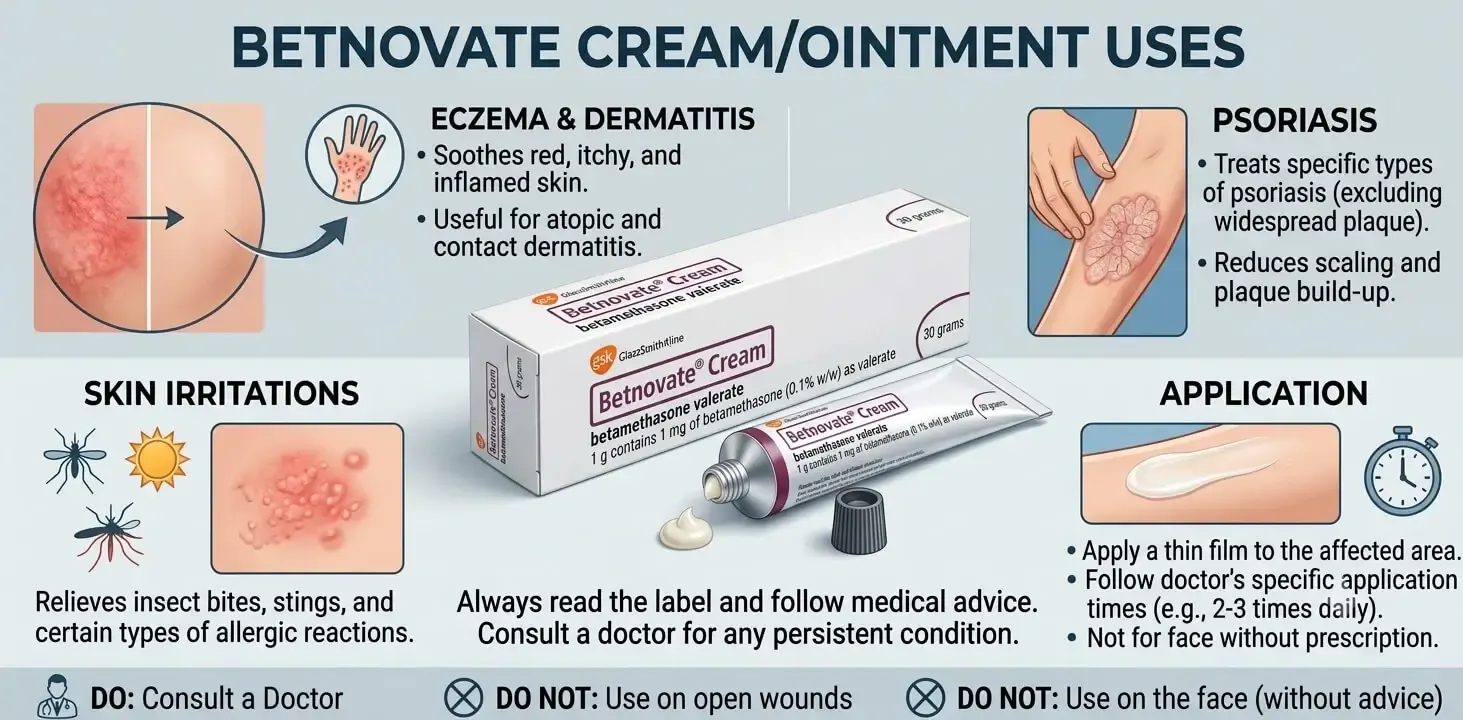
Betnovate (betamethasone valerate 0.1%) is a potent Class 3 topical corticosteroid and one of the most widely prescribed dermatological treatments in the UK. It has a broader range of clinical applications than Dermovate, appropriate for moderate-to-severe eczema, contact dermatitis, and other inflammatory skin conditions across most body areas. This guide is the canonical Betnovate reference — covering mechanism, all indications, formulations, safety, and the comparison with Dermovate.
Get Betnovate Online via Access Doctor
GPhC-registered pharmacist independent prescribers. Betnovate cream, ointment and lotion available following clinical assessment. GPhC pharmacy #9011198. Discreet next-day delivery.
Start Consultation →What Is Betamethasone Valerate?
Betamethasone valerate is a synthetic fluorinated glucocorticosteroid. At 0.1% concentration (Betnovate), it is classified as potent (Class 3) in the UK. A lower-strength preparation — betamethasone valerate 0.025% (Betnovate-RD) — is classified as moderate (Class 2) and is used for maintenance or when the full-strength preparation is too potent for a particular site.
UK steroid potency ladder
| Class | Potency | Examples |
|---|---|---|
| Class 1 | Mild | Hydrocortisone 0.5–1% |
| Class 2 | Moderate | moderate steroid Eumovate, Betnovate-RD (betamethasone 0.025%) |
| Class 3 | Potent | Betnovate (betamethasone 0.1%), Elocon (mometasone) cream, Cutivate |
| Class 4 | Very potent | Dermovate (clobetasol 0.05%) |
How Betnovate Works
Like all topical corticosteroids, betamethasone valerate works by binding to intracellular glucocorticoid receptors in skin cells, suppressing the transcription of pro-inflammatory genes. The effects include:
- Reduced cytokine production — suppresses IL-1, IL-4, IL-13 and TNF-α, the key mediators of atopic eczema inflammation
- Vasoconstriction — reduces blood vessel dilation, producing visible reduction in redness and warmth
- Reduced prostaglandin synthesis — lipocortin upregulation inhibits phospholipase A2, reducing prostaglandin-driven itch and pain
- Keratinocyte normalisation — reduces abnormal proliferation in psoriatic plaques
The potency advantage of Class 3 over Class 1–2 steroids comes from both the higher inherent glucocorticoid activity of betamethasone valerate and the valerate ester, which improves skin penetration. For a detailed scientific comparison with Class 4 (clobetasol propionate), see: How Dermovate works →
What Conditions Does Betnovate Treat?
MHRA-licensed indications for betamethasone valerate 0.1% include:
- Atopic eczema (moderate to severe) — the most common indication; for flares on body areas not controlled by mild or moderate steroids
- Contact dermatitis — both irritant and allergic; once the triggering substance has been removed or avoided
- Discoid eczema — coin-shaped inflammatory plaques on the limbs and trunk
- Lichen planus — chronic inflammatory condition producing flat-topped, itchy purple papules
- Psoriasis (body) — moderate plaque psoriasis on the trunk and limbs where mild steroids are insufficient; not for facial or flexural psoriasis without specialist direction
- Seborrhoeic dermatitis (body) — particularly on the trunk and scalp (lotion formulation); see the Betnovate lotion guide for scalp application
- Insect bite reactions and other inflammatory dermatoses — where rapid symptom control is needed on body areas
Betnovate is NOT for: acne vulgaris, rosacea, perioral dermatitis, viral skin infections (including cold sores, chickenpox), fungal infections, bacterial skin infections, or nappy rash. Always confirm the diagnosis before applying; potent steroids applied to an undiagnosed fungal infection will worsen it significantly.
Betnovate Formulations
| Formulation | Best for | Key consideration |
|---|---|---|
| Betnovate cream | Moist, inflamed, weeping eczema; most body areas | Water-miscible; easier to apply and less greasy than ointment |
| Betnovate ointment | Dry, scaly, or lichenified eczema; chronic plaques | Occlusive base improves penetration through thickened skin |
| Betnovate lotion | Scalp, hairy skin, seborrhoeic dermatitis | Spreads easily through hair; designed for scalp application — full guide: Betnovate lotion guide |
Betnovate is a prescription-only medicine, available following an online consultation with our GPhC-registered prescribers: Betnovate cream for moist or weeping skin, Betnovate ointment for dry or lichenified areas, and Betnovate scalp application for the scalp and hair-bearing skin.
Safety, Side Effects and Prescribing Limits
Betnovate is safe when used correctly and for appropriate durations. Compared to Dermovate, it carries a somewhat lower risk of systemic side effects due to lower absolute potency — but the same precautions apply:
- Do not apply to face, eyelids, skin folds, or genitals without specialist direction
- Limit to 1–2 weeks for acute flares on most body areas; review with prescriber if ongoing use is needed
- No more than 30–60g per week across all applications (lower for sensitive areas)
- Skin atrophy, striae, and telangiectasia are risks with prolonged overuse, particularly in skin folds and on thin skin
- Pregnancy: mild-to-moderate topical steroids are generally safe; potent steroids (Betnovate) warrant cautious use and prescriber discussion
Betnovate vs Dermovate: When to Step Up
| Betnovate (betamethasone 0.1%) | Dermovate (clobetasol 0.05%) | |
|---|---|---|
| UK potency class | Class 3 — Potent | Class 4 — Very potent |
| Relative potency vs hydrocortisone | ~28× | ~600× |
| Typical first use | First-line for moderate-to-severe eczema on body | Second-line; only when Betnovate has been insufficient |
| Course duration | 1–2 weeks; some conditions may allow longer under review | 1–2 weeks maximum; short courses only |
| Weekly limit | 30–60g/week (prescriber guidance) | 50g/week (MHRA strict limit) |
| Risk of atrophy | Moderate risk with overuse | Higher risk; more restrictions on use |
If you have been using Betnovate without adequate eczema control, speak to your prescriber. They may recommend a short course of Dermovate, a different potent steroid, a non-steroid second-line treatment, or specialist dermatology referral — depending on the presentation. Full Dermovate science: How Dermovate works →
Get Betnovate Online — Assessed by Registered Prescribers
GPhC-registered pharmacist independent prescribers. Betnovate cream, ointment and lotion available following clinical assessment. GPhC pharmacy #9011198.
Get Betnovate Online →Frequently Asked Questions
What is Betnovate used for?
Betnovate contains betamethasone valerate 0.1% (Class 3 potent corticosteroid) and is licensed for a wide range of inflammatory skin conditions including atopic eczema, contact dermatitis, discoid eczema, lichen planus, psoriasis (on body areas), and other responsive dermatoses. It is the most commonly prescribed potent topical corticosteroid in the UK.
How strong is Betnovate?
Betnovate is classified as potent (Class 3) in the UK BNF — one class below Dermovate (Class 4, very potent). Betamethasone valerate 0.1% is approximately 28 times more potent than hydrocortisone 1% on a weight-for-weight basis. It is significantly stronger than Eumovate or Betnovate-RD (0.025%), but less potent than Dermovate or Elocon (mometasone) cream.
Can Betnovate be used on the face?
Betnovate should not be used on the face except under specialist direction. Facial skin is thinner and more susceptible to corticosteroid side effects — skin atrophy, telangiectasia, and perioral dermatitis. For facial eczema, lower-potency steroids (hydrocortisone 1% or clobetasone 0.05%) are used. If facial eczema is severe enough to need a potent steroid, this warrants dermatologist assessment.
What is the difference between Betnovate cream, ointment, and lotion?
All three contain betamethasone valerate 0.1% at the same concentration. Betnovate cream suits moist, inflamed skin. Betnovate ointment is better for dry, scaly, or lichenified skin. Betnovate lotion is formulated for scalp and hair-bearing areas. The choice depends on skin type and treatment site — see our Betnovate lotion guide for scalp-specific guidance.
When should I use Dermovate instead of Betnovate?
Betnovate (Class 3) is tried first for moderate-to-severe eczema on body areas. If a well-prescribed Betnovate course does not adequately control the flare — particularly if the skin is lichenified or the eczema is severe and resistant — Dermovate (Class 4) may be considered for a short course under prescriber supervision.
How long can I use Betnovate for?
MHRA guidance recommends limiting potent steroids to the shortest effective course. Typically 1–2 weeks for acute flares on most body areas. More prolonged use requires prescriber review. Do not apply to the face, skin folds, or genitals for more than 5–7 days without specialist direction. In long-term skin conditions, a step-down or pulse-dosing strategy is usually recommended.
References
- MHRA. SPC: Betnovate cream (betamethasone valerate 0.1%). 2024. medicines.org.uk/emc
- NICE. Eczema — atopic: CKS. 2024. cks.nice.org.uk
- BNF. Topical corticosteroids: betamethasone. NICE/BNF, 2024. bnf.nice.org.uk
- Hengge UR et al. Adverse effects of topical glucocorticosteroids. J Am Acad Dermatol. 2006;54(1):1–15.
- NHS. Betamethasone skin treatments. nhs.uk/medicines/betamethasone-skin
Medical disclaimer: Betnovate is a prescription-only potent (Class 3) topical corticosteroid. Do not apply to the face, eyelids, skin folds, or genitals without specialist direction. A clinical consultation is required before it can be dispensed. In a medical emergency, call 999.