


How Does Dermovate Work? Clobetasol Propionate Explained
How clobetasol propionate calms severe skin inflammation, how strong it is compared with Betnovate, and how to use it safely.
Part of the Eczema & Dermatitis Health Guide.
When to get urgent help: Call 999 or go to A&E if your skin quickly turns red and you develop white, pus-filled bumps that join together – you may also have a fast heartbeat, a high temperature, or feel hot, cold or shivery. These can be signs of a more serious condition, such as pustular psoriasis, or an infection. Also call 999 if you have swelling of the face, lips, tongue or throat, or difficulty breathing. Stop using Dermovate and contact your prescriber, GP or NHS 111 if the treated skin becomes infected (hot, swollen, crusted or weeping), your vision becomes blurred, or redness and burning spread beyond the treated area after you stop.
Key fact: Dermovate contains clobetasol propionate 0.05%, which places it in the very potent group — the strongest of the four UK potency groups for topical steroids. It is a prescription-only medicine for short courses of severe or stubborn skin conditions that have not responded to a weaker steroid.
Get Dermovate Online
Access Doctor provides Dermovate following a GPhC-regulated online consultation with our pharmacist independent prescribers.
Start consultation →0.05%
Clobetasol propionate — very potent
50 g
Weekly maximum for the cream or ointment
4 wks
Maximum course length in the licence
What is Dermovate?
Dermovate is a branded topical corticosteroid available in the UK as a cream, an ointment and a scalp application. Its active ingredient, clobetasol propionate 0.05%, is a synthetic glucocorticoid in the very potent group — the strongest of the four UK potency groups. No group of topical steroid is stronger.
The cream and ointment are licensed for adults, older people and children over 1 year, for short courses of more resistant inflammatory and itchy skin conditions that have not responded to weaker steroids. Because of its strength, Dermovate is a prescription-only medicine (POM) and is used within strict limits on quantity and duration. The guiding principle is to use the weakest steroid that works, stepping up to a very potent one only when it is needed.
Clobetasol propionate has been used for decades and appears in the British National Formulary (BNF) and NICE Clinical Knowledge Summaries as an option for severe skin disease that has not responded to a potent steroid.
Conditions Dermovate treats
The Summary of Product Characteristics (SmPC) for Dermovate cream lists these uses, for conditions that have not responded to less potent steroids:
- Psoriasis (excluding widespread plaque psoriasis) — well-defined, scaly plaques
- Recalcitrant dermatoses — stubborn inflammatory skin conditions such as severe eczema that has not cleared with a potent steroid
- Lichen planus — a chronic inflammatory condition producing flat-topped, itchy bumps
- Discoid lupus erythematosus — a form of lupus affecting the skin, causing inflamed, scarring plaques
- Other steroid-responsive skin conditions that have not responded satisfactorily to less potent steroids
Dermovate is not intended for mild or moderate eczema, or for conditions that respond to weaker preparations. Where a moderate or potent steroid has already been tried properly and has not worked, Dermovate is a recognised next step.
Children: Dermovate must not be used in babies under 1 year, including for nappy rash. In older children, courses should be limited to 5 days where possible and reviewed weekly, without airtight dressings, because children absorb more steroid through the skin. NICE advises that very potent steroids should not be used in children with eczema without specialist dermatology advice.
How Dermovate works: the mechanism
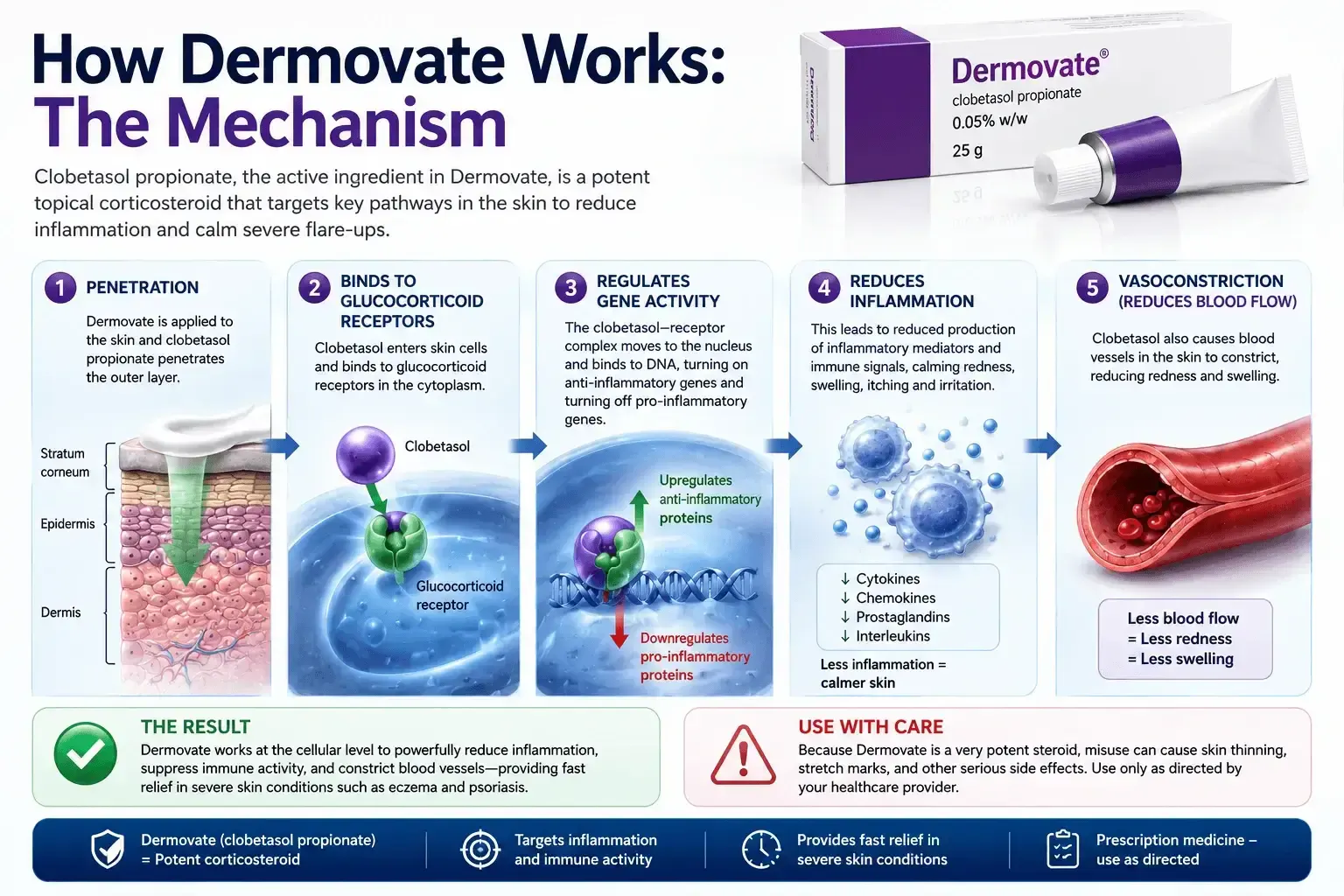
Clobetasol propionate works through several overlapping anti-inflammatory and vasoconstrictive pathways, all acting through glucocorticoid receptors inside skin cells. Understanding this explains both why Dermovate is effective for severe disease and why misuse carries real risk.
Glucocorticoid receptor binding
When Dermovate is applied, clobetasol propionate passes through the stratum corneum (the outermost layer of skin) into keratinocytes, fibroblasts and immune cells in the epidermis and dermis. Inside the cell it binds strongly to glucocorticoid receptors. Its high receptor affinity is a key reason for its very potent classification.
The drug–receptor complex then moves into the cell nucleus, where it switches many genes involved in inflammation on or off.
Suppression of pro-inflammatory cytokines
In eczema and other inflammatory skin conditions, the skin is flooded with immune signalling molecules that drive redness, swelling and itch. Clobetasol propionate reduces the production of key mediators, including:
- Interleukin-1 (IL-1) — an early activator of the inflammatory cascade
- Interleukin-2 (IL-2) — a T-cell growth factor that sustains the immune response
- Tumour necrosis factor-alpha (TNF-α) — a central pro-inflammatory cytokine
- Interleukin-4 and interleukin-13 — drivers of the type 2 immune response seen in atopic eczema
Inhibition of prostaglandins and leukotrienes
Glucocorticoids increase production of lipocortin-1 (annexin A1), a protein that blocks the enzyme phospholipase A2. This enzyme releases arachidonic acid from cell membranes — the starting material for prostaglandins and leukotrienes, which contribute to the heat, pain and swelling of inflamed skin. Blocking this early step reduces both families of mediators.
Vasoconstriction and reduced capillary leak
Clobetasol propionate narrows small blood vessels in the dermis and makes them less leaky, which limits the movement of fluid and immune cells into the skin. The visible result is less redness and swelling. This blanching effect is also the basis of the vasoconstrictor assay used to rank topical steroid potency.
Reduced mast cell and dendritic cell activity
Topical glucocorticoids also reduce the number and activity of mast cells and Langerhans cells (dendritic cells) in the skin. Mast cells release histamine and other itch mediators, so damping them down helps break the itch–scratch cycle that further damages the skin barrier.
Anti-inflammatory
Reduces IL-1, IL-2, TNF-α and other pro-inflammatory signals through glucocorticoid receptors in skin cells
Vasoconstrictive
Narrows and tightens small blood vessels, reducing redness and swelling
Anti-itch
Dampens mast cell activity, easing the intense itch of eczema and psoriasis
Immunosuppressive
Reduces Langerhans cell and T-cell activity in the skin, calming chronic inflammation
How strong is Dermovate? UK potency groups
In the UK, the BNF groups topical corticosteroids into four potency groups — mild, moderate, potent and very potent — based largely on how strongly they blanch the skin in a vasoconstrictor assay. Percentages are not a guide to strength: Dermovate is 0.05% but is stronger than many 0.1% products.
| Potency group | Example active ingredient | Example brand | Typical use |
|---|---|---|---|
| Mild | Hydrocortisone 0.5–2.5% | Hydrocortisone cream | Mild eczema; face; children |
| Moderate | Clobetasone butyrate 0.05% | Eumovate ointment | Moderate eczema |
| Potent | Mometasone furoate 0.1% / betamethasone valerate 0.1% | Elocon cream / Betnovate | Moderate to severe eczema; psoriasis |
| Very potent | Clobetasol propionate 0.05% | Dermovate | Severe or resistant conditions, short courses |
The UK scale differs from the seven-class US system, where clobetasol propionate is in class 1 (the strongest). When reading international sources, check which system is being used before comparing numbers.
Dermovate formulations
Dermovate comes in three formulations. The choice depends mainly on the type of skin and where it is.
Dermovate cream
The cream is water-based and less greasy, which suits moist or weeping skin and is more acceptable for daytime use. For guidance on using the cream in eczema, see our article on Dermovate cream for eczema.
Dermovate ointment
The ointment uses a greasy, water-free base that holds moisture in the skin. It suits dry, thickened (lichenified) or chronic plaques. See our article on Dermovate ointment for dry and lichenified skin, or the Dermovate ointment product page.
Dermovate scalp application
The Dermovate scalp application is an alcohol-based liquid that reaches the scalp through hair. It is used for short courses of scalp conditions, such as scalp psoriasis, that have not responded to less active steroids. It is flammable and should be used within 3 months of opening.
Prescription product
Dermovate Cream
Clobetasol propionate 0.05% cream — suits moist or weeping skin.
View Dermovate Cream →Prescription product
Dermovate Ointment
Clobetasol propionate 0.05% ointment — suits dry, thickened plaques.
View Dermovate Ointment →Safe usage guidelines
Because of its strength, Dermovate must be used exactly as directed. The following is drawn from the product SmPC, the BNF, NICE CKS and MHRA safety advice.
1
Apply a thin layer only
Use just enough to cover the affected area and rub it in gently. A thick layer does not work better but does increase absorption and side effects.
2
Once or twice daily, affected areas only
Apply once or twice a day until the skin improves, then apply less often or switch to a weaker steroid as advised. Do not apply to surrounding healthy skin.
3
No more than 50 g a week
For the cream and ointment, the licence limit is 50 g per week across all treated areas. Using more increases the risk of adrenal suppression.
4
No longer than 4 weeks
The cream licence states treatment should not continue for more than 4 weeks. If treatment is still needed, your prescriber should review it and consider a less potent steroid.
5
Take extra care on the face and in skin folds
Avoid the face where possible; if your prescriber advises using it there, limit it to 5 days and do not cover it. Keep it out of the eyes, as repeated contact can lead to cataract or glaucoma.
6
Do not cover unless directed
Bandages, clingfilm or other airtight dressings greatly increase absorption and should only be used if your prescriber tells you to. Skin folds act in a similar way, so take extra care there.
7
Stop gradually and keep moisturising
Once the skin is under control, reduce use gradually and carry on with an emollient. Stopping suddenly after long use can cause a flare.
Fingertip units: one fingertip unit (the amount squeezed from a standard tube from the tip to the first crease of an adult index finger) is about 0.5 g and covers an area roughly the size of two adult hands. Over large areas, weekly quantities add up quickly, so keep track and stay within the 50 g limit.
Side effects of Dermovate
The SmPC lists these side effects, which become more likely with long use, large areas or covered skin:
- Common (up to 1 in 10 people): itching, and burning or pain where it is applied.
- Uncommon (up to 1 in 100 people): skin thinning (atrophy), stretch marks (striae) and small visible blood vessels (telangiectasia).
- Very rare (up to 1 in 10,000 people): adrenal suppression and Cushing-like features, allergic reactions, generalised rash, skin infection, irritation, cataract, glaucoma, allergic contact dermatitis, pustular psoriasis, acne, and skin that becomes thin, wrinkled or dry.
- Frequency not known: steroid withdrawal reactions and blurred vision.
Systemic effects and adrenal suppression
If enough clobetasol propionate is absorbed into the bloodstream, it can reduce the body’s own cortisol production (hypothalamic–pituitary–adrenal, or HPA, axis suppression). This is rare with correct use but more likely with large quantities, airtight dressings, long courses, thin or broken skin, and in children. Signs of excess steroid can include weight gain and a rounded face. This is why the 50 g weekly limit and short courses matter.
Steroid withdrawal reactions: the MHRA warns that stopping a topical steroid after long-term use can cause a withdrawal reaction, with redness, stinging and burning that can spread beyond the original area, days to weeks after stopping. If you have been using Dermovate regularly, speak to your prescriber before stopping, and seek advice if this happens.
Who should not use Dermovate
Dermovate must not be used:
- In babies under 1 year, including for nappy rash
- On untreated skin infections (bacterial, fungal or viral), such as impetigo, ringworm, thrush, cold sores or chickenpox
- For rosacea, acne or perioral dermatitis, which steroids can cause or worsen
- For itching without inflammation, or itching around the anus or genitals
- By anyone allergic to clobetasol propionate or any other ingredient
Pregnancy and breastfeeding: Dermovate should only be used if the expected benefit outweighs the risk, using the smallest amount for the shortest time. If you are breastfeeding, do not apply it to the breasts.
Dermovate vs Betnovate: when to step up or step down
One of the most common questions about Dermovate is how it compares with Betnovate (betamethasone valerate 0.1%), a potent steroid one group below. Knowing when each is used — and when to step up from Betnovate to Dermovate, or back down again — is central to safe steroid use.
| Feature | Betnovate (betamethasone valerate 0.1%) | Dermovate (clobetasol propionate 0.05%) |
|---|---|---|
| UK potency group | Potent | Very potent |
| Typical use | Moderate to severe eczema; psoriasis | Severe or resistant eczema, psoriasis (not widespread plaque), lichen planus, discoid lupus |
| When it is used | Eczema: when a mild or moderate steroid has not worked. Psoriasis: often the first steroid used (NICE CG153) | When a potent steroid such as Betnovate has not worked |
| Scalp psoriasis (NICE CG153) | First step: once daily for up to 4 weeks | Later step for adults: up to twice daily for 2 weeks |
| Continuous use at one site (NICE CG153, psoriasis) | No longer than 8 weeks | No longer than 4 weeks |
| Risk profile | Skin thinning and stretch marks with prolonged use | Higher risk of skin thinning and adrenal suppression |
| Legal status | POM | POM |
When to use Betnovate: Betnovate is the usual next choice when eczema has not responded to a mild or moderate steroid such as hydrocortisone or clobetasone butyrate. It is used on most body sites, avoiding the face, genitals and skin folds unless a prescriber advises otherwise.
When to step up to Dermovate: stepping up is reasonable when a full, correctly applied course of a potent steroid like Betnovate has not controlled the problem — for example, skin that is still very inflamed or thickened after several weeks of proper use. The decision should be made by a GP, dermatologist or prescriber who has reviewed the skin.
Stepping down after a Dermovate course: once the flare is controlled, Dermovate should not be continued indefinitely. Stepping down to a potent steroid such as Betnovate, or to emollients alone, reduces the risk of skin thinning and systemic effects. For more, see our guide to Betnovate for eczema.
UK safety and prescribing information
- Legal status: Dermovate is a prescription-only medicine (POM). At Access Doctor it is prescribed only after an online consultation with a GPhC-registered pharmacist independent prescriber, and only where a weaker steroid has not worked. We may decline and refer you to your GP or a dermatologist.
- Licence limits (cream and ointment): adults, older people and children over 1 year; no more than 50 g a week; no longer than 4 weeks; children and face limited to 5 days where possible.
- NICE psoriasis guidance (CG153): no continuous use of a very potent steroid at any site for longer than 4 weeks, and aim for a 4-week break between courses.
- Steroid withdrawal: the MHRA warns that stopping after long-term use can cause redness, stinging and burning that may spread beyond the treated area. If your skin gets worse within 2 weeks of stopping, do not restart treatment without speaking to your prescriber.
- Fire risk: clothing and bedding that have been in contact with paraffin-containing products, such as ointments, can burn more easily, and the scalp application is flammable. Keep away from flames and cigarettes, and do not use a hairdryer straight after applying the scalp application.
- Reporting side effects: you can report suspected side effects to the MHRA through the Yellow Card scheme website or the Yellow Card app.
Getting a prescription
Dermovate is a prescription-only medicine, so it can only be supplied after a clinical assessment by a registered prescriber. You can request Dermovate cream through a short online consultation reviewed by our GPhC-registered pharmacist independent prescribers, who will check that a weaker steroid has been tried first.
Frequently asked questions
What is Dermovate used for?
Dermovate is used for short courses of severe or stubborn inflammatory skin conditions that have not responded to a weaker steroid. These include psoriasis (but not widespread plaque psoriasis), severe eczema, lichen planus and discoid lupus erythematosus.
How strong is Dermovate compared to other steroids?
Dermovate (clobetasol propionate 0.05%) is in the very potent group, the strongest of the four UK potency groups for topical steroids. It is one group above potent steroids such as Betnovate (betamethasone valerate 0.1%) and Elocon (mometasone furoate 0.1%).
Is Dermovate stronger than Betnovate?
Yes. Dermovate is very potent and Betnovate is potent, so Dermovate is one group stronger. It is usually only used when a full course of a potent steroid such as Betnovate has not worked, and people step back down to a weaker steroid once the flare is controlled.
How often should I apply Dermovate?
Apply a thin layer once or twice a day to the affected skin only. Once the skin improves, apply it less often or switch to a weaker steroid, as your prescriber advises. Using more does not work better but does increase side effects.
How long can I use Dermovate?
The cream licence states that treatment should not continue for more than 4 weeks. If treatment is still needed, your prescriber should review it and consider a less potent steroid. Courses in children and on the face should be limited to 5 days where possible.
What are the side effects of Dermovate?
Common side effects are itching, burning or pain where it is applied. Uncommon effects include skin thinning, stretch marks and small visible blood vessels. Very rarely, too much can be absorbed into the body and affect the adrenal glands. Stopping after long-term use can cause a withdrawal reaction.
Can children use Dermovate?
Dermovate must not be used in babies under 1 year. In older children, courses should be limited to 5 days where possible, reviewed weekly, and not covered with an airtight dressing. NICE advises that very potent steroids are only used in children with eczema on specialist dermatology advice.
Can I use Dermovate on my face?
It should be avoided on the face where possible, because facial skin thins more easily. If your prescriber advises it, use should be limited to 5 days without a covering, and it must be kept out of the eyes.
What is the maximum amount of Dermovate I can use per week?
For Dermovate cream and ointment, the licence limit is 50 g per week across all treated areas. If you need more than this to control your skin, speak to your prescriber, as a different treatment may be needed.
References & Sources
- electronic Medicines Compendium. Dermovate Cream — Summary of Product Characteristics. medicines.org.uk
- electronic Medicines Compendium. Dermovate Ointment — Summary of Product Characteristics. medicines.org.uk
- electronic Medicines Compendium. Dermovate Scalp Application — Summary of Product Characteristics. medicines.org.uk
- NICE. Psoriasis: assessment and management (CG153). nice.org.uk
- NICE CKS. Eczema — atopic. cks.nice.org.uk
- British National Formulary. Clobetasol propionate. bnf.nice.org.uk
- MHRA. Topical corticosteroids: information on the risk of topical steroid withdrawal reactions. Drug Safety Update, September 2021. gov.uk
- NHS. Topical corticosteroids. nhs.uk
Medical disclaimer: This article is for information only and does not replace advice from your GP, pharmacist or prescriber. Dermovate is a prescription-only medicine and must only be used under the supervision of a registered healthcare professional. If you have signs of a skin infection, a severe skin reaction, or symptoms such as extreme tiredness, dizziness or weakness while using it, seek medical advice promptly.