We’re here to help.
Our friendly team is available to help Monday to Friday 9:00am – 5:00pm.
If you need urgent assistance, do not use this service. Call 111, or in an emergency call 999.
Our friendly team is available to help Monday to Friday 9:00am – 5:00pm.
If you need urgent assistance, do not use this service. Call 111, or in an emergency call 999.

Fast, discreet delivery
Free delivery over £40
100% UK-based pharmacy
All doctors & pharmacists UK-based
Free advice & support
Clinical support free · Mon–Fri 9am–5pm
Why Patients Choose Access Doctor
10+
Years serving UK patients
—
Verified patient reviews
1,000+
Licensed treatments
24/7
Consultation available
Dermovate ointment contains a corticosteroid called Clobetasol. Used to help reduce the redness and itchiness of certain skin problems, such as eczema, psoriasis and dermatitis.
Order before 3pm — same-day dispatch (MON - FRI)
~5 min consultation
Secure & confidential · Reviewed by a UK prescriber
Dermovate ointment contains a corticosteroid called Clobetasol. Used to help reduce the redness and itchiness of certain skin problems, such as eczema, psoriasis and dermatitis.
Dermovate is a prescription-only topical corticosteroid cream and ointment containing clobetasol propionate 0.05%, manufactured by GSK. It's classified as a very potent topical steroid in the UK grading system, placing it at the top of the four-rung ladder above potent steroids like betamethasone (Betnovate) and mometasone (Elocon). At this level of potency, Dermovate is reserved for conditions that haven't responded to less potent steroids and that specifically require maximum anti-inflammatory power. Indications include severe recalcitrant psoriasis (particularly on the palms, soles, and scalp), hypertrophic lichen planus, lichen sclerosus, severe or treatment-resistant eczema, discoid lupus erythematosus, and certain other inflammatory dermatoses. Because of its potency and associated risks, Dermovate is generally initiated by a dermatologist or specialist rather than as a routine GP prescription.
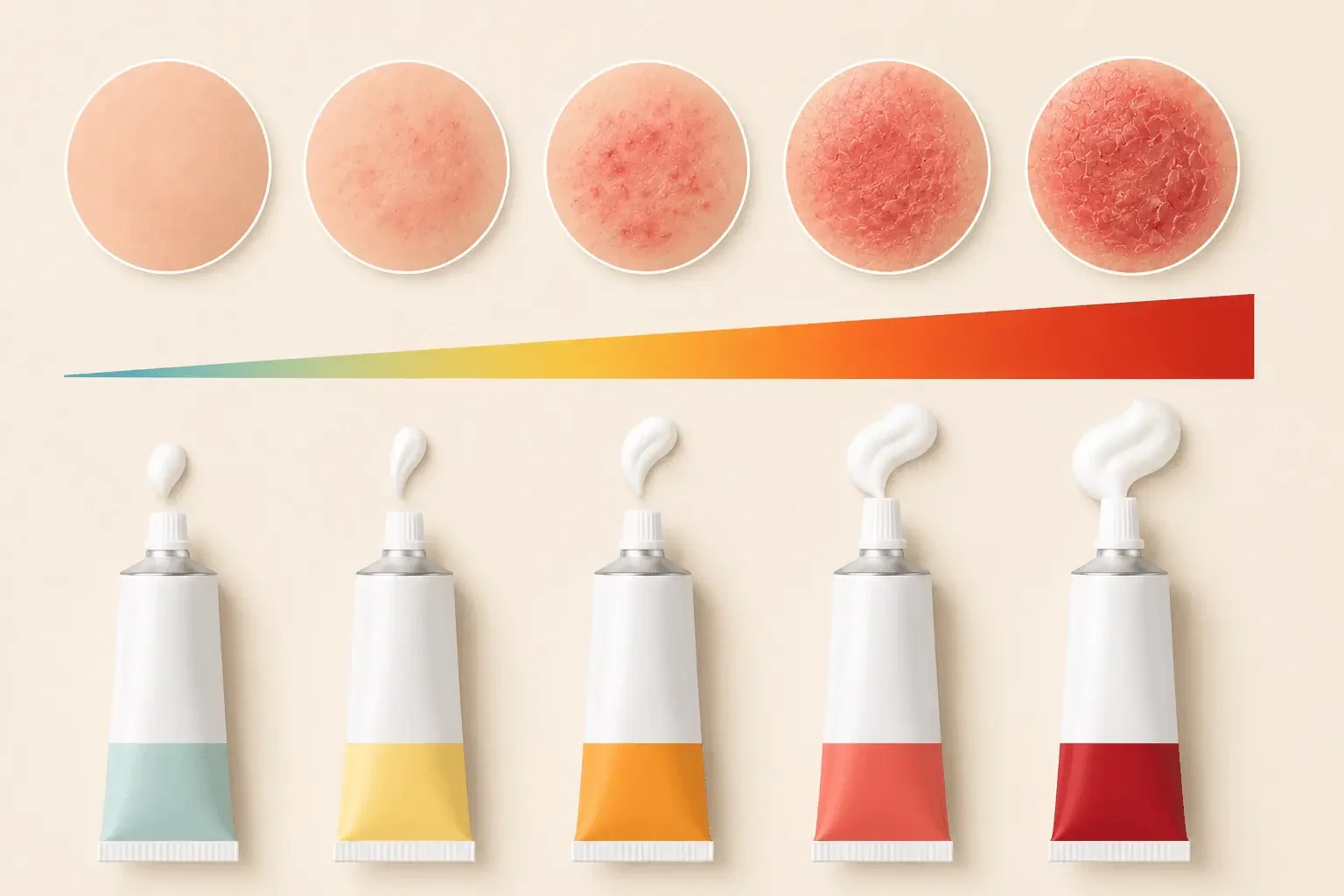
The UK classifies topical steroids in four groups based on clinical potency. Mild steroids (hydrocortisone 1%) sit at the base. Moderately potent steroids (clobetasone butyrate 0.05%, i.e., Eumovate) sit on the second rung. Potent steroids (betamethasone valerate 0.1% i.e., Betnovate, mometasone furoate 0.1% i.e., Elocon) sit on the third. Very potent steroids (clobetasol propionate 0.05%, i.e., Dermovate) sit at the top. Dermovate is approximately 600 times more potent than hydrocortisone 1% in terms of vasoconstrictive activity, which is the standard way of comparing topical steroid potencies. This explains why the percentage on the tube (0.05%) appears low despite being the most powerful option available. The flip side is that side effects accumulate at corresponding speed, which is why duration and quantity limits are strictly enforced at this potency level.
The active ingredient is identical; the base is different. The cream has a water-based emulsion that absorbs quickly, feels lighter, and is better for moist or weeping areas, acute flares, and daytime use. The ointment has a greasy, occlusive base that locks in moisture, increases clobetasol propionate absorption into the skin, and is better for dry, scaly, lichenified, or thickened patches and for overnight use. The ointment is slightly more clinically potent than the cream of the same concentration because the occlusive base drives greater absorption. At this level of steroid potency, that additional absorption difference matters: if Dermovate cream gives adequate control of a condition, there's no reason to add the ointment's extra systemic exposure on top.
Clobetasol propionate is a synthetic fluorinated corticosteroid that works through the same fundamental mechanism as other topical steroids, but with much higher potency at the receptor level. When applied to the skin, it penetrates into cells and binds to glucocorticoid receptors with high affinity. The receptor-steroid complex moves into the cell nucleus and changes gene expression, suppressing the production of inflammatory chemicals (prostaglandins, leukotrienes, cytokines), reducing the recruitment of inflammatory cells into the skin, causing vasoconstriction (which reduces redness and swelling), and settling itch and discomfort. The fluorine atom added to the clobetasol molecule's structure drives the high receptor affinity that explains the dramatic increase in potency compared with non-fluorinated steroids like hydrocortisone.
Apply a thin layer to the affected area once or twice daily, depending on the condition and the prescriber's instructions; once daily is usually sufficient for most applications. The standard quantity limit for adults is 50 g of clobetasol propionate cream or ointment per week. This isn't a rough guideline; it's the maximum above which the risk of systemic side effects including HPA axis suppression becomes clinically significant. In practice, most courses use far less than 50 g per week. A standard 30 g tube applied once daily to a limited body area would typically last considerably longer than a week. Use the fingertip unit approach: one FTU (tip to first crease on an adult index finger) equals about half a gram and covers two adult palm prints. Apply only to the affected patches, not to large areas of surrounding healthy skin.
The strict quantity and duration limits reflect real and documented systemic risks. Clobetasol propionate is absorbed through the skin in meaningful amounts, particularly on thin-skinned areas, under occlusion, and on broken skin. Once in the bloodstream, it suppresses the hypothalamic-pituitary-adrenal (HPA) axis, the system that controls the body's own cortisol production. Significant HPA suppression means the body can't mount an adequate stress response to illness, surgery, or injury, a potentially dangerous state that can persist weeks after stopping the steroid. At more extreme levels of overuse, Dermovate can cause iatrogenic Cushing's syndrome: weight gain, moon face, central fat distribution, skin fragility, striae, hypertension, and blood glucose disturbance. These systemic effects have been documented in multiple clinical case series involving topical clobetasol propionate overuse. Staying within the 50 g per week limit and treating only defined affected areas keeps systemic exposure in a range where these risks are low and the local anti-inflammatory benefit is maintained.
The decision to step up from potent to very potent reflects clinical need: the inflammatory process is severe, resistant to less potent steroids, or involves a condition where tissue changes (scarring, fusing, malignant potential) make rapid and complete treatment essential. The most common situations are palmoplantar psoriasis (psoriasis on the palms and soles, where the thick skin means potent steroids can't penetrate adequately), hypertrophic lichen planus (thick, itchy, treatment-resistant plaques), lichen sclerosus (where inadequate treatment leads to severe scarring and increased cancer risk), severe lichenified eczema that has thickened to the point where potent steroids have stopped working, and certain scalp conditions including psoriasis and alopecia areata. Conditions not in this list generally don't need a very potent steroid, and escalating to Dermovate without working through lower rungs first is not appropriate prescribing.
Yes, and lichen sclerosus is one of the most important indications for Dermovate, particularly in women where the condition affects the vulva. Lichen sclerosus is a chronic inflammatory skin condition that produces white, thin, crinkled, sometimes scarred skin in the anogenital area, with intense itch and soreness, painful sex, and in more severe cases, fusion of the labia and narrowing of the vaginal opening. Without adequate treatment, it causes progressive scarring and carries a small but real increased risk of squamous cell carcinoma. Dermovate is the treatment of choice. The standard protocol involves an intensive initial course (typically daily application for the first 4 weeks, tapering to alternate days for the next 4 weeks, then twice weekly for a further period) followed by long-term maintenance application of two to three times weekly. This can seem counterintuitive given the general principle of short steroid courses, but the data show that regular long-term Dermovate use in lichen sclerosus controls the condition, prevents progression, and significantly reduces the cancer risk. Men with lichen sclerosus affecting the foreskin or glans are treated on the same principle.
Side effects are of the same class as other topical steroids but more pronounced and more rapidly developing because of the higher potency. Local effects include skin thinning (atrophy), telangiectasia, easy bruising and skin tearing, striae (particularly on flexures), hypopigmentation, perioral dermatitis and steroid rosacea if used on the face, and worsening of any underlying fungal or bacterial infection. These local effects can develop faster with Dermovate than with potent steroids and can be harder to reverse. Systemic effects from absorption include HPA axis suppression, and with excessive use, Cushingoid changes. In children, growth suppression is a specific concern. Glaucoma and cataracts can develop with prolonged use near the eyes; Dermovate should not be applied to the eyelids or periorbital skin except under specific expert direction. Topical steroid withdrawal (TSW) is more commonly associated with very potent steroids than with any other class, and the risk is particularly high with prolonged or inappropriate use such as chronic daily use on the face or genitals without a clinical plan.
The face, eyelids, genitals, and skin fold areas (groin, armpits, under the breasts) are the areas most prone to steroid side effects because their skin is thinner and absorbs more. As a general rule, very potent steroids are avoided on these areas except in specific circumstances. The main exceptions are lichen sclerosus of the genitals (where Dermovate is the treatment of choice, as described above), severe scalp psoriasis or alopecia areata (where a scalp-specific clobetasol formulation is used), and occasional specialist-directed use for hypertrophic lichen planus or other resistant conditions in specific locations. For facial eczema, even in severe flares, clinicians prefer potent or moderately potent steroids (Elocon or Eumovate) because the face's thin skin and proximity of the eyes make the risk of atrophy, telangiectasia, perioral dermatitis, steroid rosacea, and glaucoma unacceptably high with a very potent steroid.
Very potent steroids are generally avoided in children and restricted to situations where a paediatric dermatologist has specifically indicated them. Children have thinner skin, a higher surface-area-to-body-weight ratio, and therefore much greater systemic absorption per gram applied than adults. HPA axis suppression, growth retardation, and adrenal crisis are real risks with heavy use of very potent steroids in children. UK prescribing practice restricts very potent steroids to specialist-indicated use in paediatric patients. For eczema in children, potent steroids (Elocon, betamethasone) are generally the maximum potency used. If a child has been prescribed Dermovate by a paediatric dermatologist, follow the specific course instructions precisely rather than applying general advice from this series.
Very potent steroids are used with significant caution in pregnancy. For limited short-term use on small areas when clinically essential, the risk is generally considered acceptable, but the preference is strongly for the mildest effective steroid throughout pregnancy. Clobetasol propionate has been associated with fetal growth restriction in studies involving large amounts of topical steroid, though the absolute risk from small-area short-term use is low. For most inflammatory skin conditions in pregnancy, a potent steroid (Elocon, betamethasone) or moderately potent steroid (Eumovate) is preferred. The exception is lichen sclerosus, where Dermovate may be continued during pregnancy under specialist guidance because the consequences of inadequate treatment are significant. In breastfeeding, limit use to small areas for short periods and don't apply to the breast or nipple area.
Topical steroid withdrawal (TSW), sometimes called red skin syndrome, is a condition in which the body's response to prolonged inappropriate topical steroid use becomes paradoxical: when the steroid is stopped, a rebound inflammatory reaction occurs that can be worse than the original condition, with burning red skin, peeling, oozing, swelling, and intense itch. TSW is most strongly associated with very potent steroids used over long periods, particularly on the face, and many of the clearest clinical cases have involved clobetasol propionate. The risk factors are prolonged continuous use (months to years), use on the face or genitals without a proper clinical plan, self-escalation beyond what was prescribed, and use of very potent steroids for conditions that don't require them. Patients using Dermovate as prescribed (short courses, defined indications, supervised tapering) have a much lower risk. Patients who have used it daily beyond prescribed periods, or who have sourced it without prescription through unregulated online suppliers, face considerably higher risk. If you've been using Dermovate continuously for months and are worried, seek a dermatology review rather than abruptly stopping; supervised tapering reduces the severity of any rebound.
Several features call for clinical review rather than continuing. Any worsening of the treated patch despite Dermovate suggests the diagnosis may be wrong, a superinfection has developed, or the condition needs a different approach. Signs of bacterial infection (golden crusts, increasing pain, spreading redness, fever) need antibiotics. Patches that look like fungal infection rather than psoriasis or eczema will worsen on steroids alone. Any new or worsening symptoms suggesting HPA axis suppression warrant review: unusual fatigue, dizziness on standing, weight loss, and abnormal response to minor illness. Signs of iatrogenic Cushing's syndrome after using larger amounts of Dermovate (weight gain particularly around the face and torso, easy bruising, thin fragile skin, new stretch marks) need urgent medical review. In children, any growth concerns, excessive weight gain, or abnormal response to illness should prompt immediate assessment. For lichen sclerosus specifically, any new skin changes, bleeding, ulceration, or thickening within the treated area should be assessed promptly because of the cancer risk, even in patients receiving treatment. And for any patient who finds their use of Dermovate has escalated beyond what was originally prescribed, or who is struggling to reduce or stop, a dermatology review helps set up a proper tapering plan rather than continuing independently.
Apply sparingly, for short term use ONLY.
Apply Sparingly for short term use ONLY. For external USE ONLY. Spread thinly on the affected skin only.
Helpful articles and clinical guides related to this treatment category.
Free consultation
Online review by a UK prescriber
Next-day delivery
Order before 3pm where offered
Discreet packaging
Plain outer packaging