

We’re here to help.
Our friendly team is available to help Monday to Friday 9:00am – 5:00pm.
If you need urgent assistance, do not use this service. Call 111, or in an emergency call 999.
Our friendly team is available to help Monday to Friday 9:00am – 5:00pm.
If you need urgent assistance, do not use this service. Call 111, or in an emergency call 999.

Fast, discreet delivery
Free delivery over £40
100% UK-based pharmacy
All doctors & pharmacists UK-based
Free advice & support
Clinical support free · Mon–Fri 9am–5pm
Why Patients Choose Access Doctor
10+
Years serving UK patients
—
Verified patient reviews
1,000+
Licensed treatments
24/7
Consultation available
Elocon Cream is a potent topical corticosteroid designed to treat a variety of skin conditions such as dermatitis and eczema. Containing mometasone furoate, it relieves symptoms such as inflammation, itching, and redness. Elocon Cream works by reducing the activity of immune responses that cause skin inflammation. It's simple to use and provides precise targeting of affected areas for maximum effectiveness.
Order before 3pm — same-day dispatch (MON - FRI)
~5 min consultation
Secure & confidential · Reviewed by a UK prescriber
Elocon Cream is a potent topical corticosteroid designed to treat a variety of skin conditions such as dermatitis and eczema. Containing mometasone furoate, it relieves symptoms such as inflammation, itching, and redness. Elocon Cream works by reducing the activity of immune responses that cause skin inflammation. It's simple to use and provides precise targeting of affected areas for maximum effectiveness.
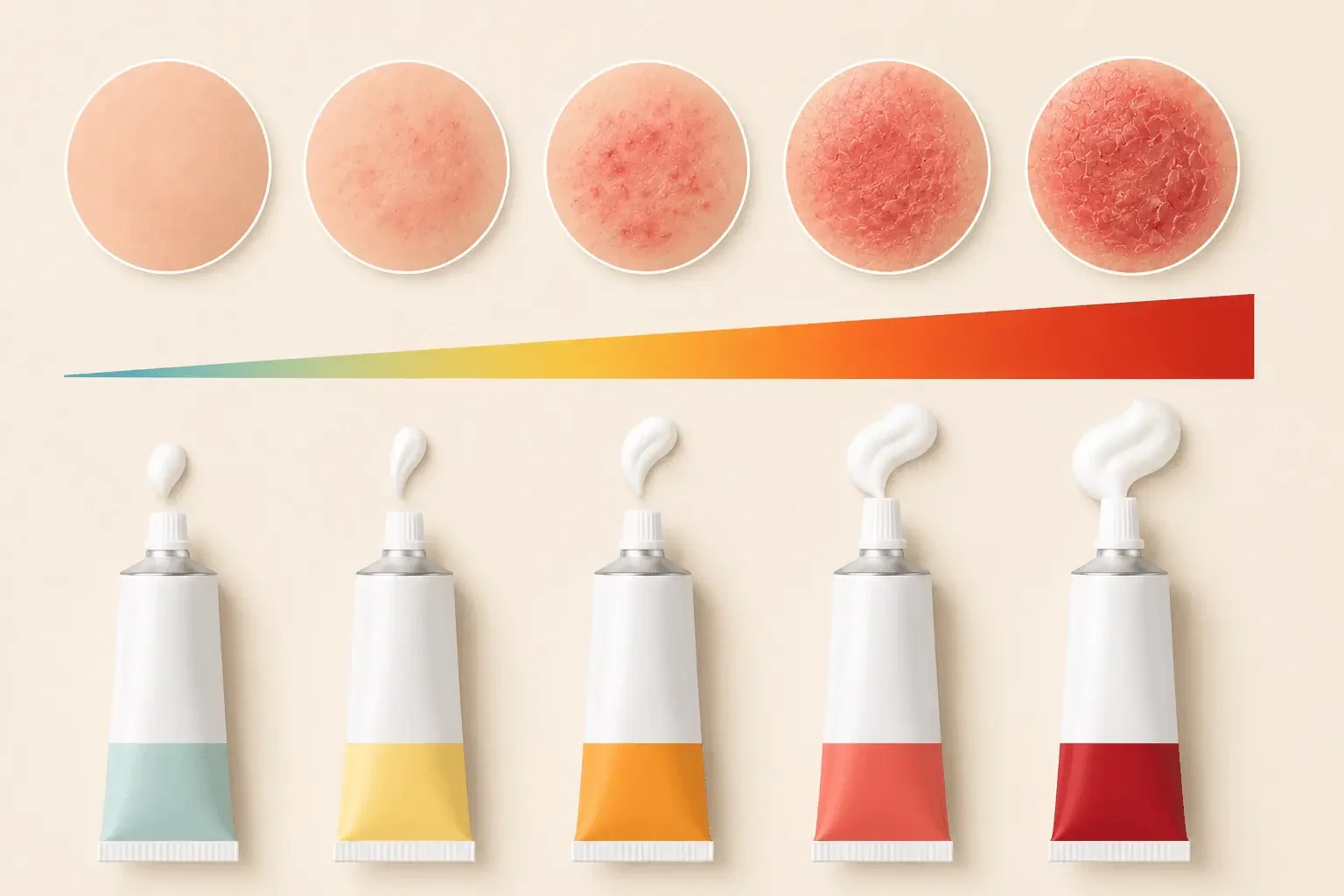
Elocon is a prescription-only topical corticosteroid cream containing mometasone furoate 0.1%, classified as a potent steroid in the UK grading system. This places it in the same potency category as betamethasone valerate 0.1% (Betnovate) and fluticasone propionate 0.05% (Cutivate). It's prescribed for moderate to severe inflammatory skin conditions including eczema and atopic dermatitis, psoriasis on limited body areas, lichen planus, discoid eczema, severe contact dermatitis, and other inflammatory conditions that haven't responded adequately to mild or moderately potent steroids. Elocon is manufactured by Organon and is prescription-only; there's no OTC version at any strength.
Both sit in the potent category of the UK steroid ladder, so their anti-inflammatory effect is broadly equivalent. The differences are practical and safety-related. Elocon is dosed once daily; betamethasone valerate cream is typically dosed twice daily. That single practical difference often means better adherence, since once-daily dosing is easier for most people to sustain consistently. Beyond convenience, mometasone furoate has a distinctive pharmacological property: after it's absorbed through the skin into the bloodstream, it's rapidly broken down into inactive metabolites. This means the systemic exposure from skin absorption is lower than you'd expect from a steroid of this potency, and studies consistently show mometasone suppresses the hypothalamic-pituitary-adrenal (HPA) axis less than betamethasone at equivalent anti-inflammatory doses. Elocon is also licensed for children from age 2, while potent betamethasone products generally carry more restricted paediatric use. In return, betamethasone has a longer track record, more established safety data across diverse populations, and a wider range of formulations and combination products (Fucibet, Diprosalic) than mometasone.
Yes. Elocon is prescription-only at all strengths in the UK. Unlike Eumovate (clobetasone butyrate), which can be purchased from a pharmacy without a prescription for short-term use, there's no OTC version of mometasone furoate available. This reflects its potent classification; all UK potent and very potent topical steroids require a prescription. If you've been using Eumovate or hydrocortisone and feel you need something stronger, the conversation should be with your GP or dermatologist rather than sourcing Elocon from an unverified online supplier.
Mometasone furoate is a synthetic corticosteroid that works by binding to glucocorticoid receptors inside skin cells. The receptor-steroid complex moves into the cell nucleus and changes gene expression, suppressing the production of inflammatory chemicals (prostaglandins, leukotrienes, cytokines), reducing the recruitment of inflammatory cells into the skin, causing vasoconstriction (which reduces redness and swelling), and settling itch and discomfort. Mometasone furoate's pharmacological profile combines high receptor affinity (which drives the strong local effect) with rapid inactivation once it reaches the bloodstream (which limits systemic exposure). This combination is why it's often described as having a favourable benefit-to-risk ratio among potent topical steroids: strong where it's needed, quickly inactivated where it isn't.
Apply a thin layer of Elocon cream to the affected area once daily. The once-daily dosing is one of the medicine's defining features and is backed by clinical trial data showing it achieves equivalent efficacy to twice-daily applications of some other potent steroids. Apply only to the inflamed patches; spreading it over large areas of healthy surrounding skin doesn't improve efficacy and increases total steroid exposure. The fingertip unit (FTU) approach works as a guide: one FTU is the amount squeezed onto an adult's index finger from the tip to the first crease, equals about half a gram, and covers an area equivalent to two adult palm prints. Rub it in gently until it just disappears; a thin layer is the correct amount. Wash your hands after applying unless your hands are the area being treated. If using an emollient at the same time, allow at least 30 minutes between the two products.
The active ingredient is the same in both; the difference is in the base. The cream has a water-based emulsion that absorbs quickly, leaves less residue, and feels lighter on the skin. The ointment has a greasy, occlusive base that locks in moisture and increases steroid absorption through the skin. The cream is generally better for moist or weeping areas, for daytime use under clothing, and for areas where the ointment feels too heavy. The ointment is better for dry, thick, scaly, or lichenified patches, and for overnight use. Elocon also comes as a lotion, which has an alcohol-based formulation specifically for the scalp and other hairy areas where cream or ointment application is awkward. The ointment is slightly more clinically potent than the cream of the same concentration because the occlusive base increases absorption.
The standard course for adults is once daily application for up to 3 to 4 weeks, with the aim of clearing the flare and then stepping down to a milder steroid or stopping. Some patients use it for longer under specialist guidance, but routine continuous use without review carries increasing side effect risk over time. Stopping abruptly after a long course can trigger a rebound flare; many prescribers suggest tapering by reducing application frequency (every other day, then every few days) or stepping down to a moderately potent steroid (Eumovate) before stopping altogether. For chronic conditions with predictable flares, a proactive approach may be used where the steroid is applied two or three times weekly to typical flare areas as maintenance, but this kind of protocol is guided by a dermatologist rather than self-managed.
Under specific medical guidance and for short courses, yes, though with the usual cautions that apply to potent steroids on facial skin. The face has thinner, more absorptive skin than the body, which increases both the potency of effect and the risk of side effects: skin thinning, telangiectasia, perioral dermatitis, and near the eyelids, raised intraocular pressure and cataracts. Elocon's lower systemic absorption profile doesn't eliminate these local risks on the face, though it may reduce systemic ones. Most prescribers use Eumovate or hydrocortisone on the face first, stepping up to Elocon only for facial flares that don't respond, and restricting the course to the minimum duration needed. If you've been given Elocon and are intending to apply it to your face, check that this is what your prescriber intended and follow the duration specified precisely.
Yes, and Elocon is one of the few potent topical steroids licensed for children in the UK. The licence covers children from age 2, which is a notable advantage over several other potent steroids that are only licensed in adults. Children have thinner skin and a higher surface-area-to-body-weight ratio than adults, which increases relative systemic absorption. Even with Elocon's favourable pharmacological profile, the principle of using the smallest effective dose for the shortest effective duration applies with particular force in children. For infants under 2, Elocon is not generally used and paediatric dermatology guidance is usually sought first. If you've been given Elocon for a child and are unsure about the duration or area of application, follow up with the prescriber before starting.
The side effect profile is similar to betamethasone, but with somewhat lower systemic risk because of the rapid inactivation after absorption. Local effects include skin thinning (atrophy), the appearance of small visible blood vessels (telangiectasia), bruising more easily, stretch marks (particularly on flexures), changes in skin pigmentation, increased hair growth in treated areas, perioral dermatitis if used around the mouth, and worsening of any underlying fungal or bacterial infection (steroids mask infection without treating it). Contact allergy to the medicine or its base is uncommon but possible. Systemic effects including HPA axis suppression, Cushingoid features, and growth effects in children are possible with extensive prolonged use or large-area application, but are less common with mometasone than with several other potent steroids at equivalent anti-inflammatory doses. For short courses on defined patches in adults, the side effect profile is generally manageable.
Yes, with prolonged use, particularly on thin-skinned areas. This is a class effect of potent topical steroids and Elocon shares it. Skin thinning develops mostly with continuous daily application over many weeks or months, particularly on the face, eyelids, flexures (groin, armpits), and any area treated under occlusion. A 3 to 4 week course on a lichenified eczema patch on the arms or legs is unlikely to produce significant permanent thinning, and the skin generally recovers when treatment stops. The situation is different for the face, flexures, or skin around the eyes, where shorter courses of potent steroids can produce visible changes. Following the once-daily dosing, the prescribed duration, and the restriction to affected patches only keeps the risk proportionate to the clinical benefit.
Potent topical steroids are used more cautiously in pregnancy than mild ones, and Elocon is no exception. Available data doesn't show a clear teratogenic risk from topical mometasone, and its systemic absorption is lower than many other potent steroids, but safety data in pregnancy are limited overall. Most clinicians prefer mild steroids (hydrocortisone) as the first choice in pregnancy, stepping up to Eumovate for inadequate control, and reserving potent steroids like Elocon for situations where milder options genuinely haven't worked. Short-term use on small areas when clinically needed is generally considered acceptable. In breastfeeding, limited systemic absorption means Elocon is generally compatible for short-term use, but avoid applying to the breast or nipple area where the baby could ingest the cream. A GP, midwife, or dermatologist can guide the decision rather than self-managing.
If a potent steroid is not working, a few explanations are worth considering. Under-treatment is the most common: not applying enough, not covering the whole inflamed area, or stopping the course too early. Infection can complicate eczema and psoriasis, and steroids alone won't resolve a bacterial or fungal superinfection; signs include sudden worsening, golden crusts, weeping, increasing pain, fever, or spreading redness, all of which need prompt review. An incorrect diagnosis occasionally explains poor response: some conditions that look like eczema (fungal infections, psoriasis, contact allergy to an ingredient in a product being used on the skin) respond differently to topical steroids. Several features call for medical review rather than continuing: a rash spreading rapidly or blistering, no improvement after 3 to 4 weeks of treatment, a rash worsening despite the steroid, any rash near the eyes that seems to be getting worse, and any rash with systemic symptoms (fever, joint pain, fatigue, unexplained weight loss). For chronic conditions like eczema and psoriasis requiring ongoing management, a dermatology review opens up additional options: non-steroid topicals (tacrolimus, pimecrolimus), phototherapy, oral immunosuppressants, and biological medicines, all of which may offer better long-term control than repeated courses of potent topical steroids alone.
Helpful articles and clinical guides related to this treatment category.
Free consultation
Online review by a UK prescriber
Next-day delivery
Order before 3pm where offered
Discreet packaging
Plain outer packaging