


How Does Dermovate Work? Clobetasol Propionate Explained
Key fact: Dermovate contains clobetasol propionate 0.05% — the active ingredient that places it in Class 4 (very potent) on the UK topical corticosteroid potency scale. This is the strongest class of topical steroid available in the UK and is a prescription-only medicine (POM). It is reserved for severe or treatment-resistant skin conditions where milder agents have proven inadequate.
50g
Maximum dose per week across all areas
4 wks
Maximum continuous use before specialist review
Class 4
Very potent — the strongest UK topical steroid class
What is Dermovate?
Dermovate is a branded topical corticosteroid manufactured by GlaxoSmithKline (GSK) and available in the UK as a cream, ointment, and scalp application. Its active ingredient, clobetasol propionate 0.05%, is a synthetic glucocorticoid that belongs to the very potent (Class 4) category on the UK’s four-tier potency classification system. No other class of topical steroid is stronger.
The medicine is licensed in the UK for the short-term treatment of severe, resistant inflammatory skin conditions in adults. Because of its potency, Dermovate is a prescription-only medicine (POM) and is subject to tighter prescribing controls than weaker topical steroids such as hydrocortisone (Class 1) or betamethasone valerate 0.1% (Class 3). It should only be prescribed when the clinical picture justifies its use, and always within strict duration and quantity limits.
Clobetasol propionate was first developed in the 1970s and remains a clinically important option for dermatologists and GPs managing conditions that do not respond adequately to moderately potent or potent steroids. Despite its age, it continues to feature in the British National Formulary (BNF) and in NICE clinical knowledge summaries as a first-line option for specific severe dermatoses.
Conditions Dermovate Treats
Dermovate is indicated for severe or resistant inflammatory skin conditions where inflammation has not responded satisfactorily to a less potent topical corticosteroid. The Summary of Product Characteristics (SPC) published on the Electronic Medicines Compendium lists the following main indications:
- Severe atopic eczema (atopic dermatitis) — particularly thick, lichenified, or chronic plaques that have not cleared with potent steroids such as betamethasone valerate
- Discoid (nummular) eczema — coin-shaped patches of intensely inflamed skin
- Plaque psoriasis (excluding widespread plaque psoriasis) — well-defined, scaly plaques on the body or scalp
- Lichen planus — a chronic inflammatory condition producing flat-topped, itchy papules
- Discoid lupus erythematosus — a chronic skin form of lupus characterised by scarring, inflamed plaques
- Other severe, resistant inflammatory dermatoses where the prescribing clinician judges that the benefit of a very potent steroid outweighs the risk
Dermovate is not intended for mild or moderate eczema, nor for inflammatory conditions that respond to weaker preparations. The guiding principle in UK prescribing practice is to use the least potent effective preparation — stepping up to very potent agents only when clinically necessary. Where a moderate or potent steroid has already been tried and found insufficient, Dermovate represents an appropriate and well-evidenced escalation.
Prescribing note: Dermovate is not licensed for use in children under 18 years of age except on specialist advice. Paediatric skin is more permeable, increasing the risk of systemic absorption and HPA axis suppression.
How Dermovate Works: The Mechanism
Clobetasol propionate works through several overlapping anti-inflammatory and vasoconstrictive pathways, all mediated through intracellular glucocorticoid receptors. Understanding this mechanism explains both why Dermovate is effective for severe disease and why misuse carries real risk.
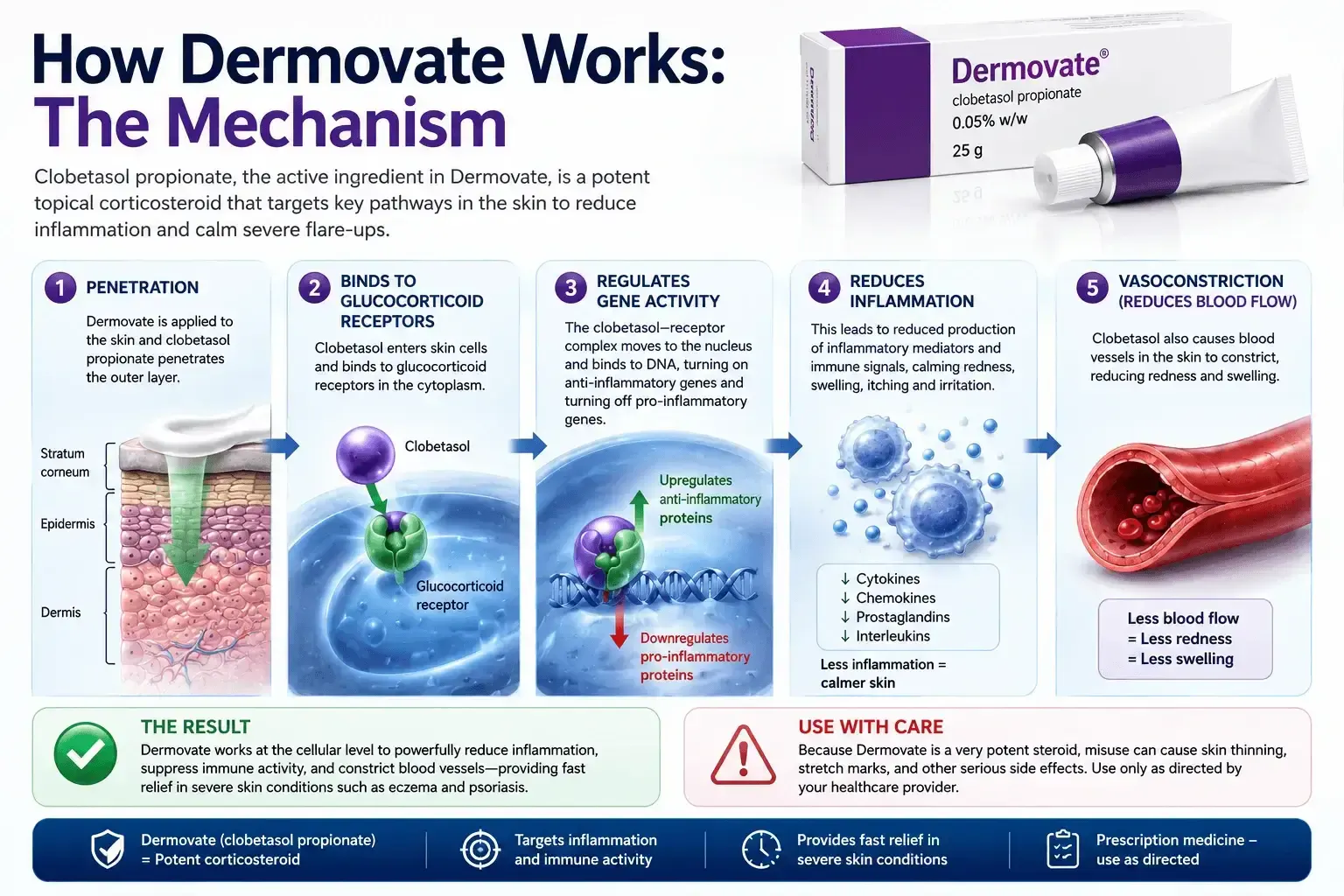
Glucocorticoid Receptor Binding
When Dermovate is applied topically, clobetasol propionate penetrates the stratum corneum (the outermost layer of skin) and enters keratinocytes, fibroblasts, and immune cells within the dermis and epidermis. Once inside the cell, it binds with high affinity to cytoplasmic glucocorticoid receptors (GR-alpha). Clobetasol propionate has a particularly high receptor binding affinity compared to other topical steroids, which is the principal reason for its very potent classification.
After binding, the drug–receptor complex translocates into the cell nucleus, where it acts as a transcription factor — directly modulating the expression of hundreds of genes involved in the inflammatory response.
Suppression of Pro-Inflammatory Cytokines
One of the most clinically significant actions of activated glucocorticoid receptors is the suppression of pro-inflammatory cytokine production. In eczema and other inflammatory dermatoses, the skin is flooded with immune signalling molecules that drive redness, swelling, and itch. Clobetasol propionate suppresses the transcription and release of key mediators including:
- Interleukin-1 (IL-1) — a potent activator of the inflammatory cascade
- Interleukin-2 (IL-2) — a T-cell growth factor that perpetuates the immune response
- Tumour necrosis factor-alpha (TNF-α) — a master pro-inflammatory cytokine that amplifies skin inflammation
- Interleukin-4 and Interleukin-13 — key drivers of the Th2-biased immune response characteristic of atopic eczema
By reducing the production of these signals, Dermovate effectively dampens the runaway immune activity that causes the visible and symptomatic features of inflammatory skin disease.
Inhibition of Prostaglandins and Leukotrienes
Glucocorticoids also upregulate the production of lipocortin-1 (annexin A1), a protein that inhibits the enzyme phospholipase A2. This enzyme is responsible for releasing arachidonic acid from cell membranes — the precursor to both prostaglandins and leukotrienes, two families of lipid mediators that contribute significantly to the heat, pain, and swelling of inflamed skin. By blocking this upstream step in the arachidonic acid cascade, clobetasol propionate reduces the production of these eicosanoids far more comprehensively than non-steroidal anti-inflammatory agents, which typically target only one branch of the cascade.
Vasoconstriction and Reduced Capillary Permeability
Clobetasol propionate also exerts a direct vasoconstrictive effect on dermal blood vessels. This reduces capillary dilatation and permeability, limiting the extravasation of fluid and immune cells into the skin. The visible result is a reduction in the characteristic redness (erythema) and oedema (swelling) of inflamed skin. This vasoconstrictive property is also the basis of the standard assay used to rank topical steroid potency — the McKenzie–Stoughton vasoconstriction assay — discussed in the next section.
Reduced Mast Cell and Dendritic Cell Activity
Beyond cytokine suppression, topical glucocorticoids reduce the number and activity of mast cells and Langerhans cells (dendritic cells) in the epidermis. Mast cells are the main source of histamine, which drives the intense pruritus (itch) characteristic of eczema. By suppressing mast cell activity, Dermovate provides significant itch relief alongside its anti-inflammatory effects, breaking the destructive itch–scratch cycle that worsens the skin barrier in atopic disease.
Anti-inflammatory
Suppresses IL-1, IL-2, TNF-α and other pro-inflammatory cytokines via glucocorticoid receptor activation in skin cells
Vasoconstrictive
Reduces capillary dilatation and permeability, decreasing redness and oedema in inflamed skin
Anti-pruritic
Suppresses mast cell activity and histamine release, providing relief from the intense itch of eczema and psoriasis
Immunosuppressive
Reduces Langerhans cell and T-cell activity within the skin, damping the adaptive immune response driving chronic inflammation
Potency Classification: The UK 4-Class Scale
In the United Kingdom, topical corticosteroids are classified into four potency groups based on their vasoconstrictive activity, as measured by the McKenzie–Stoughton vasoconstriction assay. This standardised test measures the degree of skin blanching produced by a given concentration of steroid under standard conditions — the greater the blanching, the higher the potency. The four classes are:
| UK Class | Potency | Example Active Ingredient | Example Brand | Typical Use |
|---|---|---|---|---|
| Class 1 | Mild | Hydrocortisone 0.1–2.5% | Hydrocortisone cream | Mild eczema; face; children |
| Class 2 | Moderate | Clobetasone butyrate 0.05% | Eumovate (clobetasone) ointment | Moderate eczema; face under supervision |
| Class 3 | Potent | Mometasone furoate 0.1% / Betamethasone valerate 0.1% | Elocon (mometasone) cream / Betnovate | Moderate-to-severe eczema; psoriasis |
| Class 4 | Very potent | Clobetasol propionate 0.05% | Dermovate | Severe/resistant dermatoses only |
In vasoconstriction assays, clobetasol propionate is approximately 600 times more potent than hydrocortisone 1% and approximately 2–3 times more potent than betamethasone valerate 0.1% (Betnovate). That difference in potency is what makes Dermovate effective where Class 3 preparations fail — and also demands careful, time-limited use to minimise the risk of local and systemic side effects.
The UK 4-class system differs from the 7-class US classification system, where clobetasol propionate sits in Class 1 (the strongest). When reading international literature, this distinction matters to avoid confusion about relative potency rankings.
Dermovate Formulations
Dermovate is available in three formulations, each suited to a different clinical context. The choice of formulation depends largely on the nature and location of the skin lesion being treated.
Dermovate Cream
The cream formulation contains clobetasol propionate 0.05% in a water-miscible base. It is particularly suited to moist, weeping, or acutely inflamed eczema where an ointment would feel too greasy or occlude excessive exudate. The cream is also more cosmetically acceptable for daytime use. For detailed guidance on using the cream formulation in eczema, see our article on Dermovate cream for eczema.
Dermovate Ointment
The ointment formulation uses a greasy, water-free base that provides a greater degree of skin hydration and occlusion than the cream. It is the preferred choice for dry, thickened (lichenified), or chronic plaques where enhanced penetration through a thickened stratum corneum is needed. The ointment’s occlusivity also increases the bioavailability of clobetasol propionate in the skin. Full guidance on the ointment’s use appears in our companion article on Dermovate ointment for dry and lichenified skin. For more details on the product itself, including prescribing information, see our Dermovate ointment product page.
Dermovate Scalp Application
The Dermovate scalp application is an alcohol-based lotion formulated to penetrate through hair to the scalp surface. It is used for inflammatory conditions affecting the scalp, including scalp psoriasis and severe seborrhoeic dermatitis that has not responded to milder preparations. The liquid consistency allows easier application without matting the hair.
Need Dermovate? Consult a UK-Registered Doctor Online
Access Doctor is a GPhC-registered online pharmacy (registration no. 9011198). Complete a short consultation and, if appropriate, a UK-licensed doctor can prescribe Dermovate for collection or next-day delivery.
Get Dermovate OnlinePrescription product
Dermovate Cream
Clobetasol propionate 0.05% cream — best for moist and weeping eczema. Available on prescription via Access Doctor.
View Dermovate Cream →Prescription product
Dermovate Ointment
Clobetasol propionate 0.05% ointment — best for dry, lichenified, and chronic plaques. Available on prescription via Access Doctor.
View Dermovate Ointment →Safe Usage Guidelines
Because of its very high potency, Dermovate must be used exactly as directed. The following guidance is drawn from the product SPC, the BNF, NICE CKS, and NHS patient safety information. Deviating from these instructions — even with a genuine intention to speed recovery — substantially increases the risk of local and systemic side effects.
How to Apply Dermovate
1
Apply a thin layer only
A small amount goes a long way. Apply the cream or ointment sparingly and rub gently into the affected skin. Thick application does not improve efficacy but does increase the risk of systemic absorption and local side effects.
2
Apply once or twice daily to affected areas only
The SPC recommends applying Dermovate once or twice daily to the affected areas. Do not apply to surrounding healthy skin. As soon as improvement is noted, frequency should be reduced or treatment discontinued, stepping down to a less potent preparation if further treatment is needed.
3
Observe the 50g (or 50 mL) weekly limit
The total quantity of Dermovate (cream, ointment, or scalp application combined) must not exceed 50g or 50 mL per week. Exceeding this limit increases the risk of adrenal suppression. If you are treating multiple areas simultaneously, the combined quantity across all sites must remain within this ceiling.
4
Limit continuous use to a maximum of 4 weeks
Dermovate is not suitable for long-term continuous use. The SPC advises that treatment should not exceed 4 continuous weeks without reassessment by a specialist. After a course, the skin should be reviewed and a decision made about whether to step down to a less potent steroid or to maintain treatment-free intervals.
5
Avoid sensitive and high-risk body areas
Do not apply Dermovate to the face, eyelids, anogenital region, or skin folds (axillae, groin, under the breasts) unless specifically directed by a specialist. These areas have enhanced absorption and are at much higher risk of both local atrophy and systemic effects. Dermovate is also not approved for use around the eyes, where it risks intraocular pressure elevation and cataract formation.
6
Do not use under occlusion unless directed
Occlusion (covering the treated area with a bandage, clingfilm, or similar dressing) dramatically increases percutaneous absorption of clobetasol propionate and should only be used under direct specialist supervision. Unintentional occlusion in skin folds is one reason these areas require extra caution.
Fingertip unit (FTU) guidance: One fingertip unit (the amount of cream squeezed from a tube from the tip to the first crease of an adult index finger) covers approximately 2% of the body surface area. For severe eczema covering a large area, total weekly quantities can accumulate quickly. Always count your usage across the week and stay within the 50g limit.
Side Effects of Dermovate
Like all very potent corticosteroids, Dermovate carries a range of potential side effects. These divide into local (skin) side effects — which become more likely with prolonged or excessive use — and systemic side effects, which are rare but serious, arising from absorption of clobetasol propionate into the bloodstream.
Local Side Effects
Local adverse effects are a direct consequence of the anti-proliferative action of glucocorticoids on skin cells. With appropriate short-term use within the recommended quantity and duration, the risk is low. Prolonged use significantly increases these risks:
- Skin thinning (cutaneous atrophy): Glucocorticoids inhibit fibroblast proliferation and reduce collagen synthesis, causing the skin to become thinner, more fragile, and prone to easy bruising. This effect is most pronounced on already thin skin and in areas of occlusion.
- Striae distensae (stretch marks): Dermal atrophy can result in permanent stretch marks, particularly when Dermovate is used in skin folds or over joints. These are largely irreversible.
- Telangiectasia: Prolonged vasoconstriction followed by rebound dilatation, combined with dermal thinning, can cause permanent visible dilatation of superficial blood vessels.
- Perioral dermatitis: A rosacea-like papulopustular rash around the mouth and nose, strongly associated with facial application of potent steroids.
- Hypertrichosis: Localised increased hair growth at the application site has been reported, particularly with prolonged use.
- Hypopigmentation: Temporary or permanent reduction in skin pigmentation can occur, particularly in patients with darker skin tones.
- Contact sensitisation: Although rare, patients can develop a contact allergy to clobetasol propionate itself or to excipients in the formulation. This presents as a worsening rash despite continued treatment.
- Rebound flare: Abrupt withdrawal after prolonged use can cause a rebound worsening of the underlying condition. Tapering or stepping down to a less potent preparation is preferred over sudden discontinuation.
Systemic Side Effects
Systemic effects arise when sufficient clobetasol propionate is absorbed through the skin to exert effects on organs distant from the application site. While rare with appropriate use, the risk increases substantially with large quantities, occlusion, long duration, or use on thin or broken skin:
- Hypothalamic–pituitary–adrenal (HPA) axis suppression: Exogenous glucocorticoids signal the hypothalamus and pituitary to reduce production of corticotropin-releasing hormone (CRH) and adrenocorticotropic hormone (ACTH), which in turn reduces the adrenal glands’ own cortisol output. With sustained suppression, the adrenal glands may be unable to mount an adequate stress response, creating a state of secondary adrenal insufficiency.
- Adrenal suppression and Addisonian crisis: Severe or prolonged HPA suppression can, in exceptional cases, cause an Addisonian-type crisis — a rare but potentially life-threatening emergency characterised by severe hypotension, hypoglycaemia, and circulatory collapse. This is most likely to occur if the medicine is used far beyond recommended quantities and durations.
- Cushingoid features: With very excessive use, patients may develop signs resembling Cushing’s syndrome — including central weight gain, moon face, and buffalo hump.
- Growth suppression in children: Because children have a higher skin surface area-to-body-weight ratio, they are at considerably greater risk of systemic absorption. Dermovate is not licensed for use in children under 18 years of age except under specialist supervision.
- Raised intraocular pressure / glaucoma and posterior subcapsular cataracts: These are rare but recognised risks if the product is applied near the eyes or if there is significant systemic absorption.
Important: If you have been using Dermovate regularly for more than 4 weeks, do not stop suddenly without speaking to your doctor. Abrupt withdrawal — especially after prolonged or high-dose use — can cause a rebound flare of the skin condition and, in cases of adrenal suppression, a medical emergency. Your doctor may recommend a step-down plan using a less potent preparation.
Who Should Not Use Dermovate
There are several absolute and relative contraindications to the use of Dermovate. These are set out in the product SPC and align with general BNF and NICE guidance on the appropriate use of very potent topical corticosteroids.
Dermovate must not be used in the following situations:
- Children under 18 years without specialist supervision — due to the greatly increased risk of systemic absorption and adrenal suppression in paediatric patients
- Skin infections (bacterial, fungal, or viral) — including impetigo, tinea (ringworm), candidiasis, herpes simplex, chickenpox, and molluscum contagiosum. Topical corticosteroids suppress the immune response in the skin, potentially allowing infections to spread unchecked. If infection is present, it must be treated first; combined steroid/antimicrobial preparations may be appropriate in some cases.
- Acne vulgaris — topical steroids worsen acne and can trigger steroid acne (acneiform eruption)
- Rosacea — potent topical steroids cause and perpetuate rosacea; their use is contraindicated
- Perioral dermatitis — topical steroids are a primary cause of this condition; their use will worsen it
- Known allergy to clobetasol propionate or any excipient in the Dermovate formulation
- Pregnancy and breastfeeding — Dermovate should be used with great caution during pregnancy and is not recommended for use on the breast when breastfeeding, due to the risk of neonatal exposure. Use should be limited to the minimum effective amount for the shortest possible time under medical supervision.
Dermovate vs Betnovate: When to Step Up or Step Down
One of the most common clinical questions about Dermovate concerns its relationship with Betnovate (betamethasone valerate 0.1%), the Class 3 potent topical steroid that is the most widely prescribed topical steroid for moderate-to-severe eczema and psoriasis in the UK. Understanding when to use each preparation — and crucially, when to step up from Betnovate to Dermovate or step down in the reverse direction — is central to safe steroid use.
| Feature | Betnovate (Betamethasone valerate 0.1%) | Dermovate (Clobetasol propionate 0.05%) |
|---|---|---|
| UK potency class | Class 3 — Potent | Class 4 — Very Potent |
| Relative potency vs hydrocortisone | ~300× | ~600× |
| Typical indication | Moderate-to-severe eczema, psoriasis, contact dermatitis | Severe or resistant eczema, plaque psoriasis, lichen planus, DLE |
| When to prescribe | First-line for severe eczema; when mild/moderate steroids have failed | When Betnovate or equivalent has failed; specialist-level disease |
| Maximum duration | Up to 4 weeks per course (body); 1–2 weeks (face under supervision) | Maximum 4 weeks; specialist review required before extending |
| Risk profile | Moderate — risk of atrophy, striae with prolonged use | Higher — greater risk of HPA suppression; systemic effects at lower doses |
| Prescription status | POM | POM |
When to use Betnovate: Betnovate is the appropriate first choice when mild or moderate eczema has not responded to hydrocortisone or clobetasone butyrate. It is suitable for most body sites (excluding the face, genitals, and skin folds without supervision) and is widely used for moderate-to-severe atopic eczema flares in adults.
When to step up to Dermovate: Escalation to Dermovate is clinically justified when a full, adequate course of a potent preparation like Betnovate has been tried and has not produced adequate control. In practice, this means an area of skin that remains significantly inflamed, thickened, or symptomatic after two to four weeks of correctly applied Betnovate. The decision to prescribe Dermovate should be made or endorsed by a GP or dermatologist who has reviewed the clinical picture.
Stepping down after a Dermovate course: After achieving control with Dermovate, it is important not to continue the very potent preparation indefinitely. A step-down strategy — transitioning back to a Class 3 preparation like Betnovate or to an emollient-only regimen once the acute flare is controlled — reduces the risk of the skin-thinning and systemic effects associated with long-term very potent steroid use. For more information, see our guide on Betnovate for eczema — the potent Class 3 option.
Getting Dermovate Online via Access Doctor
Dermovate is a prescription-only medicine and cannot be legally purchased in the UK without a valid prescription issued by a registered prescriber. Access Doctor is a GPhC-registered online pharmacy (registration number 9011198) that operates a clinically governed prescribing service staffed by UK-registered doctors.
You complete a structured online consultation covering your skin condition’s history — previous treatments tried, current medications, and any contraindications. A UK-licensed doctor reviews your responses and, if clinically appropriate, issues a prescription. Your medication is then dispensed from our GPhC-registered pharmacy and dispatched to your address via tracked delivery, or you can request electronic transfer to your local pharmacy.
Our clinicians follow NICE CKS and BNF guidance in prescribing decisions. Dermovate will only be prescribed where the clinical evidence supports its use — that is, where a severe or resistant inflammatory dermatosis has failed to respond adequately to less potent preparations. We do not issue prescriptions for very potent steroids as a first-line treatment where a milder preparation would be appropriate.
For scalp psoriasis specifically, some patients may benefit from alternating between a very potent steroid lotion and a keratolytic shampoo such as Etrivex shampoo to descale and improve steroid penetration. This combination approach is best discussed with your prescriber.
Start Your Online Consultation Today
Complete a short medical questionnaire — reviewed by a UK GP. If Dermovate is clinically appropriate, your prescription will be issued the same day. GPhC-registered pharmacy. Discreet delivery.
Get Dermovate OnlineFrequently Asked Questions
What is Dermovate used for?
Dermovate is used to treat severe or resistant inflammatory skin conditions in adults, including severe atopic eczema, discoid eczema, plaque psoriasis, lichen planus, and discoid lupus erythematosus. It is indicated for cases where milder topical corticosteroids — such as hydrocortisone or betamethasone valerate (Betnovate) — have failed to produce adequate control. Because of its very high potency, Dermovate is always a prescription-only medicine and should be used for the shortest effective duration.
How strong is Dermovate compared to other steroids?
Dermovate (clobetasol propionate 0.05%) is classified as Class 4 — very potent on the UK four-tier topical corticosteroid potency scale. This is the highest potency class available. In vasoconstriction assays, clobetasol propionate is approximately 600 times more potent than hydrocortisone 1% (Class 1) and approximately 2–3 times more potent than betamethasone valerate 0.1% (Betnovate, Class 3). No topical steroid currently licensed in the UK is stronger.
How often should I apply Dermovate?
Dermovate should be applied once or twice daily to the affected skin only. Always apply a thin layer — a small amount is sufficient. Do not apply more frequently than directed, as this does not improve the clinical outcome but does increase the risk of local skin thinning and systemic absorption. Once improvement is evident, the frequency of application should be reduced and eventually stopped, with a step-down to a less potent preparation if ongoing treatment is needed.
How long can I use Dermovate?
Dermovate should not be used continuously for more than 4 weeks without specialist review. This limit applies to any single body area. After a course of Dermovate, the skin should be assessed and a plan made for ongoing management — which may involve stepping down to a less potent steroid or transitioning to a non-steroidal preparation. Long-term continuous use of very potent topical steroids carries significant risks of skin atrophy and adrenal suppression.
What are the side effects of Dermovate?
Local side effects include skin thinning (cutaneous atrophy), stretch marks (striae), telangiectasia (visible blood vessels), hypertrichosis (localised hair growth), and hypopigmentation. With excessive or prolonged use, systemic effects can occur, including hypothalamic–pituitary–adrenal (HPA) axis suppression, adrenal insufficiency, and in extreme cases Cushingoid features. The risk of systemic effects is higher in children, when the medicine is used under occlusion, or when quantities exceed the recommended 50g per week. Contact sensitisation to the active ingredient or excipients is rare but possible.
Who should not use Dermovate?
Dermovate should not be used by children under 18 without specialist supervision, by anyone with a skin infection (bacterial, fungal, or viral), or by those with acne, rosacea, or perioral dermatitis. It is also contraindicated in anyone with a known allergy to clobetasol propionate or any other ingredient in the preparation. Caution is required in pregnancy and breastfeeding, and the face, eyelids, genitals, and skin folds should be avoided unless specifically directed by a specialist.
Can I use Dermovate on my face?
Generally, no. Dermovate should not be applied to the face, including the eyelids, without specific instruction from a dermatologist or specialist. Facial skin is significantly thinner and more vascular than skin on the body, leading to much greater absorption of clobetasol propionate. Use on the face risks permanent skin atrophy, telangiectasia, perioral dermatitis, and — near the eyes — elevated intraocular pressure and cataract formation. Facial inflammatory conditions requiring a topical steroid should normally be managed with mild (Class 1) preparations such as hydrocortisone under medical supervision.
What is the maximum amount of Dermovate I can use per week?
The maximum recommended quantity of Dermovate across all treatment areas combined is 50g (cream or ointment) or 50 mL (scalp application) per week. Exceeding this limit substantially increases the risk of systemic absorption and adrenal suppression. If you find yourself requiring more than 50g per week to manage your skin condition, you should contact your prescribing doctor promptly, as this may indicate that Dermovate alone is not providing adequate control and that a different treatment strategy is needed.
References & Sources
- Electronic Medicines Compendium (EMC). Dermovate Cream 0.05% Summary of Product Characteristics. https://www.medicines.org.uk/emc/product/1144
- Electronic Medicines Compendium (EMC). Dermovate Ointment 0.05% Summary of Product Characteristics. https://www.medicines.org.uk/emc/product/1145
- NICE. Eczema — atopic (CKS). https://cks.nice.org.uk/topics/eczema-atopic/
- British National Formulary (BNF). Clobetasol propionate. https://bnf.nice.org.uk/drugs/clobetasol-propionate/
- Oakley A. DermNet NZ. Clobetasol propionate. https://dermnetnz.org/topics/clobetasol-propionate
- NHS. Topical corticosteroids. https://www.nhs.uk/conditions/topical-corticosteroids/
Medical disclaimer: This article is for informational purposes only and does not constitute medical advice. Dermovate is a prescription-only medicine (POM) and must only be used under the supervision of a registered healthcare professional. The information provided is based on current NICE CKS, BNF, and MHRA guidance as of May 2026 and is intended for adult patients in the United Kingdom. Individual treatment decisions should always be made in consultation with your doctor or pharmacist, taking into account your full medical history and circumstances. If you experience a severe skin reaction, signs of infection, or symptoms that may indicate adrenal suppression (extreme fatigue, dizziness, weakness), seek medical advice promptly.