
Acid Reflux and GORD
2-minute consultation reviewed by a UK clinician
We check your answers and recommend a suitable option
Plain packaging to your door, fast and confidential
Acid Reflux & GORD: Symptoms, Causes and Treatment
A clinical overview of acid reflux and gastro-oesophageal reflux disease (GORD) — symptoms, causes, red flags, and UK treatment options including PPIs.
Chest pain warning: Severe heartburn can feel like a heart attack — and the reverse is also true. If you have chest pain or tightness and are not sure why, call 999 immediately. Do not drive yourself to hospital.
Key fact: Acid reflux affects around 1 in 5 UK adults regularly. Heartburn is the symptom; acid reflux is the mechanism; GORD is the diagnosis when reflux is frequent or severe. Most people respond well to lifestyle measures and PPI treatment.
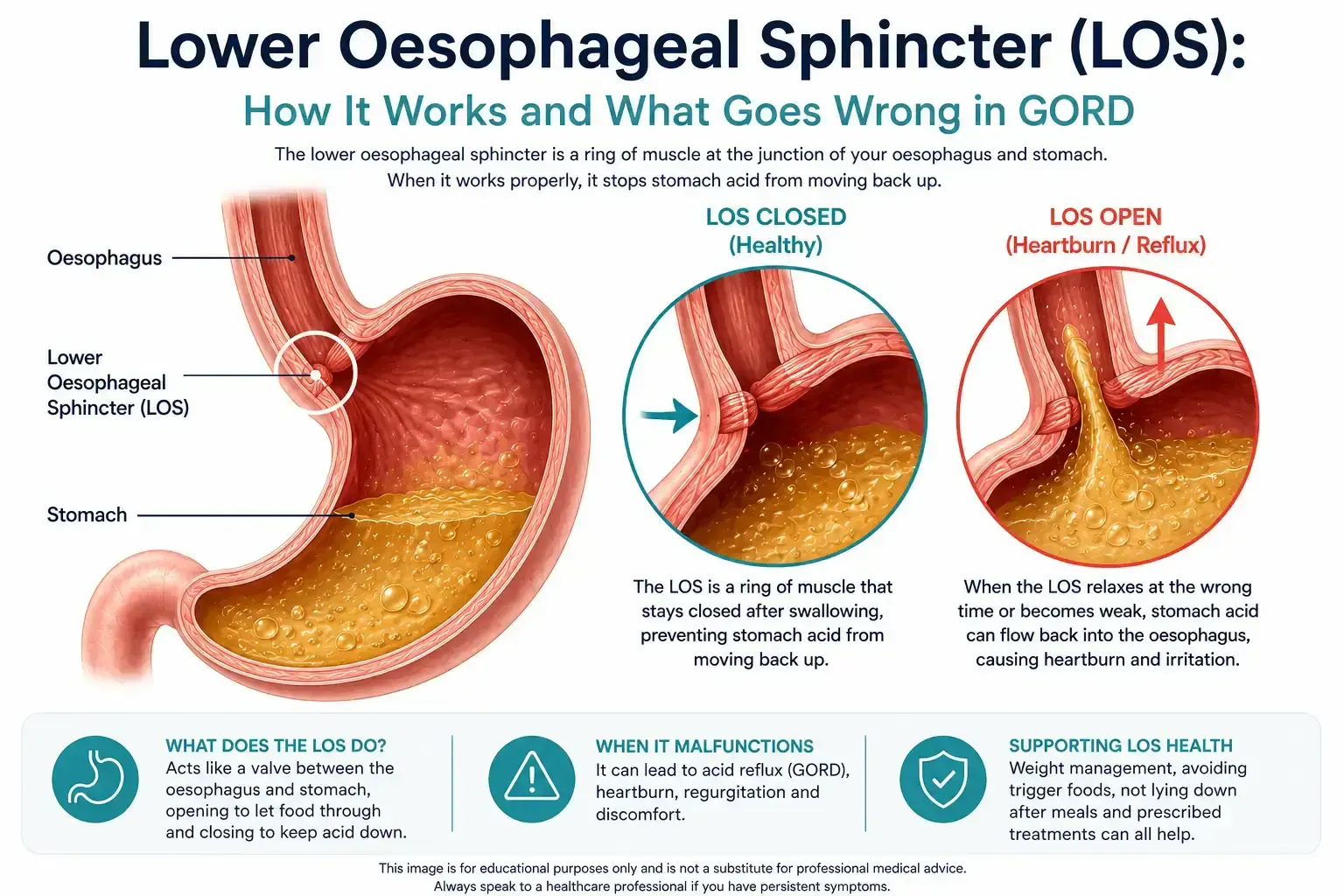
What acid reflux is
Acid reflux is the backflow of stomach contents into the oesophagus (food pipe). The stomach is lined to handle its own acidic contents; the oesophagus is not. When acid escapes upwards it irritates and inflames the lining, producing the burning sensation we call heartburn. A muscular valve — the lower oesophageal sphincter (LOS) — sits between the two and normally stays closed except during swallowing. In acid reflux it relaxes when it shouldn’t or fails to close tightly, and acid (sometimes bile) escapes. Occasional reflux happens to almost everyone and is not a disease; it becomes a clinical problem when it is frequent, prolonged, or causes damage.
Symptoms
The classic symptom is heartburn — burning behind the breastbone, often rising towards the throat. Others include:
- Regurgitation — a sour or acidic taste at the back of the mouth or throat
- Worsening after meals, especially large, fatty or late-evening ones
- Worsening when lying down or bending forward
- Relief from antacids such as Gaviscon or Rennie
- Bloating, belching or hiccups; nausea after eating
- Persistent dry cough, hoarseness or a sore throat in the mornings (silent reflux)
- Bad breath and disturbed sleep from waking with heartburn
Causes and risk factors
Acid reflux usually results from a combination of factors that weaken the LOS or raise the pressure pushing acid upwards:
Hiatus hernia
The most common structural cause — part of the stomach pushes up through the diaphragm, weakening the valve. See our hiatus hernia guide.
Pregnancy
Hormones relax the LOS and the growing uterus presses upwards — affecting up to 80% of pregnancies. See heartburn in pregnancy.
Weight & diet
Abdominal weight raises pressure; fatty, spicy, chocolate, citrus, tomato, mint, coffee, fizzy drinks and alcohol trigger symptoms. See foods to avoid.
Smoking, late eating & stress
Nicotine weakens the LOS; late meals and lying flat worsen reflux; stress lowers the symptom threshold. See everyday triggers.
Certain medicines — NSAIDs (ibuprofen, naproxen), calcium channel blockers, nitrates, bisphosphonates and some antibiotics — can also worsen reflux. Speak to your prescriber before stopping any medication.
When acid reflux becomes GORD
Gastro-oesophageal reflux disease (GORD) is the diagnosis when reflux happens regularly (typically more than twice a week), is severe, or causes complications. It affects around 10–20% of UK adults. Most respond well to treatment, but untreated GORD can cause oesophagitis, oesophageal stricture, Barrett’s oesophagus (a lining change that slightly raises oesophageal cancer risk), and airway or dental effects. For a deeper look, see our GORD diagnosis and treatment guide and our Barrett’s oesophagus guide.
Red flags — when to seek urgent care
Call 999 immediately for chest pain or tightness that is severe, sudden or unexplained; spreads to your jaw, neck, arm or back; comes with breathlessness, sweating or nausea; or does not respond to antacids and a few minutes of rest. Severe heartburn can feel exactly like a heart attack — when in doubt, treat it as cardiac. See heart attack vs heartburn.
Same-day medical assessment for difficulty swallowing or food sticking, unexplained weight loss, persistent vomiting, vomiting blood or coffee-ground material, black or tarry stools, or new dyspepsia in anyone over 55. NICE CG184 recommends urgent endoscopy for these.
Treatment overview
NICE CG184 sets out a stepped approach combining lifestyle measures (for everyone), acid suppression (when needed) and investigation (for red flags or treatment failure):
Lifestyle measures
First-line for everyone: smaller meals, weight loss, raising the head of the bed, avoiding triggers, stopping smoking.
Antacids & alginates
For occasional symptoms — OTC Gaviscon (alginate) and Rennie (antacid) work within minutes. See omeprazole vs Gaviscon.
PPIs (or H2 blockers)
For frequent or severe symptoms — omeprazole, lansoprazole or esomeprazole, typically a 4–8 week course. Famotidine is an H2-blocker alternative.
Investigation
Endoscopy or H. pylori testing for red flags, treatment failure or atypical presentations. See peptic ulcers & H. pylori.
Lifestyle measures
Lifestyle changes are first-line and remain important alongside any medication. The best-evidenced measures:
- Lose weight if overweight — the single most effective intervention
- Don’t eat within 3 hours of bed — gives the stomach time to empty
- Raise the head of the bed 10–20cm with blocks under the legs (not just extra pillows)
- Eat smaller, more frequent meals rather than large ones
- Identify and avoid your triggers — coffee, alcohol, fatty/spicy food, chocolate, mint, citrus, tomato, fizzy drinks
- Stop smoking and limit alcohol, especially in the evening
- Avoid tight clothing around the waist, and review reflux-worsening medicines with your prescriber
Proton pump inhibitors (PPIs)
PPIs are the most effective acid-suppressing medicines available, blocking the “proton pump” enzyme that produces stomach acid. Five are licensed in the UK; NICE considers them clinically equivalent at equivalent doses.
| PPI | Typical dose | Notes |
|---|---|---|
| Omeprazole | 20mg once daily (10–40mg) | Most prescribed UK PPI; OTC at 20mg for short-term use |
| Lansoprazole | 30mg once daily (15–30mg) | Orodispersible option (Zoton FasTab); the usual alternative to omeprazole |
| Esomeprazole | 20mg once daily (20–40mg) | S-isomer of omeprazole; used for severe or resistant cases |
| Pantoprazole | 40mg once daily | Fewer drug interactions; useful with clopidogrel |
| Rabeprazole | 20mg once daily | Less affected by CYP2C19 variation; faster onset |
How to take a PPI: 30–60 minutes before the first meal of the day, with water — the medicine binds to active pumps, which food switches on. How long: NICE recommends an initial 4–8 week course for uncomplicated GORD, then review; many people step down, switch to on-demand use, or stop, while some need long-term treatment. Learn more in What Is a Proton Pump Inhibitor? and the complete PPI guide. OTC PPIs are for a maximum of 14 days without advice.
Which PPI should you take? NICE treats the PPIs as clinically equivalent at equivalent doses, so the choice usually comes down to dose, tolerability, cost and interactions. Omeprazole is the UK default and the most widely prescribed; lansoprazole is the usual alternative and is available as an orodispersible tablet for anyone who struggles with capsules; esomeprazole is often chosen when reflux is severe or has not settled on another PPI. We compare all three head to head in Omeprazole vs Lansoprazole vs Esomeprazole, troubleshoot side effects and switching, and explain how to stop a PPI safely without rebound acid.
H2 blockers (famotidine)
H2 blockers are the main alternative to PPIs. Famotidine — which replaced ranitidine (Zantac) after its 2020 withdrawal — reduces stomach acid within about an hour, making it well suited to on-demand relief, night-time acid, and bridging off a PPI. It is less potent than omeprazole or the other PPIs but faster to act, and a useful option for anyone who cannot tolerate a PPI or is waiting to see whether lansoprazole or esomeprazole suits them better. Full detail in our famotidine and H2 blockers guide.
Which acid reflux medicine? A quick comparison
The four main types of acid reflux medicine work in different ways — the right one depends on how often symptoms strike and how severe they are:
| Medicine | How it works | Starts working | Lasts | Best for |
|---|---|---|---|---|
| Antacids (Rennie, Tums) | Neutralise acid already present | Minutes | ~1–2 hours | Occasional, mild heartburn |
| Alginates (Gaviscon) | Form a raft that blocks reflux | Minutes | Up to ~4 hours | Post-meal and night-time reflux |
| H2 blockers (famotidine) | Reduce acid production via histamine | ~1 hour | 10–12 hours | On-demand and night-time acid; PPI intolerance |
| PPIs (omeprazole, lansoprazole, esomeprazole) | Switch off the acid pumps at source | 2–3 days to full effect | ~24 hours per dose | Frequent reflux (2+/week), GORD, oesophagitis, ulcers |
In short: antacids and alginates are rescue treatment for occasional symptoms; PPIs are prevention for frequent or severe reflux; and H2 blockers sit in between. See Omeprazole vs Gaviscon and Famotidine & H2 Blockers for the detail.
Where to go next
Most reflux settles with lifestyle measures and pharmacy treatment. If symptoms happen more than twice a week, are not settling after two weeks of an over-the-counter remedy, or you have any of the red flags above, it should be assessed — by your GP, or through Access Doctor. Our acid reflux page explains how that assessment works.
Acid reflux at Access Doctor →Acid reflux medicines at Access Doctor
These are the acid reflux medicines Access Doctor supplies. Each one has a full guide explaining how it works, how to take it and what to watch for: omeprazole, lansoprazole, esomeprazole and famotidine. Whether any of them is right for you is a clinical decision — made with your GP, or at assessment.
Omeprazole
The UK’s most prescribed PPI — once-daily, 24-hour acid suppression.
About this medicine →Lansoprazole
A comparable PPI, including an orodispersible option.
About this medicine →Esomeprazole
A stronger option for severe or persistent reflux symptoms.
About this medicine →Famotidine
The H2 blocker — fast, on-demand relief and night-time acid control.
About this medicine →All acid reflux guides
Our full library of 22 in-depth guides across the whole acid reflux, GORD and PPI topic — including dedicated guides to omeprazole, lansoprazole, esomeprazole and famotidine:
Frequently Asked Questions
What is acid reflux?
Acid reflux happens when stomach acid escapes upwards into the oesophagus (food pipe). The stomach is built to handle its own acid; the oesophagus is not, so the result is heartburn — a burning sensation behind the breastbone, often with a sour taste. Occasional reflux is normal; reflux that happens more than twice a week, or causes complications, is called gastro-oesophageal reflux disease (GORD).
What is the difference between heartburn, acid reflux and GORD?
Heartburn is the symptom — the burning chest sensation. Acid reflux is the mechanism — stomach acid escaping into the oesophagus. GORD (gastro-oesophageal reflux disease) is the clinical diagnosis given when reflux happens regularly (typically more than twice a week), is severe, or causes complications such as oesophagitis, stricture or Barrett's oesophagus.
When should I see a doctor about acid reflux?
See a clinician if heartburn happens more than twice a week, is not controlled by over-the-counter antacids after two weeks, or affects your sleep or quality of life. Seek urgent assessment for any red flag: difficulty swallowing, unexplained weight loss, persistent vomiting, vomiting blood, black or tarry stools, or new symptoms in anyone over 55. Call 999 for any chest pain you are unsure about — heart attack and severe heartburn can feel similar.
How is acid reflux treated in the UK?
Treatment follows a stepped approach. Lifestyle measures come first — smaller meals, weight loss if relevant, raising the head of the bed, avoiding trigger foods and late meals, stopping smoking. Antacids and alginates such as Gaviscon help mild, occasional reflux. For frequent or severe symptoms, NICE recommends a proton pump inhibitor (omeprazole, lansoprazole or esomeprazole), typically for 4 to 8 weeks then reviewed. H2 blockers such as famotidine are an alternative, and investigation is offered for red flags or treatment failure.
Are PPIs safe to take long-term?
PPIs are among the most studied medicines in modern medicine and are considered safe for the vast majority of people who need them. Long-term use carries small increased risks of vitamin B12 deficiency, low magnesium, reduced calcium absorption and certain gut infections. For most people with confirmed GORD or peptic ulcer disease the benefits outweigh these risks, and anyone on long-term treatment should be reviewed at least annually to consider reducing or stopping the dose.
Can I just buy PPIs over the counter?
Omeprazole 20mg, esomeprazole 20mg and lansoprazole 15mg are available over the counter in the UK for short-term use — a maximum of 14 days without medical advice. For longer treatment, higher doses, or a diagnosed condition such as a peptic ulcer, a prescription is needed, either from your GP or an online prescriber such as Access Doctor.
References
- National Institute for Health and Care Excellence. Gastro-oesophageal reflux disease and dyspepsia in adults: investigation and management (CG184). Updated 2023. nice.org.uk
- National Institute for Health and Care Excellence. Clinical Knowledge Summary: GORD. cks.nice.org.uk
- National Institute for Health and Care Excellence. Clinical Knowledge Summary: Dyspepsia — unidentified cause. cks.nice.org.uk
- NHS. Heartburn and acid reflux. 2023. nhs.uk
- British Society of Gastroenterology. Guidelines on the management of GORD and Barrett’s oesophagus. bsg.org.uk
Medical disclaimer: This article is for informational purposes only and does not constitute medical advice. Always consult a qualified healthcare professional for diagnosis and treatment. In a medical emergency, call 999.