


BV Symptoms: Discharge, Smell and What to Look For
What BV discharge actually looks like, why the smell comes and goes, and the symptoms that point somewhere else.
Part of the Bacterial Vaginosis condition guide.
Key fact: BV is a discharge and odour condition. If itching, soreness and redness dominate, you are probably not dealing with BV.
Get BV Treatment Online
Access Doctor provides BV treatment following a GPhC-regulated online consultation with our pharmacist independent prescribers.
Start a BV consultation →The symptoms of BV
Bacterial vaginosis produces a short and fairly consistent list of symptoms. Most women who have it experience some combination of the following, and often only the first two.
- A change in vaginal discharge — thinner, more watery, and usually greater in volume than normal for you.
- A fishy or musty odour — the most characteristic feature, and often the symptom that prompts people to seek help.
- A change in discharge colour — typically grey or off-white rather than the usual clear or creamy white.
- Symptoms that fluctuate — noticeably worse after unprotected sex and around a period, better in between.
- Occasionally, mild discomfort — some women report mild irritation, but this is not typical and should not be prominent.
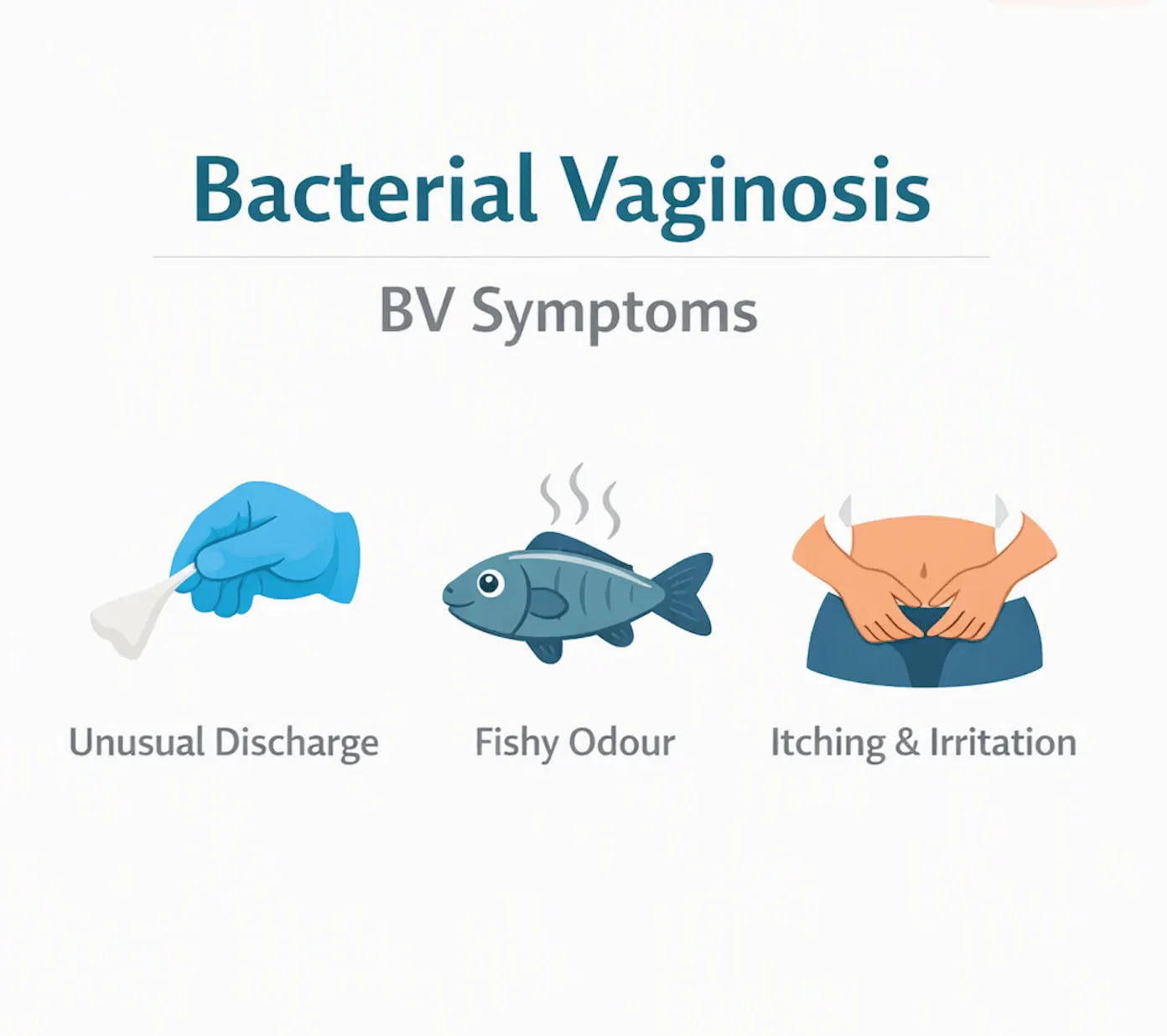
What is striking about that list is how much is missing from it. There is no pain, no fever, no bleeding and no significant itching. BV is, for most women, a symptomatically quiet condition apart from the discharge and the smell — which is precisely why the smell is so often the thing that brings people in.
1 in 3
Roughly the proportion of women affected by BV at some point
~50%
Of women with BV have no noticeable symptoms
Above 4.5
Vaginal pH in BV, versus 3.8–4.5 normally
What BV discharge looks like
Descriptions of discharge are notoriously subjective, so it helps to be specific about the features clinicians actually use.
| Feature | BV discharge | Normal discharge |
|---|---|---|
| Consistency | Thin, watery, runny | Varies with cycle — clear and stretchy mid-cycle, thicker and creamier at other times |
| Colour | Grey or dull off-white | Clear to creamy white; may look yellowish when dry |
| Volume | Usually increased | Varies; increases mid-cycle and in pregnancy |
| Texture | Smooth and even, often described as coating the vaginal walls | Variable, no coating quality |
| Odour | Fishy or musty | Little or none; a mild scent is normal |
| Lumps or curds | Absent | Absent — if present, suggests thrush |
A useful reference point: normal vaginal discharge changes across the menstrual cycle, and that variation is healthy. What matters in BV is a change from your own baseline — particularly a change that comes with an odour and does not settle within a few days.
What BV smells like, and when
The odour is the most diagnostically useful symptom BV produces, and it has a specific mechanism worth understanding, because the mechanism explains the pattern.
In a healthy vagina, lactobacilli produce lactic acid and keep pH between roughly 3.8 and 4.5. In BV those lactobacilli are displaced by anaerobic bacteria, and pH rises above 4.5. At that higher pH, compounds called volatile amines — putrescine and cadaverine among them — are released into the air rather than staying dissolved. Those amines are what you smell.
Because that pH shift is the underlying change, it is also something you can measure. A Canestest vaginal pH self-test uses a colour-change swab to show whether your pH has risen above 4.5, which is a useful pointer towards BV and away from thrush — though it does not confirm a diagnosis on its own.
Worse after unprotected sex
Semen is alkaline. It raises vaginal pH sharply for several hours, releasing a burst of amines. Many women first notice BV this way.
Worse around a period
Menstrual blood also has a higher pH than the normal vaginal environment, which is why symptoms often follow a monthly rhythm.
Worse after washing with soap
Soaps and shower gels are alkaline. Washing internally makes both the pH and the smell worse, not better.
Not improved by more washing
The odour comes from the vaginal environment, not from the skin. Douching worsens the underlying imbalance.
Do not douche. It is the most consistently identified modifiable risk factor for BV. Washing internally strips out the lactobacilli you need and raises pH further, which makes the odour worse over the following days even if it seems to help for a few hours.
Symptoms BV does not cause
Knowing what BV does not do is as useful as knowing what it does, because these symptoms redirect you elsewhere.
| Symptom | What it suggests instead |
|---|---|
| Intense itching, soreness, stinging | Thrush |
| Visible redness and swelling of the vulva | Thrush, or a skin condition or irritant reaction |
| Thick, white, cottage cheese-like discharge | Thrush |
| Frothy yellow or green discharge | Trichomoniasis |
| Pelvic or lower abdominal pain | Pelvic inflammatory disease or another cause — needs assessment |
| Fever | Not BV — needs assessment |
| Bleeding between periods or after sex | Needs assessment; several causes, none of them BV |
| Pain or burning on passing urine | Urinary tract infection or thrush |
| Sores, blisters or ulcers | Genital herpes or another cause — needs assessment |
The thrush mix-up is by far the most common and the most costly, because thrush treatments are sold over the counter while every BV treatment in the UK — including first-line metronidazole 400mg tablets — needs a prescription. Our dedicated comparison, BV vs thrush: how to tell the difference, sets the two side by side including what to do when you have both.
BV with no symptoms at all
Around half of women with BV notice nothing. It is often picked up incidentally — on a swab taken for another reason, or during a routine sexual health screen.
Asymptomatic BV generally does not need treating. The exceptions are pregnancy, where it is managed differently and is covered in our guide to BV in pregnancy, and before certain gynaecological procedures such as termination or insertion of an intrauterine device, where treating first reduces the risk of infection afterwards.
Other causes of changed discharge
Changed discharge is a symptom, not a diagnosis. Several conditions produce it, and some need treatments that BV treatment will not provide.
Thrush
Thick white discharge with prominent itching and soreness. Treated with an antifungal.
Trichomoniasis
Frothy yellow-green discharge, often with odour and soreness. A sexually transmitted infection needing specific treatment and partner notification.
Chlamydia and gonorrhoea
May change discharge, frequently with no other symptoms. Need testing rather than empirical treatment.
A retained tampon
Produces a markedly foul-smelling discharge. Needs removal, and medical help if you cannot remove it yourself.
If your symptoms do not fit the BV pattern described on this page, testing is the sensible next step rather than treatment. Our guide to how to test for BV at home covers what a pH self-test can and cannot tell you.
When to see someone
Seek medical assessment promptly if changed discharge comes with pelvic or lower abdominal pain, fever, pain during sex, or bleeding between periods or after sex. None of these are features of uncomplicated BV, and some indicate conditions that need urgent treatment. In a medical emergency, call 999.
Beyond those red flags, it is reasonable to seek treatment when the symptoms are clearly affecting you. There is no requirement to wait and see whether BV settles by itself, and no benefit in doing so if the odour is bothering you.
Seek advice rather than self-treating if you are pregnant, if symptoms persist after a full course of treatment, if you are having repeated episodes, or if you are not confident the symptoms are BV at all. For what happens after treatment starts, see how long BV takes to clear up.
Order BV Treatment for Discharge and Odour
Complete a short online consultation and, if appropriate, our GPhC-registered pharmacist independent prescribers can supply treatment with discreet delivery.
Start a BV consultation →Frequently Asked Questions
What does BV discharge look like?
BV discharge is typically thin and watery rather than thick, and grey or off-white in colour. Many women describe it as coating the vaginal walls evenly. The volume is often increased, and it does not usually contain lumps or curds.
What does BV smell like?
BV produces a distinctive fishy or musty odour caused by volatile amines released as vaginal pH rises. It is typically strongest after unprotected sex and around the time of a period, because semen and menstrual blood are both alkaline.
Can you have BV with no symptoms?
Yes. A substantial proportion of women with BV have no symptoms at all and it is picked up incidentally. Asymptomatic BV does not usually need treating outside pregnancy or before certain gynaecological procedures.
Does BV cause itching or soreness?
Not usually. Itching, soreness, stinging and visible redness point away from BV and towards thrush or another cause. BV is characteristically a discharge and odour problem without significant irritation.
What colour is BV discharge?
Grey or off-white is most typical. Yellow or green discharge, particularly if frothy, points towards trichomoniasis rather than BV and should be tested rather than treated as BV.
Why is my BV smell worse after my period?
Menstrual blood has a higher pH than the normal vaginal environment, so it temporarily raises vaginal pH and triggers the release of the amines responsible for the odour. Many women notice a monthly pattern to their symptoms for this reason.
When should I see a doctor about vaginal discharge?
Seek assessment if discharge comes with pelvic or abdominal pain, fever, pain during sex, or bleeding between periods or after sex. These are not features of uncomplicated BV. Also seek advice if you are pregnant, or if symptoms persist after a full course of treatment.
Completing the treatment
If your symptoms match the BV pattern, Access Doctor can supply treatment following an online consultation with a pharmacist independent prescriber — most commonly metronidazole tablets. If you are not certain which condition you are dealing with, a Canestest pH self-test first will usually tell you whether you are in the right category.
Self-test · Pharmacy
Canestest Self-Test
Checks vaginal pH at home to help distinguish BV from thrush before you treat.
View product →Bacterial vaginosis · Rx
Metronidazole 400mg Tablets
First-line oral antibiotic for BV, taken twice daily for five to seven days.
View product →Bacterial vaginosis · Rx
Zidoval Vaginal Gel
Metronidazole 0.75% gel applied nightly for five nights.
View product →Bacterial vaginosis · Rx
Dalacin 2% Cream
Clindamycin vaginal cream, a seven-night course with no alcohol restriction.
View product →References
- National Institute for Health and Care Excellence. Clinical Knowledge Summaries: Bacterial vaginosis. 2025. cks.nice.org.uk
- NHS. Bacterial vaginosis. nhs.uk
- NHS. Vaginal discharge. nhs.uk
- British Association for Sexual Health and HIV. National guideline for the management of vaginal discharge. bashh.org
- Centers for Disease Control and Prevention. Sexually Transmitted Infections Treatment Guidelines: Bacterial Vaginosis. cdc.gov
Medical disclaimer: This article is for informational purposes only and does not constitute medical advice. Always consult a qualified healthcare professional for diagnosis and treatment. In a medical emergency, call 999.