


How to Test for BV at Home: pH Self-Tests Explained
What a vaginal pH test measures, how to use one properly, and the questions it genuinely cannot answer.
Part of the Bacterial Vaginosis condition guide.
Key fact: A home test does not diagnose BV. It answers one narrower question well — is your vaginal pH raised? — and that single answer is usually enough to stop you buying the wrong treatment.
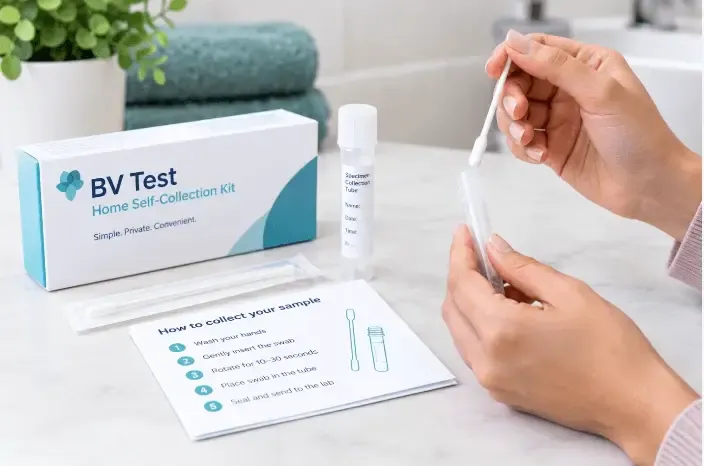
Get a Canestest Self-Test
Access Doctor supplies the Canestest self-test for vaginal infections, alongside GPhC-regulated online consultations with pharmacist independent prescribers.
See BV testing and treatment →Why test before treating
The case for testing is practical rather than medical. Every antibiotic treatment for BV in the UK is prescription-only, while thrush treatments sit on the pharmacy shelf. That asymmetry pushes people towards antifungals by default — and NICE notes that around 60% of women who self-diagnose thrush turn out not to have it.
The consequence is a week or two spent on a product that cannot possibly work, followed by the impression that the problem is unusually stubborn. A pH test costs a fraction of that lost time.
3.8–4.5
Normal vaginal pH, maintained by lactobacilli
Above 4.5
Typical vaginal pH in BV
~60%
Of self-diagnosed thrush turns out to be something else
How a vaginal pH test works
Healthy vaginal flora is dominated by lactobacilli, which produce lactic acid and hold pH in a narrow acidic band. In BV those lactobacilli are displaced by anaerobic bacteria, lactic acid production falls, and pH rises above 4.5.
A test such as Canestest is a swab tipped with a pH-sensitive indicator. You take a sample from the vaginal wall, and the indicator changes colour if pH is raised. There is no laboratory step and no waiting — the result appears within seconds.
What the test is actually detecting. Not bacteria, and not BV as such — only acidity. That is why it separates BV from thrush so cleanly, and why it cannot separate BV from trichomoniasis, which also raises pH.
How to use one properly
Most inaccurate results come from timing rather than technique. Always follow the instructions supplied with your specific test; the steps below describe the general approach.
1
Pick the right moment
Not during a period, not within 12 hours of sex, and not within 12 hours of using any vaginal product — including lubricant, pessaries, creams or gels. All of these change pH and will distort the result.
2
Wash and dry your hands
Then remove the swab from its packaging without touching the coloured tip, which is the part that carries the indicator.
3
Take the sample from the vaginal wall
Insert the swab a short distance and roll the tip against the side wall of the vagina rather than sampling pooled discharge, which can give a misleading reading. Hold it in contact for the time stated in the instructions.
4
Read the result immediately
Compare the tip against the colour chart supplied, in good light, within the time window given. Reading late is a common source of error.
Do not test while using a vaginal treatment. If you are part-way through a course of Zidoval gel or Dalacin cream, the product itself alters the local environment and the result will not be meaningful. Wait until the course is complete and symptoms have had time to settle.
Reading your result
| Result | What it suggests | Sensible next step |
|---|---|---|
| Raised pH, with thin grey discharge and fishy odour | BV is likely | Seek prescription treatment |
| Raised pH, with frothy yellow-green discharge | Possible trichomoniasis | Sexual health clinic testing, not online BV treatment |
| Raised pH, but few or no symptoms | Possible asymptomatic BV | Usually no treatment needed unless pregnant or before a procedure |
| Normal pH, with itching and thick white discharge | Thrush is likely | Pharmacy antifungal |
| Normal pH, but symptoms persist | Something else | Get assessed rather than treating speculatively |
The pattern that matters most is the first row: raised pH together with the classic discharge and odour. That combination is a reasonable basis to proceed to treatment. Our guide to BV symptoms, discharge and smell describes those features in detail, and BV vs thrush covers the comparison if the picture is mixed.
What a home test cannot tell you
Being clear about the limits is what makes the test useful rather than misleading.
It does not identify organisms
It measures acidity, not bacteria. It cannot tell you which organism is responsible for a raised pH.
It does not exclude STIs
Chlamydia and gonorrhoea frequently produce no symptoms and do not reliably alter pH. A normal result does not mean you have been screened.
It does not separate BV from trichomoniasis
Both raise pH. Trichomoniasis needs specific treatment and partner notification, so frothy yellow-green discharge warrants clinic testing.
It does not replace assessment in pregnancy
Pregnancy changes both the interpretation and the management. See BV in pregnancy.
A home test is never the right tool if you have pelvic or abdominal pain, fever, pain during sex, or bleeding between periods or after sex. These need in-person assessment regardless of what any test shows. In an emergency, call 999.
How clinics test for BV
It helps to know what a fuller assessment adds, so you can judge when it is worth having one.
- Vaginal pH — the same measurement your home test makes, usually as one component rather than the whole answer.
- Microscopy — a sample examined under a microscope for "clue cells", vaginal cells studded with bacteria that are characteristic of BV.
- The whiff test — adding potassium hydroxide to a sample releases the amines responsible for the odour, producing a distinctive smell.
- Hay-Ison or Nugent scoring — a standardised grading of the bacterial picture on microscopy, used to classify how far the flora has shifted.
- STI screening — swabs or urine tests for chlamydia, gonorrhoea and trichomoniasis, which a home test cannot substitute for.
A sexual health clinic can usually do most of this in one visit and often gives results the same day. That is the right route if you have had repeated episodes, if treatment has not worked, or if you have any doubt about the diagnosis.
What to do next
1
Raised pH with classic BV symptoms
Proceed to prescription treatment — first-line is usually a course of metronidazole tablets. All UK BV antibiotics require a prescriber, whether that is your GP, a clinic or a registered online consultation.
2
Normal pH with itching
A pharmacy antifungal for thrush is reasonable. If it does not work within a week, stop and get assessed rather than repeating it.
3
Result unclear, or symptoms do not fit
Book with a sexual health clinic. Microscopy and STI screening answer questions a pH test structurally cannot.
4
Third or fourth episode this year
Stop testing and treating episode by episode. Repeated confirmed episodes need a management plan — see recurrent BV.
Order a Self-Test or BV Treatment
Complete a short online consultation and our GPhC-registered pharmacist independent prescribers will assess whether treatment is appropriate, with discreet delivery.
Start a BV consultation →Frequently Asked Questions
How does a BV home test work?
Home tests such as Canestest measure vaginal pH using a swab with a colour-changing indicator. A healthy vagina sits between roughly 3.8 and 4.5, while BV raises pH above 4.5. The swab changes colour when it detects that raised pH.
How accurate is a BV home test?
pH tests are good at the specific job of separating raised-pH conditions like BV from normal-pH conditions like thrush. They are less good at identifying which raised-pH condition you have, because trichomoniasis also raises pH. Treat the result as a strong pointer rather than a diagnosis.
When should I not use a BV home test?
Avoid testing during a period, within 12 hours of sex, within 12 hours of using any vaginal product including lubricant or pessaries, and while using a vaginal treatment. All of these alter pH and can produce a misleading result.
What does a positive BV test mean?
A raised pH result means the vaginal environment is less acidic than it should be, which is consistent with BV, especially alongside thin grey discharge and a fishy odour. It does not exclude trichomoniasis or a sexually transmitted infection, so persistent or unusual symptoms still need clinical testing.
Can a home test tell the difference between BV and thrush?
Broadly yes, and that is its main practical value. BV raises vaginal pH above 4.5 while thrush leaves it normal, so a pH test helps you decide whether to seek prescription BV treatment or buy a pharmacy antifungal.
Do I still need a doctor if my home test is positive?
You need a prescriber, because every antibiotic treatment for BV in the UK is prescription-only. That can be your GP, a sexual health clinic or a registered online consultation. You need in-person assessment if you have pain, fever, bleeding, or are pregnant.
Can I test for BV with a pH strip from the internet?
Generic pH strips are not designed for vaginal use and are harder to interpret, since they are calibrated for a wider range than the narrow band that matters here. A test designed and CE-marked for vaginal use is more reliable.
Completing the treatment
Access Doctor supplies the Canestest self-test alongside prescription BV treatment. If your test points to BV, an online consultation with a pharmacist independent prescriber is the next step.
Self-test · Pharmacy
Canestest Self-Test
Checks vaginal pH at home to help distinguish BV from thrush before you treat.
View product →Bacterial vaginosis · Rx
Metronidazole 400mg Tablets
First-line oral antibiotic for BV, taken twice daily for five to seven days.
View product →Bacterial vaginosis · Rx
Zidoval Vaginal Gel
Metronidazole 0.75% gel applied nightly for five nights.
View product →Bacterial vaginosis · Rx
Dalacin 2% Cream
Clindamycin vaginal cream, a seven-night course with no alcohol restriction.
View product →References
- National Institute for Health and Care Excellence. Clinical Knowledge Summaries: Bacterial vaginosis. 2025. cks.nice.org.uk
- British Association for Sexual Health and HIV. National guideline for the management of vaginal discharge. bashh.org
- Centers for Disease Control and Prevention. Sexually Transmitted Infections Treatment Guidelines: Bacterial Vaginosis. cdc.gov
- NHS. Bacterial vaginosis. nhs.uk
- NHS. Visiting a sexual health clinic. nhs.uk
Medical disclaimer: This article is for informational purposes only and does not constitute medical advice. Always consult a qualified healthcare professional for diagnosis and treatment. In a medical emergency, call 999.