


We’re here to help.
Our friendly team is available to help Monday to Friday 9:00am – 5:00pm.
If you need urgent assistance, do not use this service. Call 111, or in an emergency call 999.
Our friendly team is available to help Monday to Friday 9:00am – 5:00pm.
If you need urgent assistance, do not use this service. Call 111, or in an emergency call 999.
Fast, discreet delivery
Free delivery over £40
100% UK-based pharmacy
All doctors & pharmacists UK-based
Free advice & support
Clinical support free · Mon–Fri 9am–5pm
Why Patients Choose Access Doctor
10+
Years serving UK patients
—
Verified patient reviews
1,000+
Licensed treatments
24/7
Consultation available
The first-choice antibiotic for bacterial sinusitis in UK guidance, prescribed after an online consultation with a UK prescriber.
If you have swelling around the eye, changes in your vision or a severe headache, get urgent medical help by calling 111, or 999 in an emergency.
Order before 3pm — same-day dispatch (MON - FRI)
~5 min consultation
Secure & confidential · Reviewed by a UK prescriber
Suitable age
18-years +
Max per order
1 course
Consultation
Yes, online (included in the price)
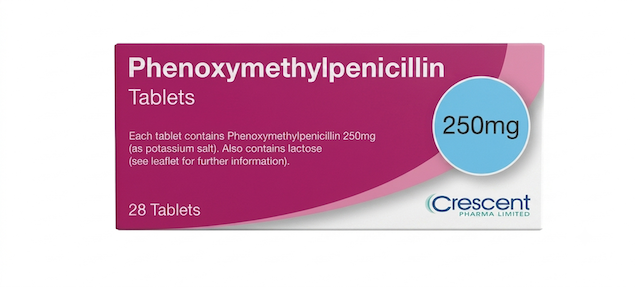
Phenoxymethylpenicillin, also called penicillin V, is a penicillin antibiotic. It kills the bacteria that most often cause bacterial sinus infections, so the facial pain, pressure and congestion can settle. NICE names it as the first-choice antibiotic for sinusitis when an antibiotic is needed.
Most sinusitis is caused by a virus and gets better within two to three weeks, and antibiotics do not help with viral infections. NICE recommends an antibiotic only when a bacterial infection is likely: if you are very unwell or at high risk of complications, or as a back-up if symptoms have lasted 10 days or more and are getting worse. If you are allergic to penicillin, doxycycline or clarithromycin are used instead.
Phenoxymethylpenicillin is licensed in the UK for infections such as sore throat, ear infections and pneumonia. Using it for sinusitis follows NICE guidance but is outside its licence, which is known as off-label use. Your prescriber will explain this before prescribing. Our guide to phenoxymethylpenicillin and amoxicillin for a sinus infection explains how it is used.
| Active ingredient | Phenoxymethylpenicillin (penicillin V) 250 mg tablets |
| Type | Penicillin antibiotic (oral tablets/solution) |
| Used for | Acute bacterial sinusitis (first-line in non-penicillin-allergic patients) |
| Typical dose | 500 mg four times daily (course usually 5 days) |
| Pack size | Full treatment course: 5 days, 40 tablets |
| Prescription | POM — reviewed by a UK prescriber |
| How supplied | After an online consultation with a UK prescriber |
Most sinus infections are caused by viruses and get better on their own within two to three weeks. For the first 10 days, rest, fluids, pain relief and saline rinses are usually all you need. If symptoms have lasted 10 days or more without improving, a steroid nasal spray is often the more useful next step. Our guide to steroid spray vs antibiotics explains why.
An antibiotic may be needed if:
you are very unwell, with a high temperature or severe facial pain;
you got better and then clearly worse again (“double sickening”);
you are at high risk of complications, for example because of a weakened immune system.
Our guides on whether a sinus infection is bacterial or viral and whether you need antibiotics go into the detail.
Phenoxymethylpenicillin is not suitable if you:
are allergic to penicillin. Doxycycline or clarithromycin are used instead, and our guide to antibiotics if you are allergic to penicillin compares them;
have had a reaction to a cephalosporin antibiotic. Tell the prescriber;
have a rare inherited intolerance to some sugars (galactose intolerance, Lapp lactase deficiency or glucose-galactose malabsorption), as the tablets contain lactose.
Get urgent help (call 111, or 999 in an emergency) if you have swelling or redness around the eye, double or reduced vision, a severe headache, a stiff neck or confusion.
Yes, when an antibiotic is needed. NICE names phenoxymethylpenicillin as the first-choice antibiotic for bacterial sinusitis. Most sinusitis is viral, though, and antibiotics don’t help viral infections, so a prescriber first checks whether a bacterial infection is likely.
There is currently a UK-wide supply shortage of phenoxymethylpenicillin. If you need treatment for sinusitis, you can still start a consultation, and our prescriber will advise on a suitable alternative if an antibiotic is appropriate.
If an antibiotic is needed, doxycycline or clarithromycin are the usual alternatives, and they are also the first choices if you are allergic to penicillin. For symptoms that have lasted 10 days or more without being very unwell, a steroid nasal spray is often more useful than an antibiotic. Your prescriber will advise which is right for you.
No. In the UK it is licensed for infections such as sore throat, ear infections and pneumonia. NICE recommends it as the first-choice antibiotic for sinusitis, which is an off-label use. Your prescriber will explain this before prescribing.
The usual adult dose is 500mg four times a day for 5 days, as recommended by NICE. With 250mg tablets, that is 2 tablets four times a day: 40 tablets in total. Take each dose on an empty stomach, and always follow the dose on your label.
No. Take it on an empty stomach, at least 30 minutes before food or 2 hours after, because food reduces how much is absorbed. Our guide on taking phenoxymethylpenicillin with food explains the timing.
Many people start to feel better within 2 to 3 days. Finish the full 5-day course even if you feel better sooner. If you are no better after the course, or get worse at any point, speak to a GP.
No. Both are penicillin antibiotics, but they are different medicines. In the UK, NICE recommends phenoxymethylpenicillin as the first choice for sinusitis, rather than amoxicillin. Our guide to phenoxymethylpenicillin and amoxicillin for a sinus infection explains why.
The usual ones are feeling sick, diarrhoea and a rash, and they are usually mild. Stop and get help straight away for signs of a serious allergic reaction, or for severe or bloody diarrhoea. Our guide to phenoxymethylpenicillin side effects has more detail.
Alcohol doesn’t stop phenoxymethylpenicillin working, so a small amount is usually fine. You are likely to recover faster if you rest, drink plenty of water and keep alcohol low until you feel better.
Helpful articles and clinical guides related to this treatment category.
Free consultation
Online review by a UK prescriber
Next-day delivery
Order before 3pm where offered
Discreet packaging
Plain outer packaging