

How Betacap Soothes an Inflamed, Irritated Scalp: Betamethasone Valerate for Scalp Inflammation
How betamethasone valerate scalp application calms scalp psoriasis and seborrhoeic dermatitis, how long you can use it, and what it means for your hair.
Part of the Dandruff & Psoriasis Health Guide.
When to get urgent help: Call 999 or go to A&E if your skin quickly turns red and you develop white, pus-filled bumps that join together – you may also have a fast heartbeat, a high temperature, or feel hot, cold or shivery. These can be signs of a more serious condition, such as pustular psoriasis, or an infection. Also call 999 if you have swelling of the face, lips, tongue or throat, or difficulty breathing. Stop using Betacap and contact your prescriber, GP or NHS 111 if your scalp becomes hot, painful, crusted or weeping, or if redness and burning spread beyond the treated area after you stop.
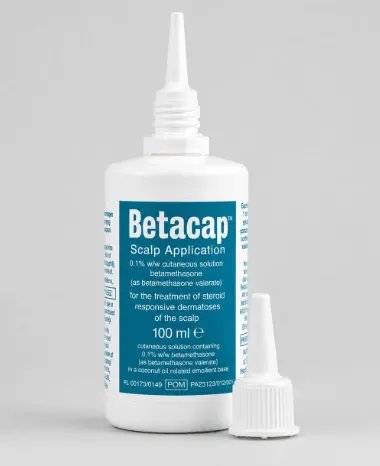
Key fact: Betacap scalp application contains betamethasone (as valerate) 0.1% — a potent topical corticosteroid that calms scalp inflammation in psoriasis and seborrhoeic dermatitis. It is designed for short courses, reviewed at 4 weeks, with breaks between courses.
Get Betacap Scalp Application Online
Access Doctor provides Betacap following a GPhC-regulated online consultation. Our pharmacist independent prescribers will assess whether it is suitable for you.
Start consultation →When your scalp is red, sore and inflamed — not just flaky — Betacap works by damping down the inflammatory response beneath the skin’s surface. It delivers betamethasone valerate, a potent anti-inflammatory corticosteroid, directly to the affected areas of the scalp.
What is Betacap and how does it work?
Betacap scalp application 0.1% contains betamethasone valerate, a potent topical corticosteroid. Corticosteroids should not be confused with anabolic steroids — they are anti-inflammatory medicines that work by suppressing the overactive immune response behind inflammatory scalp conditions.
When applied to the scalp, betamethasone enters skin cells and reduces the release of the chemical signals responsible for redness, itching and swelling. In scalp psoriasis, it also helps slow the rapid skin cell turnover that produces thick, silvery scale.
0.1%
Betamethasone (as valerate) concentration
4 wks
NICE review point for scalp psoriasis
8 wks
NICE limit for continuous potent steroid use
Not for skin infections: Betacap must not be used on areas of scalp with an untreated bacterial, fungal or viral infection. If you develop a scalp infection during treatment, contact your prescriber.
Conditions Betacap treats
- Scalp psoriasis — a potent steroid is NICE’s first-line treatment; it reduces plaque thickness, scaling and redness
- Seborrhoeic dermatitis of the scalp — reduces the inflammation, often alongside a ketoconazole shampoo that targets Malassezia yeast
| Condition | Betacap’s role | Often combined with |
|---|---|---|
| Scalp psoriasis | First-line potent steroid under NICE CG153 | A descaling product for thick scale; later, a calcipotriol combination (e.g. Dovobet gel) |
| Seborrhoeic dermatitis | Short course to settle inflammation | Ketoconazole shampoo for the yeast |
If Betacap isn’t suitable for you, your prescriber may consider an alternative such as Betnovate Scalp Application, Dermovate scalp application for stubborn scalp psoriasis, or a calcipotriol-based combination like Dovobet, depending on your condition. Etrivex (clobetasol) shampoo is another prescription option for scalp psoriasis.
Betacap is a scalp solution, not a shampoo
A lot of people search for “Betacap shampoo”. It does not exist — and the difference matters for how you use it.
Betacap is a leave-on cutaneous solution. You apply a small amount directly to the affected patches of scalp, massage it in and leave it there to work. A medicated shampoo does the opposite job: it is washed in and rinsed out within minutes, so its active ingredient has only a brief contact time. The two are not interchangeable, and neither replaces the other.
Scalp treatments come in four broad formats:
- Solutions and lotions, such as Betacap, spread easily through hair and reach the skin without leaving much residue. They contain alcohol, which is why they can sting on broken skin.
- Medicated shampoos, such as anti-dandruff and coal tar shampoos, tackle the yeast and scale that drive dandruff and seborrhoeic dermatitis. They are usually the first thing to try, and many people keep using one alongside a prescribed steroid.
- Foams and mousses feel lighter and suit thicker or textured hair, where a liquid can run off before it reaches the scalp.
- Ointments and coconut-oil-based preparations are greasier and slower to apply, but they soften and lift heavy scale in a way a solution cannot.
Used together, a medicated shampoo removes the scale and a solution like Betacap treats the inflammation underneath it. Removing scale first also lets the steroid reach the skin, which is why prescribers often recommend both.
Applying Betacap: the essentials
Apply Betacap to dry hair: turn the bottle upside down, hold the nozzle against the affected patch and squeeze gently, then massage it in and let the scalp dry naturally without a hairdryer. The leaflet directs use morning and evening until the scalp improves, then less often. For the full step-by-step technique, dosing table and tips, see our guide on how to use Betacap.
Highly flammable: Betacap contains alcohol. Do not use it near flames, lit cigarettes or other ignition sources, and do not use a hairdryer.
How long can you use Betacap?
NICE recommends a potent topical corticosteroid applied once daily for up to four weeks as the initial treatment for scalp psoriasis (CG153, recommendation 1.3.3.1), and a review 4 weeks after starting treatment (1.3.1.6). Four weeks is the point at which treatment should be reviewed rather than simply repeated.
You may notice that the Betacap product licence and the NICE guideline word the frequency differently. The licence directs application night and morning until improvement is noticeable, then a reduction to once daily or less; NICE frames the course as once daily for up to four weeks. Both are legitimate, and your prescriber will tell you which applies to you — follow the instructions you were given rather than the general figure.
In practice a course usually looks like this:
- Early on: itching and soreness often settle before the scale visibly changes.
- As it improves: reduce how often you apply it, using the least that keeps the scalp calm.
- At four weeks: review. If the scalp has cleared, stop and leave a break before any further course. If it has not, NICE advises trying a different formulation of the potent steroid, or a product that removes scale before reapplication, before stepping up to a combined calcipotriol and betamethasone dipropionate preparation.
- If it comes back within 2 weeks of stopping: the leaflet advises not to restart without speaking to your prescriber.
Breaks between courses: NICE advises aiming for a four-week break between courses of a potent or very potent corticosteroid (CG153, 1.3.1.11), and not using a potent corticosteroid continuously at any site for longer than eight weeks (1.3.1.14). Continuous use without breaks is what leads to skin thinning and, occasionally, to a withdrawal flare when you stop.
Children are treated more cautiously. In children with seborrhoeic dermatitis, Betacap should not be used for longer than five to seven days, and it must not be used in babies under one year.
What does 0.1% actually mean?
Betacap contains betamethasone (as valerate) at 0.1% w/w — one milligram of betamethasone in every gram of solution. That percentage tells you the concentration, not the strength class. A 0.05% product can be far stronger than a 0.1% one: Dermovate is 0.05% clobetasol propionate and sits a whole class above Betacap.
Where Betacap sits among scalp steroids
Topical corticosteroids are grouped into four strength classes. Betacap sits in the potent class — strong enough for psoriasis, and not the strongest option available.
| Class | Example products | Active ingredient | Typically used for |
|---|---|---|---|
| Mild | Hydrocortisone 1% | Hydrocortisone | Mild irritation; delicate skin and young children |
| Moderate | Eumovate | Clobetasone butyrate 0.05% | Mild to moderate eczema and dermatitis |
| Potent | Betacap, Betnovate Scalp, Elocon Scalp Lotion | Betamethasone valerate 0.1%; mometasone furoate 0.1% | Scalp psoriasis and seborrhoeic dermatitis |
| Very potent | Dermovate Scalp, Etrivex Shampoo | Clobetasol propionate 0.05% | Stubborn, thick scalp plaques under close supervision |
Betacap and Betnovate Scalp Application both contain betamethasone valerate at a strength equivalent to 0.1% betamethasone, so they sit on the same rung of the ladder. The difference is the base: Betacap includes macrogolglycerol cocoates, a coconut-oil derivative added to reduce the drying effect of the alcohol. Both contain isopropyl alcohol and both are flammable.
Strength is not the only thing that decides which product suits you. Scale thickness, how much of the scalp is affected, hair type and how long you have already been treating all feed into the choice, which is why these are prescription-only medicines rather than something to pick off a shelf. For a fuller explanation of the four classes across all body sites, see our guide to steroid cream strengths.
Betamethasone valerate vs betamethasone dipropionate
These are two different esters of the same corticosteroid. Betacap contains betamethasone valerate at 0.1%; betamethasone dipropionate is used at 0.05% and appears in combination products such as Dovobet alongside calcipotriol. In the UK classification both sit in the same potency class — potent — so one is not simply a stronger version of the other. US classifications rank the two differently, which is where a lot of the confusion online comes from. They are still not interchangeable on a prescription: if you have been given one and read advice about the other, check with your prescriber before assuming the instructions transfer.
Compare Betacap with other scalp steroids.
Side effects of Betacap
The leaflet does not give frequencies for its side effects, so it is not possible to say how common each one is. Some people notice stinging when the alcohol-based solution touches sore or broken skin. The side effects listed include:
- Skin irritation where it is applied — stop using it if this happens
- Allergic (hypersensitivity) reactions
- Thinning of the skin with prolonged use
- Pustular psoriasis, which can be triggered during or after steroid treatment
- Adrenal suppression with prolonged, heavy use, particularly in children
- Steroid withdrawal reaction — redness, burning, itching, peeling or oozing that can start days to weeks after stopping long-term treatment
- Blurred vision or other changes in eyesight — report these promptly
Pregnancy and breastfeeding: it is not known whether Betacap is safe in pregnancy or breastfeeding, so the leaflet advises not to use it unless your doctor recommends it.
Does Betacap cause hair loss — or help hair grow?
Hair is the single most common worry people raise about Betacap, and the honest answer sits between the two fears. It is very unlikely to be making your hair fall out, and it is not a hair growth treatment either.
Hair loss is not a listed side effect of Betacap
Alopecia does not appear among the undesirable effects listed in section 4.8 of the Betacap Summary of Product Characteristics. If you are shedding hair while using it, the scalp condition you are treating is a far more likely cause than the treatment itself.
Why an inflamed scalp sheds hair
Active scalp psoriasis and seborrhoeic dermatitis inflame the skin around each follicle, and the scratching and scale-picking they provoke snaps hairs mechanically. The result is usually telogen effluvium — a temporary shift of follicles into their resting phase — rather than permanent loss. Once the inflammation settles, shedding typically slows over two to three months and hair regrows at its normal rate of roughly one centimetre a month.
So can Betacap help hair grow back?
Only indirectly. By calming the inflammation that disrupted the follicles in the first place, it removes the reason the hair was shedding. It does not stimulate growth, thicken existing hair, or act on the hormonal process behind male or female pattern hair loss. Betacap is not licensed as a hair loss treatment and should not be used as one.
Will my hair grow back after scalp psoriasis or seborrhoeic dermatitis?
In most cases, yes. Neither condition usually scars the follicle, so once the plaques and inflammation clear the follicles resume their normal cycle. Expect the shedding to slow over two to three months rather than stop overnight, and expect regrowth at about one centimetre a month — so a noticeably thin patch can take several months to look normal again. Hair that has not started to recover three months after the scalp itself has cleared is worth having looked at.
What about alopecia areata?
Alopecia areata is an autoimmune condition that produces smooth, round bald patches with no scale on the skin underneath. It is a different problem from psoriasis or seborrhoeic dermatitis, and it is worth being precise about what the evidence shows.
Potent topical corticosteroids are sometimes prescribed for mild to moderate alopecia areata. The most frequently cited evidence is a randomised, investigator-blinded trial by Mancuso and colleagues (2003), in which 61% of patients treated with a betamethasone valerate foam achieved at least 75% regrowth, compared with 27% of those using a betamethasone dipropionate lotion. That trial used a foam formulation, not the Betacap scalp solution, so the result supports the active ingredient rather than this specific product.
Using Betacap for alopecia areata is therefore an unlicensed (off-label) use — a decision for a prescriber who has assessed you, not something to try on your own. If your hair loss is patchy and the skin underneath looks normal rather than scaly, that points towards alopecia areata rather than psoriasis, and it needs a different conversation.
What about Betnovate and hair?
Betnovate Scalp Application contains the same active ingredient at the same strength, but its leaflet does list changes in hair growth and hair loss as very rare side effects (up to 1 in 10,000 people). As with Betacap, shedding during treatment is still far more often due to the scalp condition itself, and Betnovate is not a hair growth treatment.
When to get your hair loss looked at
Speak to a prescriber or your GP if you notice smooth round bald patches, if the scalp skin looks shiny, thin or scarred, if hair has not started recovering three months after the scalp itself cleared, or if the shedding began only after you started treatment.
UK safety and prescribing information
- Legal status: Betacap is a prescription-only medicine (POM). At Access Doctor it is prescribed only after an online consultation with a GPhC-registered pharmacist independent prescriber, who may decline and refer you to your GP if it is not suitable.
- Licensed use: scalp conditions such as psoriasis and seborrhoeic dermatitis that do not respond to less potent steroids. Not for babies under 1 year; in children with seborrhoeic dermatitis, no longer than 5–7 days.
- Course limits: NICE advises review at 4 weeks, a 4-week break between courses where possible, and no continuous potent steroid use at any site for longer than 8 weeks.
- Steroid withdrawal: the MHRA warns that stopping after long-term use can cause redness, stinging and burning that may spread beyond the treated area. If your skin gets worse within 2 weeks of stopping, do not restart treatment without speaking to your prescriber.
- Fire risk: highly flammable — keep away from flames and cigarettes, and do not use a hairdryer.
- Reporting side effects: you can report suspected side effects to the MHRA through the Yellow Card scheme website or the Yellow Card app.
Get Betacap Scalp Application Online
Access Doctor provides Betacap via a short, confidential online consultation with our GPhC-registered pharmacist independent prescribers.
Start consultation →Frequently asked questions
What is Betacap used for?
Betacap scalp application (betamethasone valerate 0.1%) is a prescription topical corticosteroid used to relieve the inflammation, itching and redness of scalp psoriasis and seborrhoeic dermatitis of the scalp that have not responded to weaker steroids.
How quickly does Betacap work?
Itching and soreness often settle before the scale visibly changes, and you can reduce how often you apply it once the scalp improves. NICE advises reviewing treatment 4 weeks after starting; contact your prescriber if it has not improved by then.
Can I use Betacap long-term?
Betacap should be used for the shortest time necessary and under regular prescriber review. NICE advises a 4-week break between courses where possible and no continuous use of a potent steroid for longer than 8 weeks. Your prescriber will advise on your course.
Is Betacap a steroid?
Yes. Betacap contains betamethasone valerate, a potent topical corticosteroid, not an anabolic steroid. It works by reducing inflammation in the skin rather than building muscle.
Is Betacap the same as betamethasone dipropionate?
No. Betacap contains betamethasone valerate, not betamethasone dipropionate. Both are esters of betamethasone and both are classed as potent in the UK, but they are different medicines and are not directly interchangeable.
Does Betacap cause hair loss?
Hair loss is not a listed side effect of Betacap. Shedding during treatment is far more often caused by the scalp condition itself, as inflammation and scratching push hairs into a temporary resting phase. This usually recovers within two to three months once the scalp settles.
Does Betacap help hair grow back?
Not directly. Betacap treats the inflammation that can cause temporary shedding, so hair often recovers once the scalp clears. It does not stimulate hair growth and is not licensed for pattern hair loss or as a hair growth treatment.
Can Betacap thin your hair?
Betacap can thin the skin of the scalp if it is used continuously for too long, but thinning of the hair itself is not a listed effect. Used in the short courses your prescriber advises, with breaks between them, it is not expected to affect hair thickness.
Can I use Betacap for alopecia areata?
Only if a prescriber decides it is appropriate. Potent topical steroids are sometimes used for mild to moderate alopecia areata, but this is an unlicensed use of Betacap and the main supporting trial used a betamethasone valerate foam rather than this solution.
Will my hair grow back after scalp psoriasis?
Usually, yes. Scalp psoriasis does not usually scar the follicle, so hair normally regrows once the inflammation clears. Shedding slows over two to three months and hair grows back at roughly one centimetre a month, so full recovery of a thin patch can take several months.
Will Betacap make my hair greasy?
It is less greasy than an ointment. Betacap is an alcohol-based solution with a coconut-derived emollient, so it spreads through hair and dries without much residue, though some people notice a slight film until their next wash.
Scalp health · POM
Betacap Scalp Application
Betamethasone valerate 0.1% for scalp psoriasis and seborrhoeic dermatitis.
View product →Scalp health · POM
Betnovate Scalp Application
The same active ingredient at the same strength, in a different base.
View product →References
- NICE. Psoriasis: assessment and management (CG153). nice.org.uk
- NICE CKS. Seborrhoeic dermatitis. cks.nice.org.uk
- electronic Medicines Compendium. Betacap Scalp Application — Summary of Product Characteristics. medicines.org.uk
- electronic Medicines Compendium. Betnovate Scalp Application — Patient Information Leaflet. medicines.org.uk
- MHRA. Topical corticosteroids: information on the risk of topical steroid withdrawal reactions. Drug Safety Update, September 2021. gov.uk
- Mancuso G, Balducci A, Casadio C, et al. Efficacy of betamethasone valerate foam formulation in comparison with betamethasone dipropionate lotion in the treatment of mild-to-moderate alopecia areata: a multicentre, prospective, randomised, controlled, investigator-blinded trial. Int J Dermatol. 2003;42(7):572–5. pubmed.ncbi.nlm.nih.gov
- British Association of Dermatologists. Alopecia areata. Patient information leaflet. bad.org.uk
- NHS. Betamethasone for skin. nhs.uk
Medical disclaimer: This article is for informational purposes only and does not constitute medical advice. Betacap is a prescription-only medicine. Always use it as directed by your prescriber. In a medical emergency, call 999.