


We’re here to help.
Our friendly team is available to help Monday to Friday 9:00am – 5:00pm.
If you need urgent assistance, do not use this service. Call 111, or in an emergency call 999.
Our friendly team is available to help Monday to Friday 9:00am – 5:00pm.
If you need urgent assistance, do not use this service. Call 111, or in an emergency call 999.
Fast, discreet delivery
Free delivery over £40
100% UK-based pharmacy
All doctors & pharmacists UK-based
Free advice & support
Clinical support free · Mon–Fri 9am–5pm
Why Patients Choose Access Doctor
10+
Years serving UK patients
—
Verified patient reviews
1,000+
Licensed treatments
24/7
Consultation available
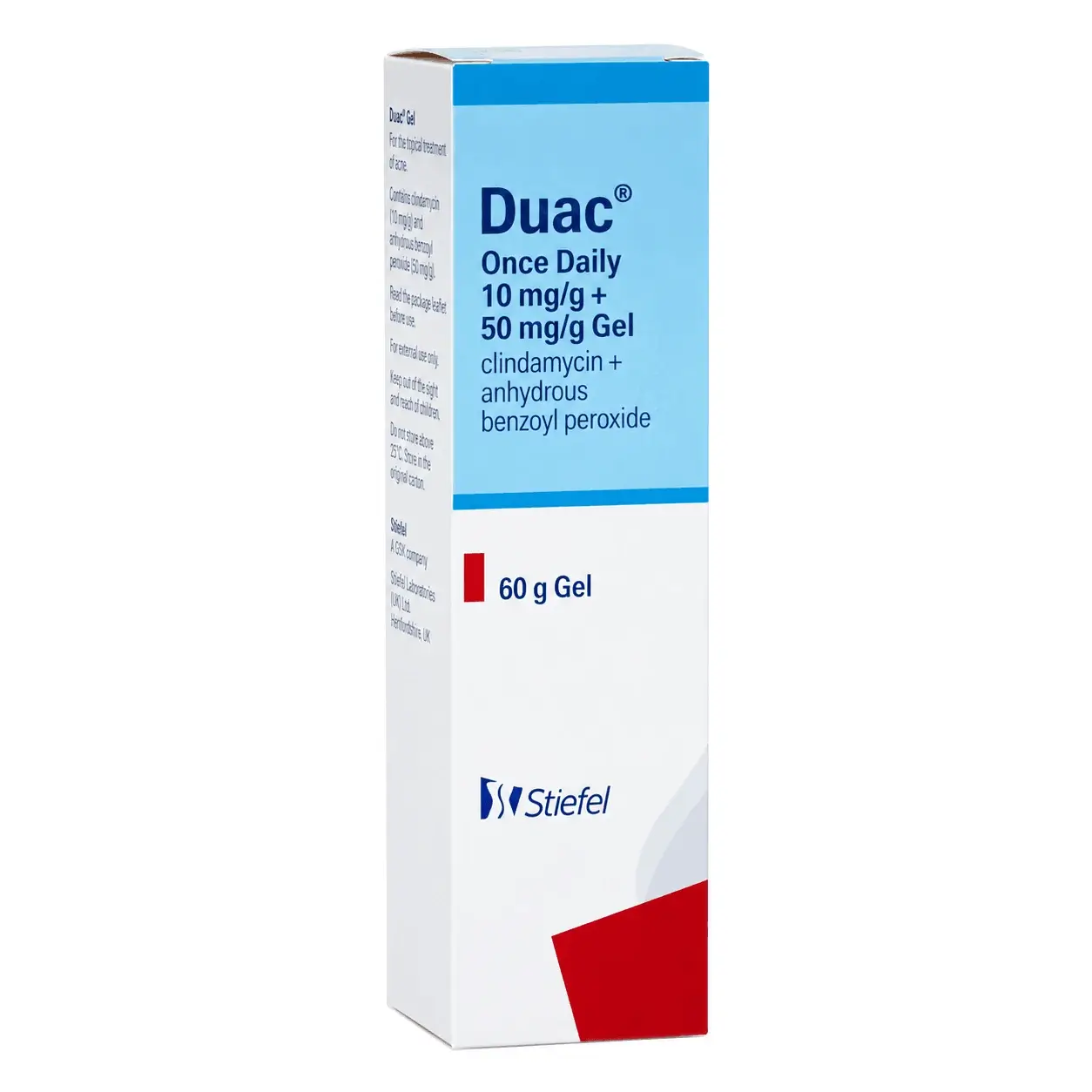
A prescription gel combining an antibiotic (clindamycin 1%) with benzoyl peroxide 5%, applied once a day in the evening. It treats mild to moderate acne, especially red and pus-filled spots.
Order before 3pm — same-day dispatch (MON - FRI)
~5 min consultation
Suitable age
18 years +
Max per order
2 months (1 × 30g for the face; 60g if also treating the back or chest)
Consultation
Yes, with a review at 12 weeks
Duac Once Daily is a prescription-only acne gel that contains two medicines: clindamycin 1%, an antibiotic, and benzoyl peroxide 5%. Clindamycin reduces the acne bacteria (Cutibacterium acnes). Benzoyl peroxide also kills these bacteria, helps unblock pores, and reduces the risk of the bacteria becoming resistant to the antibiotic. That’s why the two are combined rather than using clindamycin alone.
It’s licensed for mild to moderate acne, particularly inflamed spots, and NICE lists it as one of three first-choice gels, with Epiduo and Treclin. You apply it once a day in the evening for up to 12 weeks, then your prescriber reviews how it’s working. For every option, see our acne treatments.
| Active ingredients | Clindamycin 1% (as clindamycin phosphate) and benzoyl peroxide 5% |
| Type | Antibiotic + benzoyl peroxide gel |
| Used for | Mild to moderate acne, especially inflamed spots |
| How to use | Once a day, in the evening, to the whole affected area |
| Course | Up to 12 weeks, then a review |
| Storage at home | Below 25°C; use within 2 months of it being dispensed |
| Prescription status | Prescription-only medicine (POM) |
Acne spots form when pores block with oil and dead skin and bacteria (Cutibacterium acnes) grow inside them, causing redness and swelling. Duac tackles this in two ways. Clindamycin stops the bacteria multiplying. Benzoyl peroxide kills the bacteria, loosens blocked pores, and reduces the risk of the bacteria becoming resistant to clindamycin. It works best on red, inflamed and pus-filled spots. For mostly blackheads and whiteheads, a retinoid gel such as Differin or Epiduo may suit you better.
Duac is a prescription-only gel with two active ingredients: clindamycin 1%, an antibiotic, and benzoyl peroxide (5%, or 3% in the lower strength). Clindamycin stops acne bacteria multiplying. Benzoyl peroxide kills the bacteria, helps unblock pores, and reduces the risk of the bacteria becoming resistant to the antibiotic. It’s licensed for mild to moderate acne, especially red and pus-filled spots. You’ll need an online consultation with one of our prescribers before it can be supplied, and we supply it to adults aged 18 and over.
Gently wash the affected area with a mild cleanser and pat it fully dry. Apply a thin layer of Duac gel to the entire affected area of the face, not just individual spots, once a day in the evening. Avoid applying it to the eyes, mouth, lips, nostrils, or any broken or irritated skin. Wash your hands thoroughly after applying. Don’t apply more than directed: using extra gel won’t speed up results but will increase the risk of irritation.
Some people see fewer red spots within a few weeks, but it can take longer, so keep using it every evening. Duac shouldn’t be used for more than 12 weeks at a time. Your prescriber will review you at 12 weeks: if your skin is clear, you’ll usually move to a gel without an antibiotic to keep it clear; if it hasn’t improved, they’ll suggest another treatment.
The most common side effects (more than 1 in 10 people) are redness, peeling and dryness, which are usually mild. A burning feeling is common, and your skin may react more to sunlight. Peeling and redness increase in the first weeks for most people; a non-comedogenic moisturiser can help, or you can use the gel less often for a while. Stop using Duac and contact your GP if you get prolonged, severe or bloody diarrhoea or stomach cramps, as this can be a sign of bowel inflammation.
Yes — Duac gel contains benzoyl peroxide, which can bleach or discolour hair, clothing, towels, and bed linen if it comes into contact with them. To minimise the risk, apply the gel in the evening, allow it to dry fully before going to bed, and use white or old pillowcases and towels. Wash your hands thoroughly after applying, and rinse the sink after use to remove any traces of the product.
Yes. Benzoyl peroxide can make your skin more sensitive to sunlight. While using Duac, avoid prolonged sun exposure and don’t use sunlamps or sunbeds. When you can’t avoid strong sun, use a sunscreen and wear protective clothing. If you get sunburnt, let it heal before using Duac again.
The pharmacy keeps Duac in the fridge until it’s dispensed. At home you don’t need to refrigerate it: keep it below 25°C and don’t freeze it. Use it within 2 months of the date it was dispensed (shown on the pharmacy label), then throw away any gel that’s left.
Duac’s safety in pregnancy hasn’t been established, so it’s only used if a doctor decides the benefit outweighs the risk. If you’re breastfeeding, it shouldn’t be applied to the chest. We don’t supply acne treatment online if you’re pregnant, trying for a baby or breastfeeding: please speak to your GP, who can advise on safer options.
Duac is a gel, although many people call it Duac cream. There’s only one form of Duac: the gel, which comes in two strengths (benzoyl peroxide 3% or 5%, both with clindamycin 1%).
Yes. Apply it in the evening, let it dry, and leave it on overnight; you can wash your face as usual in the morning. Let it dry fully before your face touches the pillow, and use white or old pillowcases, as benzoyl peroxide can bleach fabric.
Yes. Duac and Dianette (co-cyprindiol) can be used together, and they don’t interact. For women with polycystic ovary syndrome whose acne hasn’t improved with first-line treatment, NICE recommends adding co-cyprindiol or another combined pill to a gel like this. Dianette is only prescribed for women with moderate to severe acne that hasn’t responded to creams or antibiotics, after a health check. What you can’t use with Duac is an antibiotic tablet, such as lymecycline or doxycycline.
Both contain the same antibiotic (clindamycin 1%); the difference is the amount of benzoyl peroxide (3% or 5%). Both strengths are licensed for mild to moderate acne. Your prescriber will recommend the strength that’s right for you.
Yes, Duac is prescription-only, so you can’t buy it over the counter. You can get it from Access Doctor after a short online consultation: you answer questions about your skin, health and previous treatments, a pharmacist prescriber checks it’s suitable for you, and if it’s approved we dispatch it from our UK pharmacy. Because Duac must be used within 2 months of being dispensed, we supply up to 2 months at a time, within a 12-week course, with a review before any further course.
No reviews yet. Be the first to write one.
Helpful articles and clinical guides related to this treatment category.
Free consultation
Online review by a UK prescriber
Next-day delivery
Order before 3pm where offered
Discreet packaging
Plain outer packaging