
Works really well for my asthma easy to use
Linda Y · 4 years ago

Our friendly team is available to help Monday to Friday 9:00am – 5:00pm.
If you need urgent assistance, do not use this service. Call 111, or in an emergency call 999.

Fast, discreet delivery
Free delivery over £40
100% UK-based pharmacy
All doctors & pharmacists UK-based
Free advice & support
Clinical support free · Mon–Fri 9am–5pm
Why Patients Choose Access Doctor
10+
Years serving UK patients
—
Verified patient reviews
1,000+
Licensed treatments
24/7
Consultation available
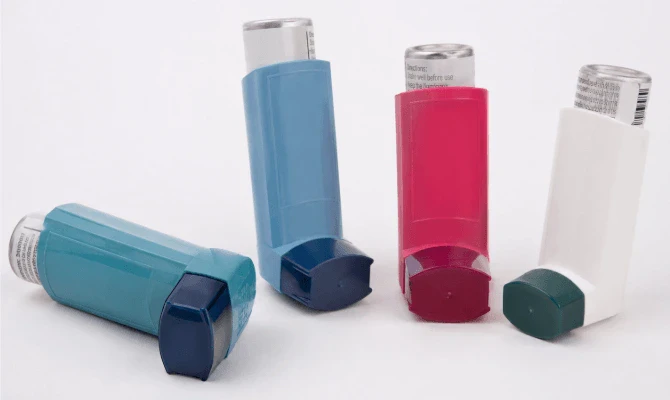
Salamol Inhaler (otherwise known as a Salbutamol Inhaler) is a “reliever” inhaler. The active ingredient is salbutamol, an asthma medicine, which opens up the airways. Salbutamol has a quick effect and a short duration of action (4 to 6 hours).
Order before 3pm — same-day dispatch (MON - FRI)
~5 min consultation
Secure & confidential · Reviewed by a UK prescriber
Salamol Inhaler (otherwise known as a Salbutamol Inhaler) is a “reliever” inhaler. The active ingredient is salbutamol, an asthma medicine, which opens up the airways. Salbutamol has a quick effect and a short duration of action (4 to 6 hours). For technique, dosing and how it compares with a standard pMDI, read our Salamol inhaler guide.
Salamol is a reliever inhaler containing salbutamol, a short-acting beta-2 agonist (SABA) bronchodilator. Like Ventolin, it's used to provide quick relief from asthma symptoms — wheeze, breathlessness, chest tightness, and cough — and is also used in chronic obstructive pulmonary disease (COPD) and to prevent exercise-induced bronchospasm. It's a reliever, not a preventer, which means it eases symptoms once they've already started rather than stopping them happening in the first place.
The active ingredient is identical: 100 micrograms of salbutamol per puff. What changes between the two is the brand, the manufacturer (Salamol is made by Teva), and the inhaler device itself. Pharmacologically, they do the same job in the same way and at the same speed. In practice, prescribers and pharmacies often interchange them depending on availability and on which device suits the patient best.
"CFC-free" refers to the propellant — the gas inside the canister that pushes the medicine out as a fine spray when you press it. Older inhalers, including the original Ventolin, used chlorofluorocarbons (CFCs) as propellants. Under the Montreal Protocol, CFCs were phased out worldwide from the late 1990s onwards because they damage the ozone layer. Modern inhalers, including Salamol, use a different propellant called hydrofluoroalkane (HFA), which does the same job without harming the ozone. Every salbutamol inhaler available in the UK today is CFC-free; the label simply persists for historical reasons. You may notice the spray feels softer and less cold than the older CFC inhalers some long-term asthma patients remember — that's because of the change in propellant, not in the medicine itself.
Salamol comes in two main forms: a standard pressurised metered-dose inhaler that you press while breathing in, and the Salamol Easi-Breathe, which is breath-actuated. With the Easi-Breathe, you don't have to coordinate pressing the canister with breathing in — the device fires automatically as you start to inhale. You open the cap (which loads the dose), breathe out gently away from the mouthpiece, place your lips around it, and breathe in slowly and steadily; the spray releases as you inhale. This is particularly useful for people who find the timing of a standard inhaler tricky — including many older patients, anyone with arthritis or limited hand strength, and children who haven't yet mastered the coordination step.
With the standard pressurised version, the technique is the same as Ventolin: shake the canister, breathe out gently, seal your lips around the mouthpiece, then breathe in slowly and steadily as you press the canister once. Keep breathing in until your lungs feel full, hold for around ten seconds, and breathe out gently. Wait around 30 to 60 seconds before any second puff. With the Easi-Breathe, the steps are similar but you don't press the canister — the device does the timing for you. Either way, asking your pharmacist or asthma nurse to watch your technique now and then is one of the most useful things you can do. Small adjustments make a real difference to how much medicine actually reaches your lungs.
With the standard pressurised inhaler, a spacer is genuinely helpful — it gives more medicine to the airways and less to the back of the throat, and it removes the coordination problem of timing breath and press. With the Easi-Breathe, a spacer isn't usually used, because the breath-actuated design solves the coordination issue on its own. In an asthma attack, a spacer becomes especially important: the emergency dose of up to ten puffs is delivered one puff at a time through a spacer, with a normal breath in and out between each puff.
The standard instruction is one to two puffs as needed for symptoms, with up to four puffs every four hours during a mild flare. In an attack, the emergency dose is usually up to ten puffs through a spacer, taken one at a time, with a 999 call if there isn't a clear improvement within ten minutes. The bigger picture, though, is the same as with any reliever: needing it more than around three times a week, or getting through more than one or two inhalers a year, is a sign that asthma control isn't where it needs to be.
This is the most important safety point about any reliever inhaler, including Salamol. Increasing reliever use is one of the clearest signals that the underlying inflammation in the airways is getting worse. Studies looking at people who have died from asthma have repeatedly found high SABA use — often without enough preventer treatment — in the months beforehand. Modern UK guidance from NICE, the British Thoracic Society and the Scottish Intercollegiate Guidelines Network now strongly favours combination inhalers (where a steroid preventer and a fast-acting bronchodilator are delivered together every time you puff) over treating with a reliever like Salamol on its own. If your blue inhaler is running out faster than it used to, please book a review rather than simply ordering another.
Most people tolerate Salamol well. The most commonly reported effects are a fine tremor (typically in the hands), a faster or pounding heartbeat, headache, and occasional muscle cramps. These usually settle quickly, ease at lower doses, and often improve when a spacer is introduced because less medicine is absorbed systemically. Some people notice a brief metallic or slightly bitter taste — this is from the medicine itself rather than a problem. At very high doses, such as during a hospital admission with nebulisers, salbutamol can cause low potassium levels, which is why bloods are checked in that setting.
Some signs mean an asthma flare needs to be treated as an attack. If your reliever isn't lasting four hours, if you're too breathless to speak in full sentences, eat, or sleep, if your peak flow has dropped below half your best, or if you simply feel the symptoms are unusually severe, follow your written asthma action plan if you have one — typically up to ten puffs through a spacer, one at a time — and call 999 if there isn't clear improvement within ten minutes, or sooner if you're worsening. People sometimes underestimate how unwell they are during an attack; if your instinct is telling you something isn't right, trust it.
A few are worth being aware of. Beta-blockers — including some used for blood pressure, heart conditions, migraine prevention, and even some glaucoma eye drops — can blunt the effect of salbutamol and, in some cases, trigger asthma symptoms in their own right. Taking Salamol alongside high doses of other stimulant-type medicines, certain water tablets, or some antidepressants can amplify side effects like tremor or palpitations. As a rule of thumb, mention to any prescriber that you have asthma, so they can pick the safest option for you.
Keep it at room temperature, out of direct sunlight and away from heat. Don't pierce or burn the canister even when empty, because the propellant remains under pressure. Most modern Salamol inhalers carry a built-in dose counter, which is by far the most reliable way of telling how many doses are left — feeling the weight, shaking it, or floating it in water are all unreliable. Replace it before it runs out, ideally with at least a week to spare, so you're never caught short during a flare.
Works really well for my asthma easy to use
Helpful articles and clinical guides related to this treatment category.
Free consultation
Online review by a UK prescriber
Next-day delivery
Order before 3pm where offered
Discreet packaging
Plain outer packaging